Showing posts with label animals. Show all posts

Sunday, March 16, 2025

Alone against the mangroves


Although solo travel isn’t my favorite kind, it is worth doing on occasion because one is forced to pay attention to every detail—especially on a wilderness trip.  In the 22 hours between when I departed by kayak from the Hell’s Bay Trailhead on March 7th and when I returned, I saw no other humans.  The only other mammal was an otter who eyed me quizzically in between rounds of swimming and rolling around on shore.   On the Pearl Bay Chickee, with Orion and Canis Major overhead, I reflected that if a count were taken, the score would be six million human souls in the Greater Miami Metropolitan area and one plus the gods know what else on this wooden platform in the estuary, surrounded by mangroves and their nutritive souls.  Crickets sang all night, and I periodically heard flapping and splashing from birds landing on the water.  When I got up for the outhouse at 3:00 AM, Scorpius had replaced Orion.


Wednesday, September 25, 2024

Dinosaur Stories on Etsy

Happy National Comic Book Day!  DINOSAUR STORIES is now up for sale on my Etsy site.  In addition to my three dinosaur comics originally published in THE MESOZINE #1-3, it also contains pin-up illustrations, including the Ankylosaurus below.  


Monday, January 2, 2023

The Beginning and the End of 2022--in Animal Art

Based on sketchbook chronology, I’ve made an educated guess that the baby alligator is my first drawing of 2022.  Indisputably, the dragonfly naiad (larva) hunting a tadpole is my last drawing of 2022.  A voracious predator with a quick-thrusting extensible lower jaw, the naiad is a real-life xenomorph.  As a young woman on my guided walk at my other job as an Everglades Ranger put it, “Nature is metal!”


Thursday, August 11, 2022

The Mesozine #2, new dinosaur comic featuring work by me, Stephen Bissette, Denis St. John, and more


Collectors of my work, take note: online sales of The Mesozine #2 are live!  I contributed a two-page comics story and a one-page essay about the science behind my story to this eclectic anthology of fiction and nonfiction works about dinosaurs by diverse talents.  Other contributors include my Center for Cartoon Studies colleagues Stephen Bissette, Morgan Pielli, Bryan Stone, and our fearless leader for this volume, Denis St. John!  The Mesozine #2 is 44 pages total, selling for $10 plus shipping at https://www.deniscomix.com/.  It makes a lovely gift for yourself or for anyone you know who likes dinosaurs.
 
Cover artwork and photo by Denis St. John. https://www.deniscomix.com/ @deniscomix,
Oviraptor sample artwork by me, © to respective creators.

Thursday, March 3, 2022

Spadefoot Toads: Summer of Love - NEW POSTER for sale on my Etsy site!

This poster celebrates the rugged desert amphibian, the spadefoot toad, and their courtship choruses after rainstorms! It makes a wonderful gift for anyone who likes frogs or animals in general. Give it for Valentine's Day, Easter, Christmas, birthdays, or any occasion.

From my backyard in Carlsbad, New Mexico, I witnessed the spadefoot toads' summer of love. Spadefoot toads survive the grueling desert heat and drought by hiding in burrows for up to three years at a stretch. They emerge for torrential rains and gorge themselves on termites and other insects. Males sing their courtship songs (which resemble the bleating of goats) and mate with females in ephemeral pools. The eggs develop into tadpoles, then toadlets, then miniature spadefoot toads in only a matter of weeks. The year 2021 had an unusually high abundance of rainstorms in Southeast New Mexico, resulting in a productive year for our spadefoots. It was remarkable to witness this miracle of life, from cacophonous chorus to rapid metamorphosis!

Couch's spadefoot toad (Scaphiophus couchii) was the dominant species in my neighborhood. Western green toads (Anaxyrus debilis insidior) also made some appearances in autumn rainstorms, and I heard calls from New Mexico spadefoot toads (Spea multiplicata stagnalis) during a spring storm.

I could write a book about the process of making this poster, from painting it physically in layers of gouache paint and India ink to modifying it extensively on my laptop computer. I commonly hit up Duckduckgo image search for photo references for my artwork. This time, I used mostly my own photos (and some by my colleague Tristen Gleason, who rescued many spadefoot tadpoles from drying pools). The project began in August 2021; it survived my December move to South Florida and the December crash of my laptop computer. Like a spadefoot toad waiting for rain, I persisted.

FREE DOMESTIC SHIPPING on this item

Monday, August 16, 2021

Desert Tortoise versus Gila Monster


As a follow-up to my previous desert tortoise scene, I looked for an opportunity to draw a female in battle.  I learned that while female tortoises rarely exhibit aggression towards their own species, they can be fierce in defending their nests and will even fight Gila monsters who want to eat the eggs.  The only venomous lizard native to the United States, the Gila monster must be a foreboding opponent.  But so is a reptilian battle tank with the temperament of a mother grizzly!

Thursday, July 22, 2021

The glorious and scary lifecycle of spadefoot toads

My friend Tristen rescued spadefoot toad tadpoles from a flooded road, which was not going to stay flooded for very long. She nurtured the tadpoles in a bucket and a pool, feeding them dried shrimp, baby frog formula pellets, and algae-based wafers. In two weeks, they grew into fully formed spadefoot toads. (These amphibians are supremely adapted to desert life and emerge from their burrows after summer monsoons to breed in ephemeral pools. The tadpoles metamorphose on hyperdrive.)

As the young spadefoots, one by one, hopped out of their pool and back into the wild, they inevitably suffered some casualties to birds!


Friday, July 9, 2021

Tortoise combat


In researching desert tortoises (Gopherus agassizii) for a new comics project, I learned that the males engage in fearsome combat for territory and access to females.  Each tortoise digs at his opponent with the gular horn at the front of his plastron (lower shell) to flip the other onto his back!   For defense, they stand tall on their four legs and become hard to flip.  The tortoises can eventually right themselves, although being overturned must be stressful.  If they knew that they are a threatened species, would they reconsider their dueling traditions?  Inspired by the slow-moving warriors, I crafted this poster.

Wednesday, March 6, 2019

Follow the Moon, my first print publication of 2019

My five page comics story “Follow the Moon” has been accepted for publication in Oh, Comics #27: Moon, an anthology edited and published by Bob Corby over at Back Porch Comics. The anthology will debut at SPACE (Small Press and Alternative Comics Expo), April 27 & 28, 2019. I will not be at this convention (I tabled in SPACE 2017 and loved it) but my work will. My contribution to the Moon issue is likely to be my first print publication of 2019—unless Carlsbad Caverns National Park sends the Junior Bat Biologist book I illustrated in 2018 to the printer first. I think that "Follow the Moon" is one of the best comics I have ever done. I plan to find more venues to publish it in. However, a book full of Moon stories is a great place to start! In the story, I bring together several topics that fire my passions—marine turtles, Native American legends, and our friendly natural satellite. As is often my process, it started with a single drawing... this one... and later on, I searched for the story behind the image. And I found it.

Notably, there is also a story which preceded the image, a story which my grandmother, Evelyn Wood Moyle, frequently shared in her elder years, about a bird dropping a turtle on her rooftop.  In my comic, I expand upon her anecdote and push it into new territory.

 Page One:

The fourth panel of page two:


And that's all I'm sharing online.  Buy the print version (online sales of the anthology will start after SPACE 2019) to read the full story.

Friday, July 27, 2018

The Black Widow


I have a black widow spider living just outside the back door of my residence in New Mexico.  Two nights ago, I checked on the spider while returning from watering my garden.  I noticed there was a second spider sharing the web—a tiny one.  A male black widow!  For the first time, I was seeing live a phenomenon that is featured in all the books about spiders.  The male black widow puts everything on the line in hopes of mating with the female, who is twice his size and inclined to eat him.  I watched their dance, with the male hovering in the web atop the female’s abdomen.  I disturbed them by getting too close while attempting a photo, and sent the female scampering back to her protected corner behind the outdoor electrical outlet, where she can hide from outsized dangers such as me.  Meanwhile, the male dropped like a stone, until being caught by his silken life line.  He climbed up the thread, to continue his quest.  All my photos of their love ritual were coming out blurry, so I gave up, and left them in peace.

The next night, I flipped on the light outside.  The male spider was dead in the web.  The circle of life.  Only time will tell if he managed to seduce the female long enough before her hunger took over.  We will see whether the female produces an egg sac.

A beetle flew into the web, perhaps drawn to the light.  The black widow spider sprung into action, trussing up the insect in silk, her rear legs working rapidly to wrap the prey.  The unfortunate beetle didn’t stand a chance.  It received a quick death, as the spider’s bite paralyzed it then liquefied its insides.  The fortunate spider consumed the nourishing innards-smoothie, and would live on, and might even make baby spiders.  There was no way not to feel sorry for the beetle; all living things want desperately to stay alive—from microbes to ourselves.  The circle of life in a beautiful, heartless world.


Thursday, June 28, 2018

A Colorful Jumping Spider


Jumping spiders are sometimes referred to as the big cats of the arthropod world, being predators who stalk and pounce, guided by their superb eyesight.  These smart little spiders also adapt their hunting techniques and learn from past encounters.  

This one's rainbow of color has made a good study in marker for me.  I've been working in color a bit more recently in part to build some skills and confidence, because I'm at work on an illustration project about bats, for the NPS, in color.  More about that soon!  I'm glad to find that I didn't forget everything from my painting courses at Denison University, even though most of my art in the subsequent years has been black and white.


Friday, June 22, 2018

Wasp from my Nightmares


For another gouache experiment, I turned to the devil of the sky.  Or, the creature that seemed that way to a younger me—the tarantula hawk, the largest and most powerful of the parasitoid wasps.  Other species of parasitoid wasps target cicadas, caterpillars, and ladybugs.  The tarantula hawk goes after a large spider that eats mice and small snakes.  Despite being much larger than the wasp, the spider is outgunned.  After the wasp paralyzes the tarantula with a sting, it’s larva eats the spider slowly, while it is still alive.

As a child, I loved spiders and kept a pet tarantula.  In the picture books about spiders which I read and re-read, I skipped over the part about the tarantula hawk, after reading it once and being horrified.

I suppose that the prolonged torture of a living tarantula to nurture a newborn wasp is part of nature and therefore we must accept it?  Charles Darwin saw parasitoid wasps as evidence that the universe was not created by an omnipotent and loving god.

Tarantula hawks are common in the desert where I work, and I’ll acknowledge that their blue-black iridescence can be quite pretty.  Virginia’s state insect is the eastern tiger swallowtail.  Pennsylvania’s state insect is the firefly.  New Mexico’s state insect is the tarantula hawk.

Thursday, June 7, 2018

Tarantula made the world?!

Who made the world?  Most pious midwesterners I know do not attribute it to a spider, but the Apache people are less constrained in their visions. 

From an Apache Legend:

"Tarantula spun a black cord and, attaching it to the ball,crawled away fast to the east, pulling on the cord with all his strength. Tarantula repeated with a blue cord to the south, a yellow cord to the west, and a white cord to the north. With mighty pulls in each direction, the brown ball stretched to immeasurable size--it became the earth! No hills, mountains, or rivers were visible; only smooth, treeless, brown plains appeared."


I used this as my inspiration while getting to know a new set of gouache paints.

Tarantulas are content to sit quietly in their burrows most of the time.  So a world made by tarantula seems like a peaceful place to me.  Alas, frenzy has invaded!

Thursday, April 19, 2018

Ross-man the Barbarian; the dragons find him tasty


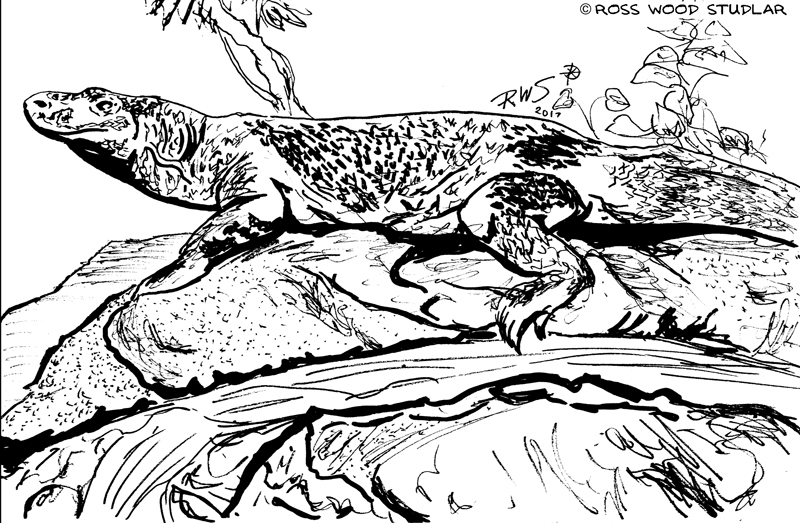
Awesome 'Possum Volume 4, the natural science comics anthology, edited by Angela Boyle, contains "Saliva & Skin," a story about Komodo dragons written by Steve Bissette and drawn by me. Here are my answers to some questions from Angela:

How did you pick your topic for Awesome ‘Possum?
I have been fascinated by Komodo dragons ever since I was a child. As a dinosaur-loving kid, I was thrilled that there were still a few giant reptiles inhabiting the earth. At age 10, I named one of my pet anoles “Komodo.” More recently, I learned from a Youtube video by the “Hybrid Librarian” (Kevin Garattoni) that until the 1920s, Americans had regarded Komodo dragons as cryptids, like the Loch Ness Monster or Bigfoot. In 1926, American naturalist W. Douglas Burden led an expedition to Komodo Island to verify the existence of the “dragon lizards.” In 1933, filmmaker Merian C. Cooper directed a blockbuster horror movie, largely based on Burden’s voyage. The movie, King Kong, is still popular 85 years later. Knowing that my collaborator for this project, Steve Bissette, is a wizard of dinosaur comics and expert on monster movies, I suspected that Komodo dragons would be a topic well-suited to his writing style. After I chose our reptilian subject matter, Bissette wrote a script (resembling a film script) and I created the comics pages based on said script.


What is your favorite animal or plant?
In recent years, I have been especially fascinated by spadefoot toads, denizens of the arid southwestern U.S. These amphibians stay quietly buried underground for most of their lives (up to three years at a stretch in the case of Couch’s spadefoot), until summer rain storms summon them to the surface. They engage in a frenzy of eating and mating, using the ephemeral pools, then return to their burrows for a long wait until the next “monsoon.” When I visited my friend Lesley, who was a park ranger at Colorado National Monument, we happened to strike it lucky and meet live spadefoot toads in the desert streams. Behind the huge cat-like eyes of the spadefoots, there seems to be an alien mind, one that does not object to hanging out alone in a hole in the ground for 1,000 or more consecutive days and nights.

Why do you think talking about nature is important?
We humans ought to preserve the earth’s remarkable diversity of life, what Charles Darwin described as “endless forms most beautiful and most wonderful.” Considering that we’re in the midst of the sixth mass extinction, it is fair to say that we’ve been doing a poor job at this task so far. People will care more about protecting creatures that they know and like. Telling the stories of wild creatures is a way of getting people to know and like them.


What are your favorite drawing tools?
I remain attached to drawing comics in the traditional way—first I sketch the images in pencil on bristol board, then I make the final drawing with india ink on top of the pencils. Then I scan the pages, make some edits and do the lettering digitally. I’m especially fond of liner brushes, which I use primarily for inking the contour lines around foreground figures and objects. My main liner brushes for the Komodo story were a Grumbacher #4 and a Princeton #4, which are very different in size. (The numbers are not at all consistent across the different brands.)

The topmost picture is my self-portrait with Komodo dragons, inspired by Frank Frazetta’s painting “Conan the Barbarian.”

To get in the mindset of a naturalist-explorer, I read Burden's first-hand account.

https://images.gr-assets.com/books/1348752616l/10649637.jpg
I warmed up for drawing “Saliva & Skin” by visiting the ABQ Biopark Zoo and sketching (and photographing) live Komodo dragons.

Back at the studio, I posed for selfies and used them as reference material for many of the panels featuring human figures. In this one, I’m reenacting the experience of Maen, the Indonesian park ranger who survived a Komodo dragon attack. Below, the drawn scene as it appears in AP4.


My studio while I was working on “Saliva & Skin.” The floor is scattered with reference photos I printed from all over the web, as well as drawing tools and scraps of carbon paper.


If all this intrigues you, you ain't seen nothing yet! Awesome 'Possum Volume 4 is 229 pages long, and contains nonfiction comics about science and nature by over 30 creators. The tales are both educational and entertaining, and feature a broad range of plants and animals, including sphinx moths, lemurs, and Rafflesia. The tome is all-ages friendly and especially good for ages 9-12. The great American author of nonfiction graphic novels about science Jim Ottaviani said,

"You'll witness love of the natural world with every story, and your own love for it will grow with every page. You'll learn stuff, too, and learning stuff is awesome."

But to bring this book to life, we still need some backers on Kickstarter! Do you know anyone who likes nature or science or comics or learning stuff? This book will make them smile.

Book cover ©Kessinger Legacy Reprints. All other pictures ©R.W.S.

Thursday, March 29, 2018

Awesome 'Possum Volume 4, featuring Komodo dragons!


“I’ll never forget seeing my first dragon,” reads the opening line of a new comics story written by Stephen Bissette and drawn by me for Awesome ‘Possum Volume 4! The book is live on Kickstarter now, so now you have the opportunity to back the book's publication and preorder your copy. Awesome ‘Possum is an anthology series of nonfiction comics about natural science, edited by Angela Boyle. It brings together leading emerging and established cartoonists to tell the stories of earth’s remarkable plants and animals. The tales range from the very scientific to the very personal; they are friendly for all ages and especially good for ages 9-12. Bissette was my teacher at The Center for Cartoon Studies, and is best known for his collaborations with Alan Moore on the DC comic book series Saga of the Swamp-Thing. As dinosaur-loving children who never fully grew up, Bissette and I put our hearts and souls into writing about and illustrating the natural history and human history of one of the few giant reptiles that still inhabits the earth. AP4 also includes stories by other creators about lemurs, llamas, sphinx moths, Rafflesia, and much more.

We’re live on Kickstarter: https://www.kickstarter.com/projects/861608378/awesome-possum-vol-4

My work also appears in AP2 (collaboration with Bissette about fishers) and AP3 (solo work about frogs and mosses). As in the previous volumes, the writers and artists of AP4 will be amazingly diverse in how they approach presenting the biodiversity of our planet!

Cheers and thank you~

Thursday, February 22, 2018

Crickets of Carlsbad Cavern

I am sharing here the first post I made for the official Carlsbad Caverns National Park Facebook page:


Of three species of cave crickets found in Carlsbad Cavern, Ceuthophilus longipes is the most adapted to cave life. It has pale coloration, long slender legs and body, and long antennae. A second species, Ceuthophilus carlsbadensis, shows fewer adaptations, and spends more time in areas close to the Underground Lunchroom, where crumbs are abundant. The crickets also eat natural foods such as bat guano and plant debris washed in by floods. The Ceuthophilus carlsbadensis also likes to eat Ceuthophilus longipes! Ceuthophilus conicadus, the third species of cricket, is in between the other two in its level of cave adaptation. It is less common in Carlsbad Cavern, but abundant in the nearby Spider Cave.

NPS/Ross Studlar


#CarlsbadCaverns #NationalPark #FindYourPark #EncuentraTuParque #NPS101


I wrote and drew this specific post about cave crickets on work time for the U.S. government (mostly), therefore it is in the public domain.

Friday, October 20, 2017

Komodo Dragons at ABQ Biopark Zoo


En route to Carlsbad, I visited the Albuquerque Biopark Zoo and sketched living Komodo dragons! This is a warm-up for Awesome 'Possum Volume 4 (the natural science comics anthology, edited by Angela Boyle.) I have teamed back up with the legendary Stephen Bissette; our new comics story will be about Komodo dragons, the beasts that inspired King Kong. We'll be at work on this one this winter, with Bissette as scribe, me as artist. Stay tuned!
 

Wednesday, September 20, 2017

A Night on Observation Peak


I spent the night in the backcountry patrol cabin on Observation Peak in Yellowstone National Park, with friends visiting from the eastern U.S. I’ll share my entry in the logbook, transcribed below.


“9/13/17  We had a glorious overnight trip to the cabin, departing this morning. Crew consisted of my friend Emily, her daughter Calia (age 10), and myself. We trekked up from Cascade Creek Trailhead. Two-thirds of the way up, Calia became fed up with hiking and threw a fit (as children are wont to do.) The rest of the trip was challenging, despite the perfect weather (sunny with a cool breeze) and the vistas of increasing grandeur as we ascended. We finally reached the cabin, and I was relieved to find that my 79 key really does work on the door—open sesame! Calia’s mood turned 180, from misery to elation, with the opportunity to stay the night in the ULTIMATE tree house. My friends are from North Carolina and have not previously sojourned west of Chattanooga, Tennessee. Therefore, the elevation here of 9,396 feet is by far the highest they have yet experienced! The challenge of removing the shutters was rewarded by the world’s best view of sunrise and sunset. I read Shoshone and Nez Pierce stories about the origins of the land below aloud to my friends in the night and the early morning. It was warm inside under the blankets at night, as the wind buffeted and rattled our little sanctuary. In the morning, the piercing bugles of elk rose from somewhere in the forest below. Emily is awed by the place and grateful for the opportunity to have stayed in the backcountry. Calia declares, “I want to live here!” Other wildlife observed include northern harrier and grouse, and two bald eagles, a mated pair. Emily is concerned that nearly all forbs were crispy and desiccated between Cascade Lake and here—punishing effects of an unusually hot, dry summer, due to global climate change?

We are all boundlessly appreciative at having gotten to stay in this marvelous shelter in a sacred land.

—Ross Wood Studlar, Interpretive Ranger, Norris


SKREEYAOOW! [sound effect for bugling elk]”


Bottom photo by Calia Sampson at Fairy Falls. All others by yours truly at Observation Peak.

Tuesday, August 8, 2017

Ode to the Buffalo Bull


Bison are the most reliable beasts in Yellowstone. Nearly 5,000 in number, they are commonly seen from the valleys and overlooks, by the rivers and by the roads. They scratch their great heads upon trees to deal with insect pests, rub off the bark, and leave scars across the forest, which everyone misattributes to bears or elk. On a misty morning in August, the bellows of the bulls echo across the plains like a rumbling volcano. As the mist rolls away in the rising sun, the battlefield is revealed. Hundreds of bison in the valley below. A bull trots beside a cow, sniffs her rear end, waits for her to come into heat, roars across the plains, telling other bulls that this one is MINE. His hold lasts only as long as he can keep other bulls away, by intimidation or by force. The cows swear fealty to no partner. Their criteria is simple: the best fighters are the most attractive. He who dominates others of his kind will sire many children whom he will not know. For the life of the bull bison is solitary, walking with the herd when convenient, walking alone when convenient, eating grass all day, tolerating others of his kind when sharing the meadow. In the prime of health, he has little to fear. At 2,000 pounds, with a battering ram for a forehead, swords in his horns, and knives in his hooves—grizzly bears and wolves keep their distance and search for easier prey. The bull eats and walks and stays out of trouble, until the next mating season. Then the fury of testosterone consumes him again. All of his weapons are at the ready, but his opponents are equally armed. Corpses litter the field at mating season’s end, the result of those fights in which both adversaries refused to back down. And this attracts beasts that are normally harder to see. Grizzly bears appear on the field, thankful for the scavenged feast, in time to prepare for winter hibernation.

Saturday, March 18, 2017

See you in SPACE


I will be exhibiting and selling my comics work at SPACE (Small Press & Alternative Comics Expo) in Columbus, Ohio, March 25-26! Debuting at this show, GUERILLA FOOTBALL: A QUEST BY A CYBORG HORSE TO MAKE HIMSELF WHOLE—a 44-page one-shot science fiction comic book, wherein a transhuman cybernetic horse and orang-utan team up to steal a priceless historic football in hopes of selling it to raise funds to buy themselves human bodies. Their quest is fraught with peril; opponents include the cybernetic football player of the future! I will also be selling just about every other comic book I’ve made or contributed to in the past 14 years, including FROG STORIES, AWESOME ‘POSSUM 2 & 3, etc.
http://www.backporchcomics.com/space.htm