Showing posts with label National Parks. Show all posts

Sunday, September 14, 2025

Two Bears, Too Few Glaciers, and Many Bighorn


I visited Glacier National Park, where there are very few Glaciers remaining, but there are still a lot of bighorn sheep. At Logan Pass in the sunset, we met our first trio of resting bighorns, complete with an old visitor explicating to the camera-wielding crowd at the overlook that the one with the more robust set of horns was a ram and the others were ewes. He was as confident as he was incorrect—all three animals were rams, the one with the biggest horns being the eldest (picture #2). A few days later, my friend Emma and I observed some real ewes and lambs in Two Medicine Lake campground, making their rounds and eating scraps from fire pits (habituated, unfortunately). Ewes have thinner, straighter horns than rams and are frequently mistaken for mountain goats (picture #3).


Emma and I became friends a decade ago, when we were both seasonal park rangers at Yellowstone National Park. We reconvened this August in her home town of Missoula after I flew from overheated Florida. For our second day in Glacier National Park, we had a backcountry camping permit for Poia Lake in the Many Glacier district. I packed and repacked my backpack more fastidiously than I ever had before, trying to bring exactly what I needed for the overnight trip and not an ounce more. Final revisions took place at the trailhead. Despite all my efforts, the pack still weighed over 40 pounds. I used to be more cavalier about carrying heavy backpacks. But since March, I've had a herniated disc in my lower back, which causes sciatica in my right leg. Sitting gives me the most trouble, and I took my turn driving Going to the Sun Road on the way over, which involves both sitting and operating the pedals with my right foot.

I had a tingling feeling in my right foot for the entire 6.5 mile hike to Poia Lake, which was mostly uphill. We hit the trail later than planned, at 2:30 PM, and took the hike at a manageable pace, which turned out to be about one mile per hour. The first third of the trail took us through thickets of thimbleberries and huckleberries, a bear's Garden of Eden (or Eatin'). And indeed, we stepped over plenty of bear skat, and I spotted a bear's claw-marking on a tree. 

The trail wound and meandered, seemingly endlessly, mostly uphill and sometimes downhill, through conifer woods, talus slopes, past a hidden lake, and over the Swiftcurrent Ridge. We started at 5,000 feet above sea level, ascended 1,200 feet to the ridge, and descended a few hundred to Poia Lake. For the last two miles of the hike, it always seemed like our destination was just around the corner. I wish that I could say that this was all fun, but I became increasingly concerned about when or if we would reach our destination.


It was almost 8:30 PM, which is 10:30 PM in my home time zone. We stopped on a ridge, orange lichens dotting the rocks, the light fading and breeze blowing; the sun had already set. Downhill to the right, the sound of rushing water, a cascading stream.

“We can bivouac here,” I suggested.

Emma recalled the hike 734 map and guide we had been following, which said , The trail then drops down quickly with a steep slope into the Kennedy Creek drainage where Poia Lake resides. The creek playfully exits the lake on your final approach.”...“That sounds like where we are now.

“That could be anywhere,” I said. Emma encouraged me to keep hiking forward.

In less than fifty feet, as I reentered conifer woods, I said, “There's a sign up here.” Five paces closer. “It says that we have arrived at the backcountry campsites.”

The first task upon entering the backcountry camping area was to stop in the cooking area and raise the bear bags. Right after we took off our packs, a feeling of extreme fatigue came over me. My legs wavered and almost buckled. Luckily, I regained my footing. The hike was only one of many factors leading to this state of affairs. Traveling is a lot of work, from getting one's life in order prior to the trip, to packing and repacking, to looking for places to dispose of greywater at Avalanche Creek Campground, to taking too long to break down camp, to driving Going to the Sun Road behind a rental sedan operated by a European who probably hadn't driven a vehicle in years, to waiting for the backcountry safety orientation video at the Many Glacier Visitor Center to finish. Furthermore, I'm an early bird with an internal clock still on Eastern Time (whereas Emma is a night owl on Mountain Time). I scrambled to do all my camp tasks—tent, bear bag, etc—as efficiently as possible, fearing that if I took a break I would fall asleep and not awaken until morning.


In the morning, Poia Lake had quite a bit of wave action for such a small body of water, bordered by barren peaks with patches of snow. I painted the scene in water color, the field medium of artist-explorers of yore. I had deliberated at the trailhead over whether to bring my field sketchbook and ultimately ruled in its favor. Emma, wearing pink flip flops, slipped and fell near the lake, acquiring a cut on her foot.  She also gained several blisters the next day from hiking (in hiking boots) or her injured foot. I felt like all the wilderness adventure camps I partook in as a youth had been validated, with their warnings against flip flops. Nevertheless, Emma is still bringing the pink flip flops next time she goes camping.

Our first encounter with a black bear occurred around noon. We were talking to a thru-hiker and eating PBJs in the backcountry cooking area, all packed up and soon to start the hike out. I saw something to the left out of the corner of my eye.

“There is a big animal there,” I said, looked again, and saw a big furry butt with a small tail walking away. “It's a bear.”

The adult black bear had walked in our direction down the trail past the backcountry campsites, reached the junction by the cooking area, apparently saw us three humans less than 25 feet away, and turned left (perpendicular to us). It casually walked away down the trail towards the lake, turned right, and disappeared into the bush, just before I could train my camera on it. Had this bear found food scraps here before, and was it returning to look for more at the very time of day when there were least likely to be people around? Or was the timing a coincidence? Wild animals commonly use human trails just to get around, so either explanation is plausible.


In the trek through the berry patches, Emma was especially consistent in talking to alert bears of our presence; you WANT them to know you're around, so you don't startle them and trigger a defensive reaction. Saying “Hey bear, bear, bear,” over and over quickly gets repetitive, so I sang “Downbound Train,” “Knockin' on Heavens Door,” the theme song from the 1980s Teenage Mutant Ninja Turtles cartoon show, the theme song from the 1960s Spider-Man cartoon show, and recited as much of The Rime of the Ancient Mariner as I could remember. I had the tingling feeling in my right foot on the downhill trek, too, and Emma walked on her foot injuries, and we were tired, but we were armed with bear spray.

One mile from the finish line, we stopped for a moment, and Emma, facing me, said, “There's a bear behind you.” I stood motionless, just in case the bruin was RIGHT behind me. I slowly looked over my shoulder, by which time the bear was gone. It had been a young black bear, perhaps 50 feet away, came out of the brush to give us a look, listen, and sniff, then continued through the brush.

Even without most of the glaciers, Glacier National Park is still a wonderland of mountains, valleys, lakes—I took a paddleboard out on Two Medicine Lake—conifers, and big mammals. The wolves of Glacier are elusive, and wildlife tours more often train their spotting scopes on bears and mountain goats. I wanted to see a mountain goat, but it was not to be. 


Driving out of the park, one of our last stops was Goat Lick Overlook, where mountain goats come down from higher elevations to lick cliffs with deposits of salt and other minerals. (Electrolytes, it's what mountain goats crave!) Sadly, we saw no goats today. An interpretive sign explained that, built for snow and cold, the mountain goats may face heat stress on their quest for minerals at these lower, hotter, elevations, and they sprawl on patches of snow to cool down. Therefore, I'm not the only mammal pushing their limits in Glacier. I got some good photos of bighorn sheep on this trip, but no mountain goats and no bears. The bear encounters live on in memory, and the glaciers live on in historic photos.


Image credits: Non-selfie photos with Ross in them by Emma Pfeiffer
Other photos and painting by Ross Wood Studlar
©2025 to respective creators 
Shepard Glacier historic photos by US Geological Survey
Interpretive signs by National Park Service  

Sunday, March 16, 2025

Alone against the mangroves


Although solo travel isn’t my favorite kind, it is worth doing on occasion because one is forced to pay attention to every detail—especially on a wilderness trip.  In the 22 hours between when I departed by kayak from the Hell’s Bay Trailhead on March 7th and when I returned, I saw no other humans.  The only other mammal was an otter who eyed me quizzically in between rounds of swimming and rolling around on shore.   On the Pearl Bay Chickee, with Orion and Canis Major overhead, I reflected that if a count were taken, the score would be six million human souls in the Greater Miami Metropolitan area and one plus the gods know what else on this wooden platform in the estuary, surrounded by mangroves and their nutritive souls.  Crickets sang all night, and I periodically heard flapping and splashing from birds landing on the water.  When I got up for the outhouse at 3:00 AM, Scorpius had replaced Orion.


Saturday, November 18, 2017

Godzilla vs. Steamboat Geyser


All summer in my ranger work at Norris Geyser Basin, I attempted to convey to visitors the power and fury of Steamboat Geyser, earth’s tallest geyser, which very few people will ever be privileged to see in its full grandeur. The intervals between the geyser’s major eruptions can be anywhere from four days to 50 years, and there is no pattern, and no way to predict it. These eruptions can be over three times the height of Old Faithful, and many times louder and more violent.

Late in the summer, while doing some informal research on one of my favorite subjects, the Godzilla films, I had a realization. When Steamboat Geyser reaches its maximum eruptive height of 380 feet (116 meters), it is taller than Godzilla! Or to be precise, it is taller than NEARLY all versions of Godzilla. Godzilla was 164 feet (50 meters) tall in the original 1954 Toho film, and was scaled up for the sequels. In The Return of Godzilla (1984), he was 262 feet (80 meters) tall; in Godzilla vs. King Ghidorah (1991) he was 328 feet (100 meters) tall; in Godzilla (2014, Legendary Pictures), he was 355 feet (108.2 meters) tall. Only the Shin Godzilla (2015) version of the beast may be taller than Steamboat Geyser, at 389 feet (118.5 meters).

To illustrate the titanic size of Steamboat Geyser, I produced the drawing above. Maybe we can make a t-shirt out of it, for folks who work at Norris.

Godzilla is trademarked to Toho studios, so I will not be doing anything big with my drawing.

Wednesday, September 20, 2017

A Night on Observation Peak


I spent the night in the backcountry patrol cabin on Observation Peak in Yellowstone National Park, with friends visiting from the eastern U.S. I’ll share my entry in the logbook, transcribed below.


“9/13/17  We had a glorious overnight trip to the cabin, departing this morning. Crew consisted of my friend Emily, her daughter Calia (age 10), and myself. We trekked up from Cascade Creek Trailhead. Two-thirds of the way up, Calia became fed up with hiking and threw a fit (as children are wont to do.) The rest of the trip was challenging, despite the perfect weather (sunny with a cool breeze) and the vistas of increasing grandeur as we ascended. We finally reached the cabin, and I was relieved to find that my 79 key really does work on the door—open sesame! Calia’s mood turned 180, from misery to elation, with the opportunity to stay the night in the ULTIMATE tree house. My friends are from North Carolina and have not previously sojourned west of Chattanooga, Tennessee. Therefore, the elevation here of 9,396 feet is by far the highest they have yet experienced! The challenge of removing the shutters was rewarded by the world’s best view of sunrise and sunset. I read Shoshone and Nez Pierce stories about the origins of the land below aloud to my friends in the night and the early morning. It was warm inside under the blankets at night, as the wind buffeted and rattled our little sanctuary. In the morning, the piercing bugles of elk rose from somewhere in the forest below. Emily is awed by the place and grateful for the opportunity to have stayed in the backcountry. Calia declares, “I want to live here!” Other wildlife observed include northern harrier and grouse, and two bald eagles, a mated pair. Emily is concerned that nearly all forbs were crispy and desiccated between Cascade Lake and here—punishing effects of an unusually hot, dry summer, due to global climate change?

We are all boundlessly appreciative at having gotten to stay in this marvelous shelter in a sacred land.

—Ross Wood Studlar, Interpretive Ranger, Norris


SKREEYAOOW! [sound effect for bugling elk]”


Bottom photo by Calia Sampson at Fairy Falls. All others by yours truly at Observation Peak.

Tuesday, August 29, 2017

The Great American Nightfall


I looked to the sun through my special lenses, and it looked as if a cosmic Cookie Monster had taken a bite out of it. I could see why both the Chinese and the Native Americans tell stories about a dragon or a frog that devours the sun. The word ‘eclipse’ means ‘abandonment’ in Greek, and before astronomy had advanced to the point of explaining the eclipse, it was met with dread that the sun was abandoning the earth. For the Great American Eclipse of 2017, which I viewed from Yellowstone National Park, the mood was more joyous than fearful. The fears I had carried included that cloud cover might prevent us from seeing the eclipse, and that I might have to respond to a dehydration or cardiac patient during the eclipse, preventing me from seeing it. Thankfully, we had a clear blue sky on August 21, and no medical calls. I took my first glimpse of the eclipse from outside the ranger station at Madison junction. From there, I rolled in the ambulance with fellow ranger Amy to her normal work station, the Madison visitor center. We met a throng of tourists, scattered throughout the parking lot and the field by the Madison River. The American flag flew before the historic visitor center, built of great pine logs. In the distance elk munched on grass. Closer by, men and women tilted back in their camp-chairs, and looked skyward through their eclipse glasses. Children chased each other back and forth—when we get older, it can be too easy to forget this obvious use for an open field.


One family used a colander for an eclipse pinhole-viewer, and it worked well. The shadow of the moon advanced over the sun. The sun reduced to smaller and smaller crescent, until it was only a thin sliver. The sky shifted to a darker blue, and the yellow grass of the field turned to orange. Long shadows were cast on the landscape, from the human figures, the trees, and the flagpole. I raised my camera to take a photo, and it kicked automatically into sunset-mode. (A simple AI had interpreted what was happening.)


A chill wind blew. I heard the voice of a seven-or-so-year-old boy asked his mom, “Why is it getting so cold?” Near the peak of the sky’s dome, another point of light emerged—the planet Venus! We were not in the path of totality, so were not privileged to the full effect of nightfall in the daytime. This was the closest we came. The sliver of sunlight moved to the top of the sun, and slowly the crescent of sun enlarged again, as the moon’s shadow moved away. The moment the sun began its return, the persistent dull roar and whoosh of traffic returned. To me, the eclipse was not over until the sun resumed its full form; but many tourists obviously saw it differently, taking to the road the instant our star began to return.


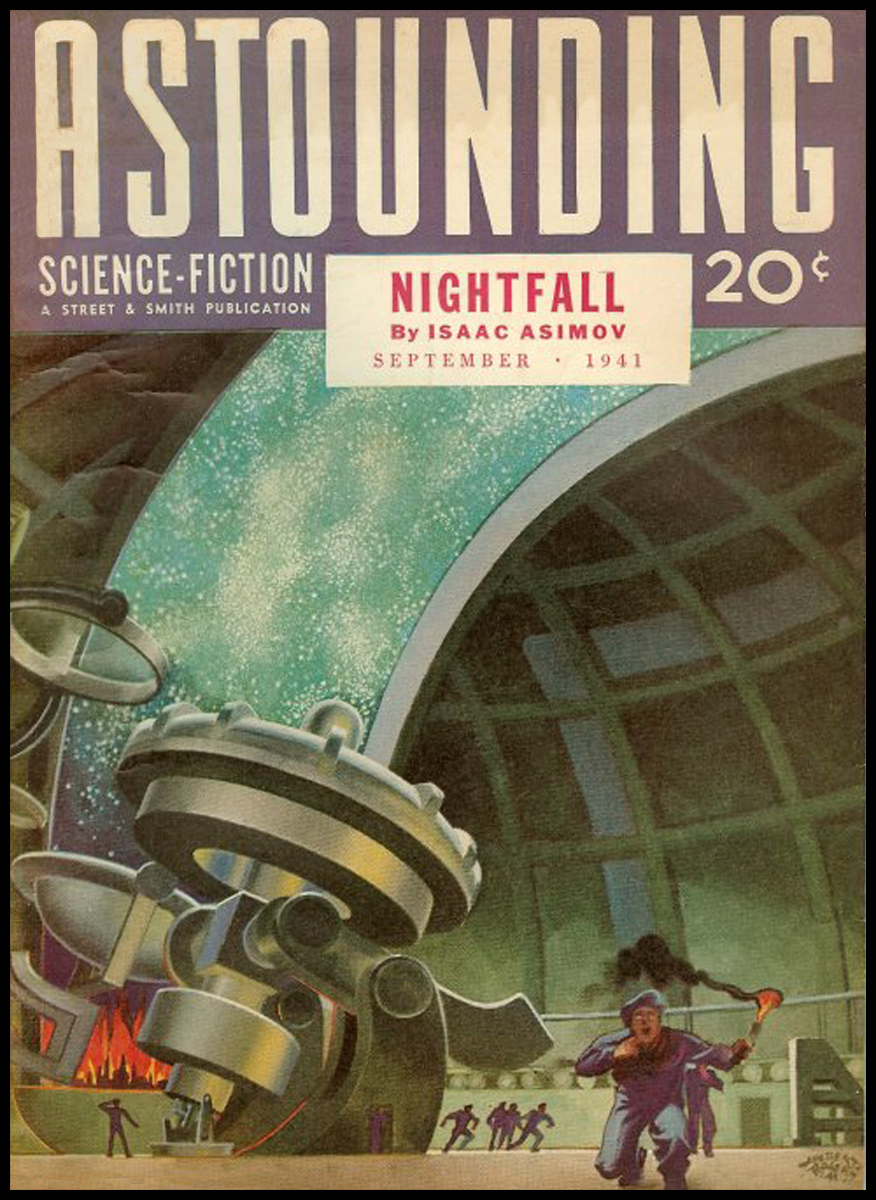
As the eclipse approached, my imagination inevitably drifted back to the planet Lagash. Considering how much fear as an eclipse can elicit in a world where darkness comes every night, imagine what effect it would have in a world that is otherwise bathed in perpetual daylight! This is the premise of Isaac Asimov’s groundbreaking science fiction short story “Nightfall,” first published in the September 1941 issue of Astounding Science Fiction. Taking place on Lagash, a world much like earth with inhabitants who seem just like humans—except that Lagash is lit by six suns, so its denizens have never experienced the dark of night. Once every 2000 years or so, the moons and planets in the six-star system line up just right so that the dark of night comes to Lagash for about half a day. This time, as nightfall approaches, a crew of scientists with telescopes attempt to unravel the mysteries of the universe and interpret what is to occur. Having had no night sky to work with, their grasp of astronomy is rudimentary, but they are on the road to understanding nightfall as an astronomical phenomenon. Meanwhile, religious zealots siege their observatory, demanding repentance before the end times. Their "Book of Revelations" contains some records handed down from survivors of a previous nightfall, who speak of stars (whatever those are) that will emerge from the dark sky and rob men of their souls. All this takes place in anticipation of the raw panic that is going to ensue when Lagash is bathed in darkness. Civilization may not survive.

Richard Lea, writing for The Guardian in 2012, notes that the conflict between science and science-denial brought to vivid light in “Nightfall” is even more relevant today than it was 70 years ago, as global warming threatens to destroy much of civilization, and many powerful people deny the science. I note that climate-deniers are driven less by religious belief than by the knowledge that addressing the climate crisis will compromise their profit margin. And most politicians and mainstream commentators who do acknowledge climate change propose solutions that are woefully inadequate. On some level, we are all in denial of the coming storm.


Astounding cover by Hubert Rogers, originally published by Street & Smith publications, and I'm not sure of its current copyright status. Low-resolution reproduction used here for educational purposes only. Photos of Ross by Amy Rether.