Showing posts with label Yellowstone National Park. Show all posts

Saturday, November 18, 2017

Godzilla vs. Steamboat Geyser


All summer in my ranger work at Norris Geyser Basin, I attempted to convey to visitors the power and fury of Steamboat Geyser, earth’s tallest geyser, which very few people will ever be privileged to see in its full grandeur. The intervals between the geyser’s major eruptions can be anywhere from four days to 50 years, and there is no pattern, and no way to predict it. These eruptions can be over three times the height of Old Faithful, and many times louder and more violent.

Late in the summer, while doing some informal research on one of my favorite subjects, the Godzilla films, I had a realization. When Steamboat Geyser reaches its maximum eruptive height of 380 feet (116 meters), it is taller than Godzilla! Or to be precise, it is taller than NEARLY all versions of Godzilla. Godzilla was 164 feet (50 meters) tall in the original 1954 Toho film, and was scaled up for the sequels. In The Return of Godzilla (1984), he was 262 feet (80 meters) tall; in Godzilla vs. King Ghidorah (1991) he was 328 feet (100 meters) tall; in Godzilla (2014, Legendary Pictures), he was 355 feet (108.2 meters) tall. Only the Shin Godzilla (2015) version of the beast may be taller than Steamboat Geyser, at 389 feet (118.5 meters).

To illustrate the titanic size of Steamboat Geyser, I produced the drawing above. Maybe we can make a t-shirt out of it, for folks who work at Norris.

Godzilla is trademarked to Toho studios, so I will not be doing anything big with my drawing.

Wednesday, September 20, 2017

A Night on Observation Peak


I spent the night in the backcountry patrol cabin on Observation Peak in Yellowstone National Park, with friends visiting from the eastern U.S. I’ll share my entry in the logbook, transcribed below.


“9/13/17  We had a glorious overnight trip to the cabin, departing this morning. Crew consisted of my friend Emily, her daughter Calia (age 10), and myself. We trekked up from Cascade Creek Trailhead. Two-thirds of the way up, Calia became fed up with hiking and threw a fit (as children are wont to do.) The rest of the trip was challenging, despite the perfect weather (sunny with a cool breeze) and the vistas of increasing grandeur as we ascended. We finally reached the cabin, and I was relieved to find that my 79 key really does work on the door—open sesame! Calia’s mood turned 180, from misery to elation, with the opportunity to stay the night in the ULTIMATE tree house. My friends are from North Carolina and have not previously sojourned west of Chattanooga, Tennessee. Therefore, the elevation here of 9,396 feet is by far the highest they have yet experienced! The challenge of removing the shutters was rewarded by the world’s best view of sunrise and sunset. I read Shoshone and Nez Pierce stories about the origins of the land below aloud to my friends in the night and the early morning. It was warm inside under the blankets at night, as the wind buffeted and rattled our little sanctuary. In the morning, the piercing bugles of elk rose from somewhere in the forest below. Emily is awed by the place and grateful for the opportunity to have stayed in the backcountry. Calia declares, “I want to live here!” Other wildlife observed include northern harrier and grouse, and two bald eagles, a mated pair. Emily is concerned that nearly all forbs were crispy and desiccated between Cascade Lake and here—punishing effects of an unusually hot, dry summer, due to global climate change?

We are all boundlessly appreciative at having gotten to stay in this marvelous shelter in a sacred land.

—Ross Wood Studlar, Interpretive Ranger, Norris


SKREEYAOOW! [sound effect for bugling elk]”


Bottom photo by Calia Sampson at Fairy Falls. All others by yours truly at Observation Peak.

Tuesday, August 29, 2017

The Great American Nightfall


I looked to the sun through my special lenses, and it looked as if a cosmic Cookie Monster had taken a bite out of it. I could see why both the Chinese and the Native Americans tell stories about a dragon or a frog that devours the sun. The word ‘eclipse’ means ‘abandonment’ in Greek, and before astronomy had advanced to the point of explaining the eclipse, it was met with dread that the sun was abandoning the earth. For the Great American Eclipse of 2017, which I viewed from Yellowstone National Park, the mood was more joyous than fearful. The fears I had carried included that cloud cover might prevent us from seeing the eclipse, and that I might have to respond to a dehydration or cardiac patient during the eclipse, preventing me from seeing it. Thankfully, we had a clear blue sky on August 21, and no medical calls. I took my first glimpse of the eclipse from outside the ranger station at Madison junction. From there, I rolled in the ambulance with fellow ranger Amy to her normal work station, the Madison visitor center. We met a throng of tourists, scattered throughout the parking lot and the field by the Madison River. The American flag flew before the historic visitor center, built of great pine logs. In the distance elk munched on grass. Closer by, men and women tilted back in their camp-chairs, and looked skyward through their eclipse glasses. Children chased each other back and forth—when we get older, it can be too easy to forget this obvious use for an open field.


One family used a colander for an eclipse pinhole-viewer, and it worked well. The shadow of the moon advanced over the sun. The sun reduced to smaller and smaller crescent, until it was only a thin sliver. The sky shifted to a darker blue, and the yellow grass of the field turned to orange. Long shadows were cast on the landscape, from the human figures, the trees, and the flagpole. I raised my camera to take a photo, and it kicked automatically into sunset-mode. (A simple AI had interpreted what was happening.)


A chill wind blew. I heard the voice of a seven-or-so-year-old boy asked his mom, “Why is it getting so cold?” Near the peak of the sky’s dome, another point of light emerged—the planet Venus! We were not in the path of totality, so were not privileged to the full effect of nightfall in the daytime. This was the closest we came. The sliver of sunlight moved to the top of the sun, and slowly the crescent of sun enlarged again, as the moon’s shadow moved away. The moment the sun began its return, the persistent dull roar and whoosh of traffic returned. To me, the eclipse was not over until the sun resumed its full form; but many tourists obviously saw it differently, taking to the road the instant our star began to return.


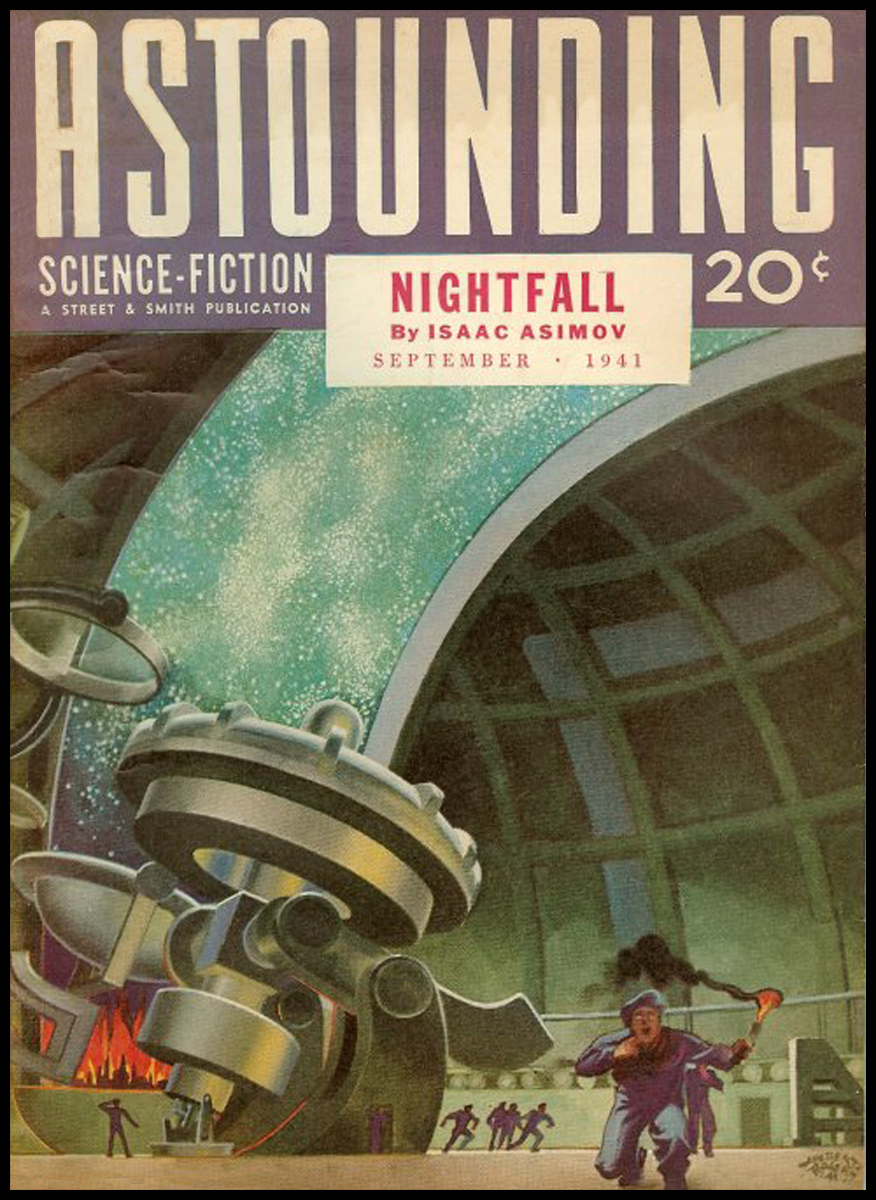
As the eclipse approached, my imagination inevitably drifted back to the planet Lagash. Considering how much fear as an eclipse can elicit in a world where darkness comes every night, imagine what effect it would have in a world that is otherwise bathed in perpetual daylight! This is the premise of Isaac Asimov’s groundbreaking science fiction short story “Nightfall,” first published in the September 1941 issue of Astounding Science Fiction. Taking place on Lagash, a world much like earth with inhabitants who seem just like humans—except that Lagash is lit by six suns, so its denizens have never experienced the dark of night. Once every 2000 years or so, the moons and planets in the six-star system line up just right so that the dark of night comes to Lagash for about half a day. This time, as nightfall approaches, a crew of scientists with telescopes attempt to unravel the mysteries of the universe and interpret what is to occur. Having had no night sky to work with, their grasp of astronomy is rudimentary, but they are on the road to understanding nightfall as an astronomical phenomenon. Meanwhile, religious zealots siege their observatory, demanding repentance before the end times. Their "Book of Revelations" contains some records handed down from survivors of a previous nightfall, who speak of stars (whatever those are) that will emerge from the dark sky and rob men of their souls. All this takes place in anticipation of the raw panic that is going to ensue when Lagash is bathed in darkness. Civilization may not survive.

Richard Lea, writing for The Guardian in 2012, notes that the conflict between science and science-denial brought to vivid light in “Nightfall” is even more relevant today than it was 70 years ago, as global warming threatens to destroy much of civilization, and many powerful people deny the science. I note that climate-deniers are driven less by religious belief than by the knowledge that addressing the climate crisis will compromise their profit margin. And most politicians and mainstream commentators who do acknowledge climate change propose solutions that are woefully inadequate. On some level, we are all in denial of the coming storm.


Astounding cover by Hubert Rogers, originally published by Street & Smith publications, and I'm not sure of its current copyright status. Low-resolution reproduction used here for educational purposes only. Photos of Ross by Amy Rether.

Tuesday, August 8, 2017

Ode to the Buffalo Bull


Bison are the most reliable beasts in Yellowstone. Nearly 5,000 in number, they are commonly seen from the valleys and overlooks, by the rivers and by the roads. They scratch their great heads upon trees to deal with insect pests, rub off the bark, and leave scars across the forest, which everyone misattributes to bears or elk. On a misty morning in August, the bellows of the bulls echo across the plains like a rumbling volcano. As the mist rolls away in the rising sun, the battlefield is revealed. Hundreds of bison in the valley below. A bull trots beside a cow, sniffs her rear end, waits for her to come into heat, roars across the plains, telling other bulls that this one is MINE. His hold lasts only as long as he can keep other bulls away, by intimidation or by force. The cows swear fealty to no partner. Their criteria is simple: the best fighters are the most attractive. He who dominates others of his kind will sire many children whom he will not know. For the life of the bull bison is solitary, walking with the herd when convenient, walking alone when convenient, eating grass all day, tolerating others of his kind when sharing the meadow. In the prime of health, he has little to fear. At 2,000 pounds, with a battering ram for a forehead, swords in his horns, and knives in his hooves—grizzly bears and wolves keep their distance and search for easier prey. The bull eats and walks and stays out of trouble, until the next mating season. Then the fury of testosterone consumes him again. All of his weapons are at the ready, but his opponents are equally armed. Corpses litter the field at mating season’s end, the result of those fights in which both adversaries refused to back down. And this attracts beasts that are normally harder to see. Grizzly bears appear on the field, thankful for the scavenged feast, in time to prepare for winter hibernation.

Tuesday, June 14, 2016

Father wolf brings a gift


I am back to Park Ranger work at Yellowstone, this time at Norris Geyser Basin, in time for the centennial of the National Park Service (1916-2016)!

On an off-day last week, I awoke at 4:15 AM, and drove my Subaru across winding roads, past towers of steam and fields of grass and sage. The roads were mostly empty (too early for even the tour buses) and the sky turned from grey to pink to blue. My destination was Slough Creek, at the edge of Lamar Valley, where my contact Rick McIntyre waited, seated upon a stool behind a spotting scope, with crowds of wolf-watchers around him. Rick is a Biological Science Technician at Yellowstone, and has been out at the break of dawn to watch wolves and record their ways, seven days a week, for the past 16 years or so. I sought Rick’s wisdom in preparation for my evening program about Survival Stories from Yellowstone, which features, among others, Wolf 755M, now the alpha male of the Wapiti Pack in Hayden Valley, who has lived through hell and back. 755M and his mate the great huntress 06 had a den of pups in 2010, in the same location now occupied by newer generations. From our perch on the ridge, we not only spoke of the legends of elder wolves, but also watched the nascent lives of young wolves—legends in the making. We watched the den of the Junction Butte Pack. We saw their alpha male trot back to the den, with a bison skull in his jaws. Found on the plain, this skull would make a fine chew toy for his pups. We later saw a family reunion; canids young and old joyfully wagged their tails. We saw bison chase wolves, and wolves chase bison. No violence occurred, but the relationship between the great herbivores and carnivores is often tense. Wildlife biologist and wolf project director Doug Smith made an appearance at the overlook as well, and joined us in watching the unfolding story of the Junction Butte Pack through the scopes. With the den in clear view, we had a rare opportunity to see the wolves grow up, one that would prompt enthusiasts to travel around the world for a glimpse through the scopes. For me, it was a trip of one-and-a-half hours in the early morning, with a weary day to follow; even though I normally arise early, this trek challenged even my circadian rhythms!

(Of course, remember that I write this blog from the standpoint of a private citizen, who coincidentally happens to also work for the National Park Service.)

Friday, November 6, 2015

Together we are strong


I painted this watercolor of a black bear (based on my own photo from Yellowstone), while my friend Raven practiced her singing and piano. The friends who art it up together stay together, in my opinion.

And an unrelated announcement.....

http://350.org/kxl-victory/

VICTORY! After hundreds of thousands of us took to the streets, many hundreds committed acts of nonviolent civil disobedience, and over two million called or wrote to the president in opposition to the black snake.

A time to celebrate. (And rock out to Epica's "Omen--the Ghoulish Malady"!) One down, so many more to go......  

No KXL image by and belongs to the folks at 350.org.

Monday, October 19, 2015

Fear of the Predators


The horror writer H.P. Lovecraft wrote, “The oldest and strongest emotion of mankind is fear, and the oldest and strongest kind of fear is fear of the unknown.” On this subject, I am not qualified to dispute the old grand master of horror (whose bust adorns the World Fantasy Award)... but I will anyway.

I suspect that our true oldest and strongest fear is the fear of being eaten.

I've been reading the manga series Attack on Titan by Hajime Isayama, set in a dark future wherein the last survivors of humanity fight a war against giant zombie-like beings, the Titans, who eat people. I must be impressed by the visceral power of the story and art: the shock factor of a titan closing its jaws around a human torso never seems to ebb. Over here in America, creators Robert Kirkman and Tony Moore have produced a similar extended-war-with-zombies story The Walking Dead, which has been both a bestselling comic book series and a hit television saga.

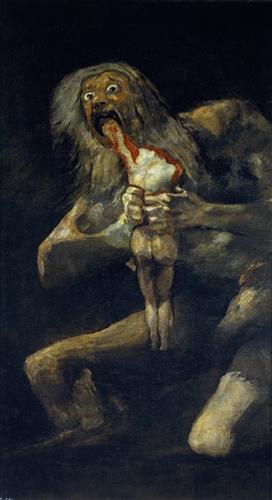
The (mythic) Titan Saturn devouring his son, painting by Francisco Goya, 1823.

There are many hypotheses for the psychological reasons behind the boom in zombie media, which has now been going on for over a decade. One is that zombies are some kind of metaphor for hi-technology, that—like drones or robots or computer viruses or smart phones—they “only do what they are programmed to do.” This hypothesis may be partially correct, but the zombie's tapping into our primal fear of becoming prey must be a factor as well. Several of the other standard horror tropes, such as vampires and werewolves, are also known for their consumption of human flesh and blood. Some of the most memorable old horror movies (such as Curse of the Demon and Cat People, both directed by Jacques Tourneur) feature a protagonist being stalked as prey by a fanged beast. Some of Lovecraft's own stories feature cannibalism, such as the short but terrifying “The Picture in the House,” which I sometimes read aloud on Halloween or at campfires, to rattle the bones of friends.

The monsters we draw have canines and jagged carnassials—the teeth of predators. For much of America's history, without a modern understanding of ecology, Euroamericans saw herbivores as good and carnivores as bad--and so sought to exterminate the latter. And the image of the benevolent herbivore and villainous carnivore still lurks somewhere deep within our imaginations. In an old Jesse Marsh Tarzan comic book, a group of Iguanadons surround the ape-man to protect him from a Tyrannosaur.  Somehow, I think that if a real person found himself surrounded by Iguanadons, they would have a "fight or flight" reaction, just like today's wild animals. They would either see him as a threat and kill him, or maybe run away if he was lucky.

 Marsh, sometime in the 1950s.
 
Alternatively, to make herbivores look scary, cartoonists sometimes give them the teeth of carnivores. In his narrative “The Bugling Elk” about the mighty battles of bull elk during the fall rut, Ernest Thompson Seton drew a caricature of an angry elk, as such:

Seton, 1913

Becoming prey was likely a more frequent cause of death to people in paleolithic times, when there weren't cars to hide in or guns to hide behind. There was also the persistent danger of falling prey to another human.

From my work as a Park Ranger at Yellowstone, I have regularly experienced the disproportionate fear which people hold towards carnivores. Bears are the objects of fear to many of the travelers who look to me for orientation and advice. There is good reason to be cautious, and to watch the bruins from a long distance away. Bears can hunt people, but rarely ever do. The opportunistic omnivores are more commonly seen chowing on berries and roots and insects and carrion, or hunting elk calves by the lake. When bears do attack people, it is a defensive maneuver, in 99.5% of cases. And in 70% of human fatalities caused by grizzly bears, the attack is by a sow with cubs, whom she will protect at all costs. Natural selection favored mother bears who will not only die for their cubs, but also kill for them.

However, the same people who may refuse to exit their cars in bear country (even in the safety of a large group), walk right up to other dangerous animals with their cameras and selfie-sticks in hand. Bison injure an average of four personsper year at Yellowstone, while bears injure an average of one. Five people have been thrown or gored by bison this year at Yellowstone, and four out of the five had to be life-flighted out of the park. Luckily, all survived. Across the Atlantic, in the wilds of Africa, the deadliest large animal, in the opinion of many experts, is not the lion or even the crocodile. It is the hippopotamus, an herbivore with a fearsome desire to protect territory and young. Hippos kill 2,900 people per year in Africa, which is exponentially more than lions do. (And apparently crocs don't have exact statistics.)
And yet, somehow, the war-hammer head and horns of a bison don't invoke the same deep-seated fear as the teeth and claws of a grizzly. Repeatedly, we underestimate the herbivores, and think that animals who eat grass must not be dangerous—even when the statistics say otherwise, even after we have seen two bull bison on the plain laying into each other in the contest for a cow's affection—they ram with heads and stab with horns, parry and counter their opponent's attacks, with the agility of lightweight boxers and the power of Mack trucks.

Gary R. Paul, 2007

We reserve our greatest fear—and awe—for the animals who threaten to displace us at the top of the food chain. This sense of fear and awe has driven us to obliterate carnivores—then try to restore them. An Animal Planet poll rated the tiger as the “world's favorite animal.” On some polls, people have rated wolves as the animal they most want to preserve—which is a 180 from 100 years ago, when the wolf was perhaps the most vilified animal on the planet, or at least in the Euroamerican world. Notably, wolves at the Yellowstone region and most other places have never hunted people. However, they can compete with human hunters for large game, and may hunt livestock when their preferred wild foods are scarce. Hence, they are our competitors for the top predator title. This is likely one of the reasons why many cattle ranchers opposed the reintroduction of wolves to Yellowstone, and some still oppose it today, despite the many forms of compensation the government gives for the rare livestock fallen to the canids. The anti-wolf ranchers are a minority voice, but a vocal one. (And there are some pro-wolf ranchers as well.)

In a world filled with dismal environmental news, the story of wolf reintroduction to the Yellowstone is one of victory and hope. So is the story of the return of Yellowstone's bears to the wild, after decades of life as beggars at the park's garbage dumps and roadsides. We can share the world with carnivores, and revel in the fear and awe and humility they give us. Provided that we watch cautiously from a long distance away.

Goya and Seton images in public domain. Other images copyrighted to respective creators and companies.

Sunday, August 30, 2015

Painting the Yellowstone and Seeing in Color

Last weekend, I took a short course on plein air oil painting in Yellowstone with Daniel Hidalgo of the Idaho Art Lab.  It was my first time using oils since Painting I at Denison University, fourteen years ago.


 I must have had an urge to impersonate Thomas Moran, since I bought an oils set and brushes specifically for the course. I must conclude that—with its toxic chemicals and long drying times—oil  is impractical for a man who lives out of a car and has no studio, save perhaps a corner of his small and temporary bedroom. (Watercolor, gouache, even acrylic omit the hazardous fumes and are quicker to dry.) But I appreciate the vibrancy of the colors, which is said to be a strength of the traditional paint. And the challenges can be overcome, for those artists for whom oil holds unique power.

We painted at Lamar Buffalo Ranch and Mammoth Hot Springs, and at the Devil's Hoof near Tower Falls. By the third painting, I became wildly expressionistic, holding my long wide brushes near their tail end, as I tend to do when presented with a canvas and colors to mix. I must wonder if my painting looks more like a forest fire than the spire formations of welded volcanic ash which we set out to depict. It was good not be painting alone, for a change.


On the last day, in the morning near sunrise, I sat on the back porch overlooking Lamar Valley and its buffalo herd, and saw all the highlights and shadows, crimsons and indigos in the rolling plains. I told Daniel, who stood before the overlook sipping coffee, that after only three days of painting, I saw the land differently, in its many colors, as though just noticing an autumn in Vermont. With every activity, every conversation, and every television commercial, our brains form new connections. After working in a nursery in Pennsylvania for a few months, I had a new awareness of the landscaped suburban backyards, their types and arrangements of plants. After drawing forest scenes in black and white for my latest comics story, I became more cognizant of the forests around me, the pillar-like or serpentine pine trunks, the light and shade. And with paint in hand, I see more of the world's color.


The right side of the brain is associated with pictures, feelings, compassion, and empathy, while the left is associated with words, numbers, and logic. The world's great minds—artists and scientists alike—have developed both right- and left-brained skills. If only the public schools would learn about the importance of this balance, they might stop cutting the arts with every budget shortfall. And it is wise to remember that the great places in nature are not just science labs, but art labs as well.

Sunday, July 19, 2015

Old Faithful from a weary ol' Wood

It appears that July will not be a big blog month for me, since I am preoccupied to the Nth degree with other projects. First it was my evening program about the artists of Yellowstone, which I titled The Artistic Frontier, and finished, and presented on the big screen by the campfire at Canyon Village campground (to a surprisingly small crowd), then triumphantly returned a big stack of books to the library at the Yellowstone Heritage and Research Center in Gardiner, Montana. Now it's a comics story in collaboration with the legendary Stephen Bissette, featuring a fisher--that wily big weasel who leaps silently through the trees and hunts small animals up to and including porcupines. The fisher is like nature's ninja, or like a Sasquatch whose existence has been confirmed. I am drawing the five-page story based on a script by Bissette; and submitting the finished tale to the Awesome Possum collection of animal comics, edited by Angela Boyle. The editor loved Bissette's script, so I am doing all I can to ensure that my art measures up. I have penciled most of it, and the whole thing is due, inks and all, at the end of the month…. !

In the meantime, I'll share a watercolor drawing I made from life of Old Faithful. I felt the collective energy of the crowd gathered around this ancient geyser, the suspense as they waited for the blow. As they waited, I painted the surrounding landscape, and left space for the gush of hot steam. When it fired, I had to draw fast….!

I hope that all are well and a little less busy than me.


Monday, June 8, 2015

Lady Bighorns on the Edge


I thought that they were mountain goats, two adults and two babies. I wondered if they might be a family, not knowing the family structure of these ungulates. From my vantage point, on a higher cliff on the trail up Mt. Washburn (Yellowstone National Park), the animals won my heart. The babies shared their parents' boldness for walking on the edges of cliffs; however, they always made sure to keep within a leg's-length of mom. I saw a baby nurse. I zoomed in with my cameras, and clicked away. I lamented that mountain goats are not native to Yellowstone. I should not glorify or romanticize an exotic invader, no matter how majestic said animal might be, I had thought.

I put away my cameras and hiked the rest of the trail, to the fire lookout tower at the top. All of the tower except for the very top was open to the public. Inside the glass-windowed panoramic viewing room, there was a sign duct-taped to the wall. It showed a photo of a mountain goat and one of a female bighorn sheep. My subjects clearly belonged to the latter category. Female bighorn sheep can look suspiciously like mountain goats; I should have known better, having met a lady bighorn previously on a trek through the Grand Canyon.


Relieved that my animal friends had been vindicated, I ambled back downhill, and found the spot from which I had seen the wily ungulates. On the cliffs below, those bighorn sheep were still around! Evidently, these rock outcrops were lush with plants—comparatively speaking in the harsh tundra world of 10,000 feet! There were lichens of many colors, oranges and blacks, growing all over the rocks around me. And, where the sheep grazed, patches of grasses, almost fluorescent green in color, and maybe a quarter of an inch tall. Nonetheless, the bighorns munched on this sparse vegetation, a feast for them. The lambs took some nibbles from the plants, then returned, each to nurse from their respective mother. Back and forth the babies scurried, with the spastic energy of youth. It was charming to see these two mother sheep out together with their youngsters. Were the ewes sisters? Friends? Of the same herd in any case, and they liked to keep together, the fearless four. One of the moms rested, belly to the ground, evidently taking a break both from foraging and her lamb's frequent attention to the teat. Through the binoculars, I had a good view of those spooky eyes that sheep and goats have, the horizontal pupils, suggesting an alien intelligence within that elongate head. And since people are naturally acrophobic, the lifestyle of the bighorn sheep seems foreign and hard to imagine. Perhaps more amazing is how the sheep find sustenance on these barren mountains. Somehow, a tiny green stalk at a time, they find the energy to not only survive, but thrive. Lactation takes a great deal of energy—making milk for a baby requires the mother to give so much of her body and her self. And these sheep were able to do it, in the fiercest of lands. Ian Malcom (Jeff Goldblum) of Jurassic Park was right: “Life will find a way.”

Monday, June 1, 2015

Peace in the Valley


Hayden Valley is frequented by bison, elk, bears, and wolves. And it has (for me) the virtue of being close to my Canyon home base. I am often in the valley in uniform on roves, where I meet devoted older tourists with spotting scopes, who share volumes of knowledge on Wolf 755 (and adult male who roams the valley), and generally know more about the wildlife than I or most rangers ever will. On some early mornings or evenings, I come to the valley in civilian attire, with my pencils and brushes and pastels. The Yellowstone River, with its serpentine undulations, unifies Mother Nature's grand composition of landscape. I may not be able to capture it fully on paper, but it's a learning process. And, in the quietude, after the mobile homes have roared to their next stop, elk emerge from their hiding spots and trek downhill. Ravens soar to and from their nest in the trees, unconcerned with whether people are watching. And I hack away at building layers of pastel on the page. I become a shrub by the road, with that curious musky person-smell, which the beasts of the field have come to know.  

Monday, May 25, 2015

Bear in the Valley


In Hayden Valley, a young adult grizzly bear was out and about, on the far side of the river. Likely to be a female who is known to roam the valley. Many people pointed their cameras and binoculars from the field by the road, and luckily kept their distance. The bear chomped away on some carcass in the field, then trotted towards us. I was a ranger on duty, and so I told folks to step back and keep the 100 yards distance. The bear hopped into the river. She waded out to grab hold of a bison carcass (mostly a skeleton with a bit of flesh still clinging.) She spun the carcass about and reared up on top of it, sunk her jaws deep into the abdomen. She attacked the carcass from every angle, and tried to extract every last morsel of meat, all the while braving the chill water. Then she went back to the far side of the river, and ran downstream. The people followed, most in their cars, to the next pull-out. A pair of law enforcement rangers arrived there, and I left the crowd control to them. In this event, had to refrain from photography, so as not to look like a tourist. I did get some fine views of the distant bear through the binoculars. The bruin, in classic fashion, exploited the remains of animals who did not survive the winter--a brutal time for the large ungulates. Yellowstone astounds!

Monday, May 18, 2015

Be wary of animals large....

I asked my supervisor at Yellowstone Park her opinion about solo hiking. She said that she did it regularly, and called it a “calculated risk.” The next day, I was out alone, hiking stick in hand, wide-brimmed hat on head, in a lodgepole pine thicket, after a meadow. I had my canister of bear-spray clipped to my hip. I had sent my friend Lesley a last minute text message about where I was going, which I consider as passing with a “D” when it comes to notifying an outside party of one's travel plans. I had hiked solo in black bear country countless times, but Yellowstone is also home for the larger and less predictable grizzly.


As I went, I spoke “Yo whazup bears, I be passin' through.” (They normally walk away at the sound of a human voice.) It felt odd, talking to myself, and the one-sided conversation was hard to maintain. I passed a wetland where the chorus frogs sang  their continuous “Creek-eek.” There were many patches of snow among the fallen timber.

In the forest, it was scarier. I glanced about, wondering what lurked in the shadows under the trunks. My senses heightened halfway to the level of a deer, the ever-vigilant prey. My imagination turned a small branch breaking in the wind into the footfall of a massive animal; a crunch of rocks under boot became a bruin's grunt; a boulder into a hairy beast. Then I came to an indisputable sign of the grizzly bear—tracks in the mud, with long claws prominent.


I splashed through some muddy trail to Cascade Lake, my destination. I turned around and headed back.

I strode faster on the way back, my confidence increased. Still I periodically checked for my canister of spray, and made my voice quietly heard to the trail ahead.

The next morning, in the shower, I felt a little bump somewhere on my buttocks. After out-ruling potential scabs or zits, I knew what I had to do. I grasped the tick with my fingernails at the front of the head, and ripped it out forcefully, some skin along with it. With abdomen full of blood, the critter slipped out of my hand and down the drain of the sink. With its little legs waving, I failed to identify the type of tick, but regarded it as certainly larger than a deer tick. Now, a week later and with no symptoms, I am in the clear.


However, the irony was not lost on me. While I was distracted by the thought of large and fearful mammals, a silent but deadly beast, the miniature septic tank, easily crawled up my pants leg. A tick check the same day as my woods walk would have saved me some blood and concern.

Precautions for bears and sharks are important. However, the deadliest animal in the world is the mosquito, for its spread of disease. Ticks rank second as disease spreaders. Bees are another force to be reckoned with, as 53 people per year in the US die from allergic reaction to their stings. We can share the wilds with all these creatures, with the right precautions. Enjoy the woods, my friends, but be wary of animals large and small!

Saturday, May 9, 2015

Ravens in the Steam


Another vignette from my visit to Yellowstone last year:

“The ravens were everywhere. They watched from trees, soared above on ebony outstretched wings, owners of the domain of yellow rocks. Along the “back basin” of Norris Geyser basin, a group of three ravens cackled and cawed and croaked, in a three way dialog of some kind. Perhaps gossip about the goofy bipeds who pass in the thousands by day, and point their gaping cameras at the steam.”

This year, I have moved in to Yellowstone for the next five months. My inaugural field sketch, below, I made at Norris Geyser Basin. New stories await!


Tuesday, March 31, 2015

Bear of the Northern Wilds


A vignette from my Yellowstone trip (with my parents) last year:

At one point along the North Loop Road, we came upon another backlog of cars—elk jam, I guessed. With so many tourists gawking and aiming cameras, we too decided to scoot our station wagon barely off the road, and join them. Some place in the woods, to which all the cameras pointed. One could imagine lines projecting from the cameras, all to converge at a point—on the nose of a small black bear. A young one. He attacked a shrub, probably fruited with currants, from every angle. He reached munched and picked, berries, leaves and all, first from one side of the bush then the other, then above and then below. From any available clearing in the vegetation by the road, the binoculars and cameras pointed and clicked. As thorough as a kid with a bag of M and M's, the bear ate for every last berry, and then shuffled on to find another bush. My mother remarked that when she visited Yellowstone as a child, the tourists would gather by the road to feed the bears bread and candy and turn them into overweight beggars. What an amazing shift between now and then, that we now capture and light up our computer screens with pictures of bears practicing their natural habits in their natural habitats! The young bear is probably out shuffling through the woods somewhere today, with pine smell in his nostrils and food on his mind.


(I don't know the bear's gender, so my male pronouns have a 50% chance of being correct.)

Tuesday, March 24, 2015

Big event for this wandering ranger


On the evening of March 22, a few hours before my birthday, I accepted a seasonal Park Ranger (interp) position at the Canyon district of Yellowstone National Park. I will be there May through September.
I never imagined that this would happen.
For all my years of working at national parks and environmental ed centers, I had always assumed that getting a job at Yellowstone was beyond me. In good part, because of the principle of "it's not what you know, it's who you know." This time, said principle worked in my favor!
And, fittingly, the Grand Canyon of the Yellowstone is the subject of an epic seven-foot by twelve-foot painting by Thomas Moran. Moran's paintings, along with William Henry Jackson's photographs and Ferdinand Hayden's geology-based writings, convinced the U.S. Congress in 1872 to declare Yellowstone a national park, the first in the world.
I go to where an artist moved the Earth.
I am no match for Moran, but will share my own humble oil pastel drawing, of the canyon's Lower Falls, drawn from life on my visit last year.
I hope that you all come visit me this summer!


Thursday, August 28, 2014

The Canyon of Yellow Stones and Waterfalls

At long last, I visited the place of legend—Yellowstone National Park. Among the many awe-inspiring sites was the Grand Canyon of the Yellowstone.

Thomas Moran's epic painting of this great chasm was instrumental in making Yellowstone become the world's first national park. I am no match for him, but still I made the attempt to capture the essence of the Canyon and the Lower Falls, in oil pastels and watercolors.


I am at work on a longer and more complete entry on my Yellowstone adventure, will post when I can. For now, excelsior!