Showing posts with label bison. Show all posts

Tuesday, August 8, 2017

Ode to the Buffalo Bull


Bison are the most reliable beasts in Yellowstone. Nearly 5,000 in number, they are commonly seen from the valleys and overlooks, by the rivers and by the roads. They scratch their great heads upon trees to deal with insect pests, rub off the bark, and leave scars across the forest, which everyone misattributes to bears or elk. On a misty morning in August, the bellows of the bulls echo across the plains like a rumbling volcano. As the mist rolls away in the rising sun, the battlefield is revealed. Hundreds of bison in the valley below. A bull trots beside a cow, sniffs her rear end, waits for her to come into heat, roars across the plains, telling other bulls that this one is MINE. His hold lasts only as long as he can keep other bulls away, by intimidation or by force. The cows swear fealty to no partner. Their criteria is simple: the best fighters are the most attractive. He who dominates others of his kind will sire many children whom he will not know. For the life of the bull bison is solitary, walking with the herd when convenient, walking alone when convenient, eating grass all day, tolerating others of his kind when sharing the meadow. In the prime of health, he has little to fear. At 2,000 pounds, with a battering ram for a forehead, swords in his horns, and knives in his hooves—grizzly bears and wolves keep their distance and search for easier prey. The bull eats and walks and stays out of trouble, until the next mating season. Then the fury of testosterone consumes him again. All of his weapons are at the ready, but his opponents are equally armed. Corpses litter the field at mating season’s end, the result of those fights in which both adversaries refused to back down. And this attracts beasts that are normally harder to see. Grizzly bears appear on the field, thankful for the scavenged feast, in time to prepare for winter hibernation.

Monday, October 19, 2015

Fear of the Predators


The horror writer H.P. Lovecraft wrote, “The oldest and strongest emotion of mankind is fear, and the oldest and strongest kind of fear is fear of the unknown.” On this subject, I am not qualified to dispute the old grand master of horror (whose bust adorns the World Fantasy Award)... but I will anyway.

I suspect that our true oldest and strongest fear is the fear of being eaten.

I've been reading the manga series Attack on Titan by Hajime Isayama, set in a dark future wherein the last survivors of humanity fight a war against giant zombie-like beings, the Titans, who eat people. I must be impressed by the visceral power of the story and art: the shock factor of a titan closing its jaws around a human torso never seems to ebb. Over here in America, creators Robert Kirkman and Tony Moore have produced a similar extended-war-with-zombies story The Walking Dead, which has been both a bestselling comic book series and a hit television saga.

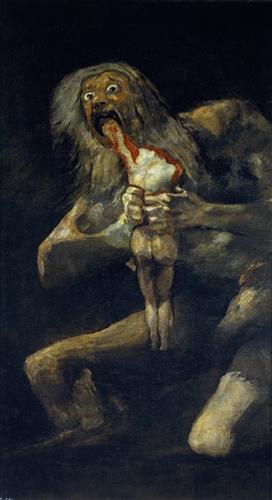
The (mythic) Titan Saturn devouring his son, painting by Francisco Goya, 1823.

There are many hypotheses for the psychological reasons behind the boom in zombie media, which has now been going on for over a decade. One is that zombies are some kind of metaphor for hi-technology, that—like drones or robots or computer viruses or smart phones—they “only do what they are programmed to do.” This hypothesis may be partially correct, but the zombie's tapping into our primal fear of becoming prey must be a factor as well. Several of the other standard horror tropes, such as vampires and werewolves, are also known for their consumption of human flesh and blood. Some of the most memorable old horror movies (such as Curse of the Demon and Cat People, both directed by Jacques Tourneur) feature a protagonist being stalked as prey by a fanged beast. Some of Lovecraft's own stories feature cannibalism, such as the short but terrifying “The Picture in the House,” which I sometimes read aloud on Halloween or at campfires, to rattle the bones of friends.

The monsters we draw have canines and jagged carnassials—the teeth of predators. For much of America's history, without a modern understanding of ecology, Euroamericans saw herbivores as good and carnivores as bad--and so sought to exterminate the latter. And the image of the benevolent herbivore and villainous carnivore still lurks somewhere deep within our imaginations. In an old Jesse Marsh Tarzan comic book, a group of Iguanadons surround the ape-man to protect him from a Tyrannosaur.  Somehow, I think that if a real person found himself surrounded by Iguanadons, they would have a "fight or flight" reaction, just like today's wild animals. They would either see him as a threat and kill him, or maybe run away if he was lucky.

 Marsh, sometime in the 1950s.
 
Alternatively, to make herbivores look scary, cartoonists sometimes give them the teeth of carnivores. In his narrative “The Bugling Elk” about the mighty battles of bull elk during the fall rut, Ernest Thompson Seton drew a caricature of an angry elk, as such:

Seton, 1913

Becoming prey was likely a more frequent cause of death to people in paleolithic times, when there weren't cars to hide in or guns to hide behind. There was also the persistent danger of falling prey to another human.

From my work as a Park Ranger at Yellowstone, I have regularly experienced the disproportionate fear which people hold towards carnivores. Bears are the objects of fear to many of the travelers who look to me for orientation and advice. There is good reason to be cautious, and to watch the bruins from a long distance away. Bears can hunt people, but rarely ever do. The opportunistic omnivores are more commonly seen chowing on berries and roots and insects and carrion, or hunting elk calves by the lake. When bears do attack people, it is a defensive maneuver, in 99.5% of cases. And in 70% of human fatalities caused by grizzly bears, the attack is by a sow with cubs, whom she will protect at all costs. Natural selection favored mother bears who will not only die for their cubs, but also kill for them.

However, the same people who may refuse to exit their cars in bear country (even in the safety of a large group), walk right up to other dangerous animals with their cameras and selfie-sticks in hand. Bison injure an average of four personsper year at Yellowstone, while bears injure an average of one. Five people have been thrown or gored by bison this year at Yellowstone, and four out of the five had to be life-flighted out of the park. Luckily, all survived. Across the Atlantic, in the wilds of Africa, the deadliest large animal, in the opinion of many experts, is not the lion or even the crocodile. It is the hippopotamus, an herbivore with a fearsome desire to protect territory and young. Hippos kill 2,900 people per year in Africa, which is exponentially more than lions do. (And apparently crocs don't have exact statistics.)
And yet, somehow, the war-hammer head and horns of a bison don't invoke the same deep-seated fear as the teeth and claws of a grizzly. Repeatedly, we underestimate the herbivores, and think that animals who eat grass must not be dangerous—even when the statistics say otherwise, even after we have seen two bull bison on the plain laying into each other in the contest for a cow's affection—they ram with heads and stab with horns, parry and counter their opponent's attacks, with the agility of lightweight boxers and the power of Mack trucks.

Gary R. Paul, 2007

We reserve our greatest fear—and awe—for the animals who threaten to displace us at the top of the food chain. This sense of fear and awe has driven us to obliterate carnivores—then try to restore them. An Animal Planet poll rated the tiger as the “world's favorite animal.” On some polls, people have rated wolves as the animal they most want to preserve—which is a 180 from 100 years ago, when the wolf was perhaps the most vilified animal on the planet, or at least in the Euroamerican world. Notably, wolves at the Yellowstone region and most other places have never hunted people. However, they can compete with human hunters for large game, and may hunt livestock when their preferred wild foods are scarce. Hence, they are our competitors for the top predator title. This is likely one of the reasons why many cattle ranchers opposed the reintroduction of wolves to Yellowstone, and some still oppose it today, despite the many forms of compensation the government gives for the rare livestock fallen to the canids. The anti-wolf ranchers are a minority voice, but a vocal one. (And there are some pro-wolf ranchers as well.)

In a world filled with dismal environmental news, the story of wolf reintroduction to the Yellowstone is one of victory and hope. So is the story of the return of Yellowstone's bears to the wild, after decades of life as beggars at the park's garbage dumps and roadsides. We can share the world with carnivores, and revel in the fear and awe and humility they give us. Provided that we watch cautiously from a long distance away.

Goya and Seton images in public domain. Other images copyrighted to respective creators and companies.

Wednesday, April 23, 2014

Wind Cave Passages, including mine on safety and ferrets, in comics form!

My fellow Ranger at Wind Cave National Park, Matthew Chuvarsky, recently sent me the final PDF of this year's version of the visitor guide (park newspaper), ready to go to press. All of us seasonal interpreters labored heavily for this production; and the final product seems to shine (despite its destination on newsprint.) I will link to the paper when it becomes available. Matthew and fellow Ranger Amanda Hagerty designed and wrote most of the contents. I must applaud their clever layouts and techniques, such as  the alternating pattern of text and images found on page 3, the gallery of notable speleothems on page 4, and the condensation of a complicated schedule into a highly readable table on page 5. I contributed the draft version of the text for the "summer" section of page 3, and--more notably--the illustrations and comics, interpreting the safety rules and the plight of the black-footed ferrets (and the text on the ferrets as well.)  Features like this are not found in many National Park Service newspapers. I must consider this publication a success, and a victory for me in bringing comics into a new educational venue. Readers young and old connect with the simple iconography and sophisticated narrative power of the comics medium. It makes a fantastic medium for communicating about National Parks and public lands, whether to explain the rules for safety and park protection, or to tell the stories of animals and plants, and evoke a sense of empathy for these residents of the great preserves. Comics have been used before as educational and interpretive tools for land protection: Grand Canyon's nonprofit support organization gives out comics featuring the superheroes Chasm and the Eco Squad (who protect nature against polluters); I have seen comics about the wildlife in Yellowstone (details unknown); the Forest Service distributes comics about fire education starring Smokey Bear; and the National Oceanic and Atmospheric Administration (NOAA) has contracted comic strip character Mark Trail and his current author Jack Elrod to communicate about the impacts of global climate change (and how to survive the resultant extreme weather!) (Mark Trail's original creator, Ed Dodd, was a Park Ranger at Yellowstone, where he guided mule pack trips.) A state park in Texas featured a brilliant cartoon sign about why not to feed the animals....
...which probably had some influence on my illustrations for Wind Cave. Having said all of this, there is a great deal more that land preservation agencies and organizations can do with the comics medium; it's potential applications are as diverse as the life in an Amazon Rainforest.

And so, I present my humble contribution to the visitor guide of Wind Cave National Park.

This was my original final product:


The park's Chief of Interpretation asked for some edits, some of which were carried out by Matthew after I departed the park. This is what finally appeared in the park newspaper:


I gave this project my best and fullest effort. I am happy to be part of our Visitor Guide. To steal a line from a skillful and hardworking maintenance employee at Wind Cave, "I aim to serve."

NPS publication cartoons are not copyrighted.

Sunday, March 30, 2014

A Walk with Tatanka


Knowing that my time in Wind Cave National Park ran short, I set out for another hike in the prairie. It was a mild and overcast day, the sort of the day the widlife would be out and about (without heavy rain or harsh cold to prompt them to seek shelter among trees or in ravines.) With my wide-brimmed hat, and backpack with sketchbook, water, etc, I jumped into my vehicle, with a planned destination of Highland Creek or Centennial Trail, both of which begin in the eastern part of the park, off of NPS 5, our dirt road “widlife loop.”

The previous evening, I had taken a saunter from Wind Cave Canyon to Bison Flats Trail, a trip which began practically outside my doorstep, and brought me across rolling prairie. Coyotes barked and howled back and forth in the graying evening. And of course, the prairie dogs did their backflips and high-pitched yelps of warning as I approached.

Now, I drove to the north end of the park and turned left onto road 5, prepared for more encounters with the prairie fauna, especially the large and charismatic. Greeting me on the rolling hillocks of prairie were three bison, one of whom struck a dramatic pose, with the waving grass around her, and the backdrop of angular orange-and-purple mountains behind. I started a pencil outline for an image in oil pastel, but the subject kept moving. And her cousins advanced towards the car, and I pressed the pedal and moved on.

At the bison corralles (so named for their role in the annual roundup) a throng of bison stood, moved in their slow amble, and watched the coming vehicle, distracted from their pursuit of grass. One was in Highland Creek, lapping up water.


I decided to go farther, to the trailhead of Highland Creek Trail. As I drove the car higher up and toward the open field, a herd of bison appeared. In my apparent naivety, I still hoped to hike on Highland Creek Trail, and pulled from the road onto its pull-off. 

 
The bison were a good few hundred yards away, and had their own business to attend to—or so I thought. With confident strides, the herd advanced toward me. The young ones, some yearlings, who looked like pygmy bison, RAN towards the mobile mineral deposit. They licked their lips as they ran, as though my vehicle were an ice cream truck. The bigger bison kept to an even walk, but also had their pink snake tongues dangling at the ready. The young ones reached me first, and the lick-fest began, like a Tootsie Pop convention. With the car's aluminum shell and glass windows separating me from then, I grabbed my camera from its holster and set to taking photographs. The car gently rocked under the barrage of licks. A larger bull bison swung his head to the side, and pushed one of the young ones away—a backhanded slap from a sledgehammer head. His larger size made this side of the car rightfully his, but his code. I knew it was quite unsafe to try to get out and hike, or even to open a door or window. I hoped that they would lose interest after a few licks. But it was not to be. Instead, through my rear window, the horde of salt-hungry thunderbeasts advanced. I restarted the engine, and very slowly backed out from the parking space. The bison, young and old, stepped aside for the moving vehicle, sometimes just an inch from its path. Nonetheless, they respected the metal beast in motion. I drove slowly down the road, And noted through the rear-view mirror that the bison followed. But when I sped up just a bit, they quickly vanished into the distance. Despite their fondness for salt, they wouldn't expend precious energy on running to catch it, save for the youngsters, rambunctious as children are.


En route back, I tried to pick up Centennial Trail, but found that it had its own crew of bovid guardians. The one in the creek was preoccupied in slurping water, but the others started their saunter towards my salty goodness. Grudgingly, I drove back south. I elected to try Cold Brook Canyon trail, since it was the only trail in this park which I had not yet hiked. After a flat and unexciting mile out to the park's boundary fence, and another back, I was still ready for more adventure. I and my wheels went back north, to the other trailhead of centennial trail. The southern trailhead was pleasantly nestled under a clump of ponderosa pines. Passing the signs at the trailhead that warned of bison, ticks, and rattlers, I went downhill.

In the valley, with walls of red rock ahead, I met a trio of bison. Their heads to the ground, munching tufts of tannish-yellow grass, the ongoing quest of the herbivore. I felt the beckoning of opportunity, and reached for my sketchbook. A medium-sized bull posed before me. He lifted his head and evaluated the bipedal ape. I backed away, until he lowered his head and resumed the grass mission. I went to my knees in the grass, and opened my sketchbook, and set to work with the pencil. The wind ruffled the pages as I went. I laid out the animal and its environs, and went to brushes and india ink. Once I was stationary, I became colder, and my one leg started to go to sleep, with weight on the knee, mooshed into the grass. I shifted my weight to the other knee, then stood upright for a bit. This wasn't a temperature-regulated studio. Out here in the field, I had to earn every line, and every stroke from dip pen or brush. I marveled at how Conrad Martens, George Catlin, Mark Catesby, and John William Lewin did it. Before cameras, this was how scientists and journalists and documentarians made field records. It still has its utility, although I had to acknowledge that one could shoot more than a hundred pictures in the time it takes to draw one. Today, I hear the debate over whether GPS will make people forget how to use maps. The debate over whether calculators would make people forget how to do math happened mostly before my time, but some of it carried over into my young days. But whatever debate happened over whether cameras would make people forget how to draw, it had ended before my parents were born. While artists lost some jobs to cameras, they also felt a new freedom, and took up abstract expressionism and the like.

I completed my drawing while munching a chocolate-flavored energy bar, which helped raise my body temperature (and made for a luxury not shared with the artists of yore.) Then I walked onward. A little further on, where I followed the trail dipped down to meet the stream, I met a large bull. This one scared me more, with his size. I shook a bit when he stared my direction, to make his judgement. I was either significant (as threat or competitor) or not significant. I backed away slowly, reducing my percieved level of danger. I needed to forgo the trail and bridge, and find a different place to cross the stream. Luckily, the bull lowered his head back to the stream, and resumed his drink. And I found another stream crossing, with only a little muck having penetrated my boot when I arrived on the other side.

I walked onward down the path, until it was time to turn around. As I came back, I walked behind the great beast. He strode through the path hewn by the stream. His muscles rippled as he walked. I had to admire the power of Tatanka—and try to keep my distance. As he turned and veered, and I strove to maintain a seperation of more than 100 feet, and so stayed well away from the trail.

The bull, in confident strides, approached the others. The three bison eyed each other, and stared and held ground, but took to sharing the space of the field. As this occurred, I continued efforts to keep far away, but also to get a few pictures. I still shuddered when one bison or the next stared in my direction. I looked to the forested areas and considered escape routes from a charging buffalo—I had learned that putting a barrier between them and me was wise, but had also seen the video where bison deftly went around the tree, to catch the man who had angered him, scooped him up with head and horns, and threw him into the air, like a rag doll. (Luckily, the man suffered only minor injuries.) Not wanting to be the next one, I kept clear, and walked along the edge of the fence, at the boundary of the field.


I passed by in peace, and back to the vehicle. Upon returning to my residence, I felt some weariness from the thrills of dodging bison, I ate some bean soup but fell into a short nap before I finished my tea.

It is glorious to be able to go for a walk near “home” and encounter the bison, the buffalo, the American icons, in their natural habitat leading their natural lives, and dodge them in one place then the next. It made me feel alive. And glad to be where I am, and to have experienced perhaps my last immersion in the grand prairies of Wind Cave. My next destination is Timpanogos Cave National Monument. A new cave, with new mountains, new forests, new territory, new people, and a new city nearby. I am not sure how long I can keep up the uncertain and unstable life of the vagabond ranger, but I must acknowledge that it has its moments of joy. I walked with Tatanka.

Thursday, February 27, 2014

Photos from the American Serengeti


When Lewis and Clark came west (early 1800's), they found oceans of grass, populated by legions of bison, as well as large numbers of pronghorns, elk, wolves, and grizzly bears. When artist and writer George Catlin journeyed into this landscape (1830's), and lived as guest among multiple tribes of American Indians, to draw and record their ways of life, he proposed the creation of a "Nation's Park" to protect the grand environment and its inhabitants. (And as far as we know, Catlin was the first person to propose the concept of a National Park, the originator of "America's Best Idea.") Later, the prairie became the American Serengeti, a popular safari destination for Europeans. After guns, trains, and imperialism had their way, the landscape was not the same. Wind Cave National Park preserves small remnants of the grand prairie, with some key actors (such as bison and black-footed ferrets) restored, while others (such as wolves and bears) are still missing. To restore more of this great world, larger public parks are needed.

 (Topmost photo stars my big bro Carl. Third photo stars the Yucca Glauca, one of the most versatile plants used by native peoples. You probably recognize the bison and pronghorns.) 

Thursday, December 19, 2013

Bison on the Prairie


Yesterday, I made this oil pastel drawing from life, and viewed this shaggy bull from the security of my car, near the southeastern end of Wind Cave National Park. It was like a pleasant fall day, with temperature around 50 Fahrenheit, and the sun dropped lower in the afternoon sky as I worked; I had already been for a hike in the prairie. Today, the temperature has plummeted, the wind whistles and the snow flurries, and visibility is less than 50 feet. A change in weather similar to the one described in the story of Tatanka! (See previous post.) In these conditions, the bison endures, faces the wind head-on, and relies on his many layers of fur and fat for warmth. I applaud the animal's durability. As for me, I am agreeable to be inside right now, but wish that I had a fireplace. Happy Holiday season, everyone!


Friday, December 6, 2013

The Thunderbeast has a taste for salt


At last, my blue Subaru Outback, with its ton of books and clothes and art supplies and camping gear, chugged up the final hill. On the hull and grill were the collected dust and unfortunate insects from the National Parks of Rocky Mountains, Arches, Canyonlands, Mesa Verde, and Chaco Culture; the cities of Denver and Albuquerque; and the long string of townships and open country along interstate 70 and highway 55. Finally, I came to the entrance of Wind Cave National Park. I would stay here for a while. Beside the emblematic wooden sign, painted brown with engraved yellow letters, was the great beast of the frontier. The bison, or American buffalo. Probably a bull, with its looming shoulder hump, massive head, shaggy black fur, curved horns, muscular forelegs. He lumbered along the prairie, sniffed the air, brought his head low to munch the grass. I pulled over for a photo, but stayed in the car. I thought it best to be safe with a wild bison. Upon resuming the drive, I shortly passed a sign: “Buffalo are dangerous. Do not approach.”

Further up the road, there were more of them. They wandered about the prairie, and in the road. No fences barred their path. I slowed dramatically, and as I approached, they ambled to just barely out of the way. The road cut through open prairie. The great blue dome of sky above stretched to far horizons in all directions. The omnipresent grass waved in the wind, and so did the branches of the ponderosa pine trees, at the prairie's edge, and covering the hills. The beast of American yore in the setting of yore. The great plains.

A few miles on, a coyote ran across the road, and continued his bounding until he was a toy in the distance. More cautious than the bovids, he looked back towards me and continued to run away, this time at an easy lope.


Parts of the prairie were pockmarked with holes. Beside them, the prairie dogs stood on their hind legs and surveyed the landscape, ready to sound the alarm. The ones near to the road bounded on all fours to the nearest hole when my car rolled by.

I pulled up before the visitor center, exited the vehicle and entered the building, met my new co-worker Amanda, received instructions for how to reach my new residence. In a hidden corner of the prairie, the housing area resembled a miniature suburb, complete with the backyard basketball hoops and volleyball net. The biologist Barb, from two doors down, having received a Facebook message from Amanda, greeted me as I pulled in, and showed me to my door. A sizeable apartment, with two bedrooms, and a desk in the living room. As the first to move it, I claimed that precious wooden cuboid. I tested my gizmos, and found an absence of phone signal or functioning internet. I wished to connect with friends, and inform them that I had arrived. But I lacked the means.

My smart phone, for all its high-tech bragaddocio, wasn't good for much here, except an alarm clock. I later learned that north from the visitor center, at the junction of roads, phones could gain signal. On a cold and windy evening, I fired up the engine of my subaru, and drove uphill. The car chugged and strained less than it had on the road trip, for its great load of stuff had moved into the apartment.


Up hill, at the junction, I pulled over, and turned off the engine. A group of ten or more bison grazed, their humped forms silhouetted against the darkening grey sky. My phone gained a few bars. I called my friend Raven in Los Angeles, and she answered. As we talked about my adventures in Arches and Canyonlands, a bison ambled my direction, and others followed. I thought it perhaps coincidence. I soon realized it was not. They walked to my vehicle. Then the creaking and popping noises of tongues on metal. They licked the salt, which had accumulated on my hull throughout the road trip. As more of them surrounded me and the car seemed to rock gently under the caress of beastly tongues, I became concerned. Only a narrow bit of metal was between me and an unpredictable herbivores. Should I turn on the engine? Would it disperse the bison or anger them? As more gathered, I asked Raven for a pause in conversation. I had seen the animals move from the path of cars, albeit reluctantly. I turned on the engine. The bovids backed off, by a few feet. Before they could resume their pursuit of salt, I drove further up the road.

It is wise to exercise caution around bison. We often underestimate the herbivores. Bison evolved alongside wolves, grizzly bears, forest fires, and subzero winter temperatures; they were bred in a world where only the strong survive. Against real or perceived threats, the bison often practices the strategy of “the best defense is a good offense.” It's first weapon is it's thick skull, used as a battering ram. At full gallop, the beast becomes a freight train with fur. It will also gore with horns, and kick and stomp with hooves. Between 1980 and 1999, in Yellowstone National Park, bison injured more than three times as many people as grizzly bears did.[1]

Hence, the Native Americans played a deadly game every time they embarked on a bison hunt. (The Lakota are the first people of the Wind Cave area.) There is at least one cliff used for a “buffalo jump” in Wind Cave National Park, as documented by archeological evidence. In this famed technique, Native American hunters drove the bison herd to stampede over a cliff—and break their legs. More hunters waited below and finished the animals with arrows and spears. Then the people reaped the rewards, the raw materials for many months of survival in a harsh land. The bison's hide became clothing and the canvas for teepees, its liver and muscles became meat, its bones became weapons, its hooves became glue, and its manure became fuel for fires, which kept people warm when the snow fell. Extra meat was preserved as pemmican, an older equivalent to high-energy bars, and a needed source of winter sustenance.

Considering the bison's essential and central role in life, it should be no surprise that the Lakota people honor them in religious stories. Wind Cave is sacred to the Lakota people, who describe it as their place of emergence—where they came up from their subterranean birthplace, to inhabit the surface world. The bison too, were born at Wind Cave, according to Lakota stories [2]. When the wise medicine man Tatanka had a vision from underground, and saw the people on the surface caught in the throes of winter, he came up through Wind Cave, and transformed himself into a bison . He sacrified himself, gave his body, so that the people could live. Hence, The Lakota would not dishonor the Earth by wasting a single portion of Tatanka's precious gift.”[3]
 
I am amazed and intrigued by the stories which the native people tell, as I usually am when I travel the wild lands of this great nation. Albeit, the “wild” part has been greatly reduced since the white man showed up with a gun. White men exterminated the wolves, bison, grizzly bears, black bears,cougars, and many other animals from this prairie. Thanks to some forward-thinking people in 1913, the bison came back to Wind Cave, in the form of imports from Yellowstone and the New York Zoological society. These animals became the ancestors of the modern herd. Today, forward-thinking people bring back another noted animal, a smaller one with an elongate body. I shall have more to say about that endeavor in future posts.


Footnotes
1. Bison and people can safely share the range, provided that we observe each other from a distance. More survival tips from Rich Johnson.
2. The Lakota creation story is online, at the Cheyenne River Sioux Tribe site:
3.  "The Lakota Ways", PBS Homeland documentary site
4. For amazing footage of the Yellowstone Bison herd (and their clashes with wolves), see the National Geographic documentary Thunderbeast.
5. The above drawing was inspired by a Chiricahua Apache story wherein the young hero Child of the Water faces a monstrous Bison.