The horror writer
H.P. Lovecraft wrote,
“The oldest and strongest emotion of mankind is fear, and the oldest and strongest kind of fear is fear of the unknown.”
On this subject, I am not qualified to dispute the old
grand master of horror (whose bust adorns the World Fantasy Award)...
but I will anyway.
I suspect that our true oldest and
strongest fear is the fear of being eaten.
I've been reading the manga series
Attack on Titan by Hajime Isayama, set in a dark future wherein the
last survivors of humanity fight a war against giant zombie-like
beings, the Titans, who eat people. I must be impressed by the
visceral power of the story and art: the shock factor of a titan
closing its jaws around a human torso never seems to ebb. Over here
in America, creators Robert Kirkman and Tony Moore have produced a similar
extended-war-with-zombies story
The Walking Dead, which has been both
a bestselling comic book series and a hit television saga.
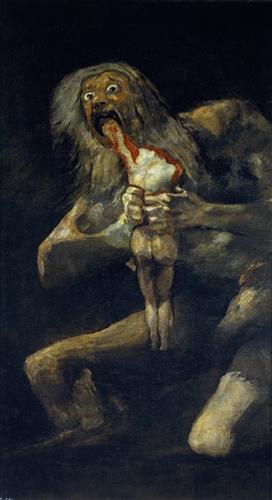
The (mythic) Titan Saturn devouring his son, painting by Francisco Goya, 1823.
There are many hypotheses for the
psychological reasons behind the boom in zombie media, which has now
been going on for over a decade. One is that zombies are some kind of
metaphor for hi-technology, that—like drones or robots or computer
viruses or smart phones—they “only do what they are programmed to
do.” This hypothesis may be partially correct, but the zombie's
tapping into our primal fear of becoming prey must be a factor as
well. Several of the other standard horror tropes, such as vampires
and werewolves, are also known for their consumption of human flesh
and blood. Some of the most memorable old horror movies (such as
Curse of the Demon and
Cat People, both directed by Jacques Tourneur) feature a
protagonist being stalked as prey by a fanged beast. Some of
Lovecraft's own stories feature cannibalism, such as the short but
terrifying “The Picture in the House,” which I sometimes read
aloud on Halloween or at campfires, to rattle the bones of friends.
The monsters we draw have canines and
jagged carnassials—the teeth of predators. For much of America's history, without a modern understanding of ecology, Euroamericans saw herbivores as good and carnivores as bad--and so sought to exterminate the latter. And the image of the benevolent herbivore and villainous carnivore still lurks somewhere deep within our imaginations. In an old Jesse Marsh
Tarzan comic book, a group of Iguanadons surround the ape-man to protect him from a Tyrannosaur. Somehow, I think that
if a real person found himself surrounded by Iguanadons, they would
have a "fight or flight" reaction, just like today's wild animals. They would either see him as a threat and kill him, or maybe run away if he was lucky.
Marsh, sometime in the 1950s.
Alternatively, to make herbivores look
scary, cartoonists sometimes give them the teeth of carnivores. In
his narrative
“The Bugling Elk” about the mighty battles of bull
elk during the fall rut, Ernest Thompson Seton drew a caricature of
an angry elk, as such:
Becoming prey was likely a more
frequent cause of death to people in paleolithic times, when there
weren't cars to hide in or guns to hide behind. There was also the
persistent danger of
falling prey to another human.
From my work as a Park Ranger at
Yellowstone, I have regularly experienced the disproportionate fear
which people hold towards carnivores. Bears are the objects of fear
to many of the travelers who look to me for orientation and advice.
There is good reason to be cautious, and to watch the bruins from a
long distance away. Bears can hunt people, but rarely ever do. The
opportunistic omnivores are more commonly seen chowing on berries and
roots and insects and carrion, or hunting elk calves by the lake.
When bears do attack people, it is a defensive maneuver,
in 99.5% of cases. And in 70% of human fatalities caused by grizzly bears,
the attack is by a sow with cubs, whom she will protect at all costs.
Natural selection favored mother bears who will not only die for
their cubs, but also kill for them.
However, the same people who may refuse
to exit their cars in bear country (even in the safety of a large
group), walk right up to other dangerous animals with their cameras
and selfie-sticks in hand. Bison injure an average of
four personsper year at Yellowstone, while bears injure an average of one. Five
people have been thrown or gored by bison this year at Yellowstone,
and four out of the five had to be life-flighted out of the park.
Luckily, all survived. Across the Atlantic, in the wilds of Africa,
the deadliest large animal, in the opinion of many experts, is not the lion or even the crocodile. It is the
hippopotamus, an herbivore with a
fearsome desire to protect territory and young. Hippos kill 2,900 people per year in Africa, which is exponentially more than lions do.
(And apparently crocs don't have exact statistics.)
And yet, somehow, the war-hammer head
and horns of a bison don't invoke the same deep-seated fear as the
teeth and claws of a grizzly. Repeatedly, we underestimate the
herbivores, and think that animals who eat grass must not be
dangerous—even when the statistics say otherwise, even after we
have seen two bull bison on the plain laying into each other in the
contest for a cow's affection—they ram with heads and stab with
horns, parry and counter their opponent's attacks, with the agility
of lightweight boxers and the power of Mack trucks.
We reserve our greatest fear—and
awe—for the animals who threaten to displace us at the top of the
food chain. This sense of fear and awe has driven us to obliterate
carnivores—then try to restore them. An Animal Planet poll rated
the tiger as the “world's favorite animal.” On some polls, people
have rated wolves as the animal they most want to preserve—which is
a 180 from 100 years ago, when the wolf was perhaps the most vilified
animal on the planet, or at least in the Euroamerican world. Notably,
wolves at the Yellowstone region and most other places have never
hunted people. However, they can compete with human hunters for large
game, and may hunt livestock when their preferred wild foods are
scarce. Hence, they are our competitors for the top predator title.
This is likely one of the reasons why many cattle ranchers opposed
the reintroduction of wolves to Yellowstone, and some still oppose it
today, despite the many forms of compensation the government gives
for the rare livestock fallen to the canids. The anti-wolf ranchers are a
minority voice, but a vocal one. (And there are some pro-wolf
ranchers as well.)
In a world filled with dismal
environmental news, the story of wolf reintroduction to the
Yellowstone is one of victory and hope. So is the story of the return
of Yellowstone's bears to the wild, after decades of life as beggars
at the park's garbage dumps and roadsides. We can share the world
with carnivores, and revel in the fear and awe and humility they give
us. Provided that we watch cautiously from a long distance away.
Goya and Seton images in public domain. Other images copyrighted to respective creators and companies.