Based on sketchbook chronology, I’ve made an educated guess that the baby alligator is my first drawing of 2022. Indisputably, the dragonfly naiad (larva) hunting a tadpole is my last drawing of 2022. A voracious predator with a quick-thrusting extensible lower jaw, the naiad is a real-life xenomorph. As a young woman on my guided walk at my other job as an Everglades Ranger put it, “Nature is metal!”
Showing posts with label insect. Show all posts
Monday, January 2, 2023
Friday, July 27, 2018
The Black Widow
I have a black widow spider living just outside the back door of my residence in New Mexico. Two nights ago, I checked on the spider while returning from watering my garden. I noticed there was a second spider sharing the web—a tiny one. A male black widow! For the first time, I was seeing live a phenomenon that is featured in all the books about spiders. The male black widow puts everything on the line in hopes of mating with the female, who is twice his size and inclined to eat him. I watched their dance, with the male hovering in the web atop the female’s abdomen. I disturbed them by getting too close while attempting a photo, and sent the female scampering back to her protected corner behind the outdoor electrical outlet, where she can hide from outsized dangers such as me. Meanwhile, the male dropped like a stone, until being caught by his silken life line. He climbed up the thread, to continue his quest. All my photos of their love ritual were coming out blurry, so I gave up, and left them in peace.
The next night, I flipped on the light outside. The male spider was dead in the web. The circle of life. Only time will tell if he managed to seduce the female long enough before her hunger took over. We will see whether the female produces an egg sac.
A beetle flew into the web, perhaps drawn to the light. The black widow spider sprung into action, trussing up the insect in silk, her rear legs working rapidly to wrap the prey. The unfortunate beetle didn’t stand a chance. It received a quick death, as the spider’s bite paralyzed it then liquefied its insides. The fortunate spider consumed the nourishing innards-smoothie, and would live on, and might even make baby spiders. There was no way not to feel sorry for the beetle; all living things want desperately to stay alive—from microbes to ourselves. The circle of life in a beautiful, heartless world.
Friday, June 22, 2018
Wasp from my Nightmares
For another gouache experiment, I turned to the devil of the sky. Or, the creature that seemed that way to a younger me—the tarantula hawk, the largest and most powerful of the parasitoid wasps. Other species of parasitoid wasps target cicadas, caterpillars, and ladybugs. The tarantula hawk goes after a large spider that eats mice and small snakes. Despite being much larger than the wasp, the spider is outgunned. After the wasp paralyzes the tarantula with a sting, it’s larva eats the spider slowly, while it is still alive.
As a child, I loved spiders and kept a pet tarantula. In the picture books about spiders which I read and re-read, I skipped over the part about the tarantula hawk, after reading it once and being horrified.
I suppose that the prolonged torture of a living tarantula to nurture a newborn wasp is part of nature and therefore we must accept it? Charles Darwin saw parasitoid wasps as evidence that the universe was not created by an omnipotent and loving god.
Tarantula hawks are common in the desert where I work, and I’ll acknowledge that their blue-black iridescence can be quite pretty. Virginia’s state insect is the eastern tiger swallowtail. Pennsylvania’s state insect is the firefly. New Mexico’s state insect is the tarantula hawk.
As a child, I loved spiders and kept a pet tarantula. In the picture books about spiders which I read and re-read, I skipped over the part about the tarantula hawk, after reading it once and being horrified.
I suppose that the prolonged torture of a living tarantula to nurture a newborn wasp is part of nature and therefore we must accept it? Charles Darwin saw parasitoid wasps as evidence that the universe was not created by an omnipotent and loving god.
Tarantula hawks are common in the desert where I work, and I’ll acknowledge that their blue-black iridescence can be quite pretty. Virginia’s state insect is the eastern tiger swallowtail. Pennsylvania’s state insect is the firefly. New Mexico’s state insect is the tarantula hawk.
Thursday, February 22, 2018
Crickets of Carlsbad Cavern
I am sharing here the first post I made for the official Carlsbad Caverns National Park Facebook page:
Of three species of cave crickets found in Carlsbad Cavern, Ceuthophilus longipes is the most adapted to cave life. It has pale coloration, long slender legs and body, and long antennae. A second species, Ceuthophilus carlsbadensis, shows fewer adaptations, and spends more time in areas close to the Underground Lunchroom, where crumbs are abundant. The crickets also eat natural foods such as bat guano and plant debris washed in by floods. The Ceuthophilus carlsbadensis also likes to eat Ceuthophilus longipes! Ceuthophilus conicadus, the third species of cricket, is in between the other two in its level of cave adaptation. It is less common in Carlsbad Cavern, but abundant in the nearby Spider Cave.
NPS/Ross Studlar
#CarlsbadCaverns #NationalPark #FindYourPark #EncuentraTuParque #NPS101
I wrote and drew this specific post about cave crickets on work time for the U.S. government (mostly), therefore it is in the public domain.
Of three species of cave crickets found in Carlsbad Cavern, Ceuthophilus longipes is the most adapted to cave life. It has pale coloration, long slender legs and body, and long antennae. A second species, Ceuthophilus carlsbadensis, shows fewer adaptations, and spends more time in areas close to the Underground Lunchroom, where crumbs are abundant. The crickets also eat natural foods such as bat guano and plant debris washed in by floods. The Ceuthophilus carlsbadensis also likes to eat Ceuthophilus longipes! Ceuthophilus conicadus, the third species of cricket, is in between the other two in its level of cave adaptation. It is less common in Carlsbad Cavern, but abundant in the nearby Spider Cave.
NPS/Ross Studlar
#CarlsbadCaverns #NationalPark #FindYourPark #EncuentraTuParque #NPS101
I wrote and drew this specific post about cave crickets on work time for the U.S. government (mostly), therefore it is in the public domain.
Saturday, January 14, 2017
The Girl Power of Mothra
Footnotes
1. Lees, J. D. and Marc Cesani (1998). The Official Godzilla Compendium. pp. 137. ISBN 0-679-88822-5
2. Kalat, David (2010). A Critical History and Filmography of Toho's Godzilla Series (2nd ed.). Jefferson, N.C.: McFarland & Co. pp. 184–90. ISBN 978-0-7864-47-49-7
Mothra is trademarked to Toho Studios.
Labels:
fantasy,
film,
Godzilla,
insect,
Kaiju,
monster movies,
monsters,
Mothra,
science fiction
Friday, December 18, 2015
Dawn of the Bats
My logo will appear on the park's Facebook page, as well as fliers and advertisements for the special event. I wish good luck to the bats, rangers, and visitors at Carlsbad Caverns!
I produced the logo as an outside illustrator, not as a park employee, so the image is copyrighted to me and the park has permission to use it.
Wednesday, August 20, 2014
Bats Over the Water
When first I encountered a bat up
close—close enough to touch—I rapidly sketched the critter, and
wrote beside it “I am amazed by the live bat, how fuzzy its body,
how delicate its fingers, and stretched between them—that's real
skin! No photograph can capture it, nor can the sketchbook.”
The event was our first bat survey
night of the summer season at Timpanogos Cave National Monument,
sometime back in June. The Natural Resources staff run the operation,
to discover what bats inhabit the canyon and forest. The method: find a
quiet spot on the American Fork river somewhere in the National Forest land, and stretch a net across. Wait
for the bats to swoop in for a sip of water and get caught in the
net; handle with gloves; identify the species, gender, etc; weigh the
animal, photograph it, record its echolocation call; then release the
furry flyer. Not having had my vaccinations, I just watch (and draw
and photograph, as I can.)
I have been to three more bat nights
since; all have provided an opportunity to listen to the river and
watch the moonlight draw patterns in the ripples, under the canopy of
silhouetted trees and rockfaces. As for the bats themselves, the
level of activity has varied. On some nights, only a few get tangled
in the artificial spiderweb. On the second bat night of the summer,
we had a bonanza.
We most often catch the small bats of the genus Myotis (We can generically call this group “little
brown bats.”) These streamed in on that special night in June, but
so did one hoary bat—a larger and feistier type—followed by another and another. These
fellows don't take kindly to being grabbed, and bite and flail, captives to no one, not even the pale-skinned Kaiju. For
hoary bats, two pairs of gloves are recommended.
Up close, bats provoke incredulity: so
like us, as mammals, and yet so alien—with small size, skin and
veins stretched like a latex glove across wings and tail, and a
different sensory world by flight and echolocation. What goes on in
their little minds is hard to fathom, and that such animals can exist
can be hard to believe. We might seem just as strange to them, were
they not caught up in the struggle to escape our clutches at bat night.
Let us hope that they can continue to awe us, and escape the wrath of
White Nose Syndrome.
Back at the studio, I made tribute to
the winged mammals on scratchboard. I chose the Townsend's big-eared bat, which we see sleeping or flying about in Hansen Cave (part of
the Timpanogos Cave system) from time to time. I intend to create
more stories on bats, in words and pictures. I'll make the time
somehow.
Third picture (Hoary Bat) by National Park Service, public domain.
Wednesday, July 17, 2013
A Revival for Insects
As I write these words, rain falls in a
steady drizzle, across the expansive and flat landscape of the Chihuahuan desert. I'm glad to be inside this old stone house, with
a cup of hot tea, listening to the persistent tapping and gushing.
The desert needs rain. We have not had enough of it in recent years.
Cacti and ocotillo and agave have extraordinary abilities to sustain
themselves on low water, but even they will eventually meet their
limits. And the drought is the most likely explanation why our
numbers of bats have been lower than previously years. Carlsbad
Caverns is famous for the Brazilian free-tailed bats that rise from
the cave in a giant thunderhead, composed of hundreds of thousands of
individuals. Bat flights this year have featured only a thin, steady
stream of the flying mammals. The bats feast upon flying insects,
mostly moths and beetles. In a drought-stricken landscape, there are
fewer insects, which prompts bats to go elsewhere.
Even with the drought, some rugged
insects persist. I am familiar with this desert's diversity of ants,
as both the large and red and the tiny and black varieties scamper
through my dwelling, and leave no tiny crumb of foodstuff or minute leg of cricket uneaten. And there are the cicadas whose song fills the
air on the mid-morning hike to Slaughter Canyon cave. The desert is a fearsome,
eat-or-be-eaten world, and so many invertebrates are armed, with
stingers, fangs, or chemical defenses. On my night walks, I have
encountered tarantulas (see previous entry), scorpions, centipedes,
and millipedes. By night and by day, wasps and tarantula hawks buzz
past.
It will take more than today's rainfall
for the desert to recover from drought, but it is a beginning. We
must bring a stop to anthropogenic climate change, for it is the
cause of much of our recent spate of planetary extreme weather. In
the meantime, as a tribute to the insects, I am sharing a few drawings (above and below.)
These hornets were inspired by a nest which a friend and I found on a hike
in the forests of Oregon. But they are equally fitting to the
desert, and its panoply of insects who bite and sting for defense.
Labels:
Carlsbad Caverns,
desert,
hornet,
insect,
National Parks,
New Mexico,
wasp
Sunday, December 23, 2012
A colorful take on art and nature
There is an alliance between The Center for Cartoon Studies and The Montshire Museum of Science, which is almost as old as the former. I should know, for I was part of the first-ever class at CCS; and so, I was part of many first-evers, including the first-ever CCS field trip to the Montshire. We came equipped with sketchbooks and pencils and brushpens and charcoal; we departed with sketchbooks full of amazing rare things, the preserved moose and the preserved insects being among the most popular subjects to draw. Upon return to base, our task, or “drawing challenge” was to depict a story about a miniature figure among the specimens. I wove a semi-autobiographical narrative around the dead bugs. The result, “Insecticide” is one of my best works from my prolific two years at CCS:
Recently, I revisited my alma mater, and also returned to the halls of the Montshire. Of course, I carried a sketchbook. And a new brush. I'll share a few sketches:
Since my graduation, CCS has moved
onward and upward in so many respects—including collaboration with
the Montshire. The people of these two institutions have taken it to
the next level, with a new exhibit (on display at the Montshire
through February 3, 2013): Cartoonists' take on Charley Harper. It
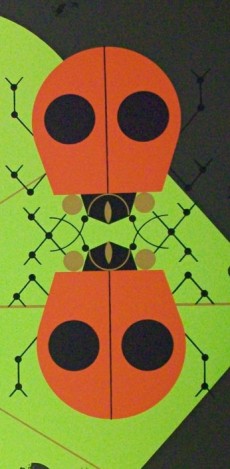
provides a unique compliment to the traveling exhibit Beguiled by the Wild: the Art of Charley Harper. Harper was a famed nature artist,
best known for his seriagraph (silk-screen) prints of wildlife, in a
style he called "minimal realism." He made art for many
nature organizations, including the Cincinnati Zoo, Hawk Mountain
Sanctuary, and the National Park Service. On a trip with the Denison
outing club (pre-CCS), I saw a poster by Harper on sale, probably at
the visitor center of Bandelier National Monument. I knew that I had
to take it home, and adorn the ceiling of my cabin at The Homestead.
I didn't yet know Harper by name, but I recognized his remarkable
compositions of wild animals, distilled to their essence.
And so, in the Montshire, with a set of Harper prints at
one end of the room, the other is adorned by work by CCS students, taking inspiration from Harper and from nature. (Evidently,
I don't have a trademark on “Comics from the Wood.”) The colors
are vibrant; and while Harper was a master of telling a story with a
single image, the intrepid cartoonists apply minimal realism to a
stories composed of multiple images in sequence. The results are
charming, and well worth taking home, in the form of the comic book
collection of the CCS work, which can be found at the Museum shop.
And I can recall all this positive
detail about the exhibits, despite having lost my wallet on the trip
back. Subsequently, I have been pressed to replace all my essential
cards and Ids. Simultaneously, I have worked to prepare for
Christmas with family, in my old home in West Virginia. It is a way
of starting afresh, but with the weight of what has been and what's
to come. I have much to do, to re-evaluate my life and path, and the
pursue new challenges. I hope that I can take a hint from The Center
for Cartoon Studies, and rise to new frontiers.
Happy Holidays and Merry Christmas!
The two color images are by Charley Harper, the former for the National Park Service, public domain;
the latter is being used online to promote the traveling "Beguiled" exhibit.
Thursday, October 25, 2012
Hornet Woman and Scarier Things
With Halloween at the near, I ought to share something spooky.
On a recent hike along the Rogue River
beginning near Union Creek, my comrade Lesley—who has the eyes of
an owl—chanced upon an abandoned hornet's nest, on the ground,
having fallen from a tree, and now withering away. Instantly, I
noted that it looked like the face of a monster, or zombie perhaps.
And Lesley expressed a desire to see my depiction of said creature.
After a few sketchbook attempts at beasts with the layered carapace
of the hornet's nest, I came upon “Hornet Woman."
I am considering making her the subject
of a comic book. She has potential.
All autumn at Crater Lake, I guided
children on school field trips through a forest of hemlock trees
and—yellow jackets. In the warm autumn, the stinging insects were
prevalent. On cold days, they slowed to a torpor. For many insects,
weather has a direct impact on behavior, including activity and
breeding. In our modern era of global warming, we have increased
populations of mosquitoes and the diseases they carry. And the
whitebark pines featured in my previous post are getting devoured by
mountain pine beetles, who are in a population boom, thanks to
climate change.
While bees and wasps are rather
non-agressive, and not to be feared, they may be an indicator of
something truly ominous.
I hope that we come together against global warming, before it's too late.
Labels:
bee,
climate change,
Crater Lake,
global warming,
hornet,
insect,
wasp,
yellow jacket
Subscribe to:
Posts (Atom)