Showing posts with label bats. Show all posts

Friday, December 18, 2015

Dawn of the Bats


I created this logo for Carlsbad Caverns National Park to promote their Dawn of the Bats special event! Millions of people have seen the spectacular out-flight of Brazilian free-tailed bats from the cavern's natural entrance in the evening. Much fewer have seen the awe-inspiring IN-FLIGHT, which takes place near the break of dawn. With a belly full of moths and beetles from the night's hunt, each bat, individually, rises high above the natural entrance, tucks her wings in and dives into the void at high speed. A loud cascade of VWOOSH sounds accompanies the dives--even a tiny animal can make a big noise if she swoops fast enough. Inside the cave, each mother bat will use sound, smell, and touch to locate her own pup and nurse him, converting the tasty insects into nutritious milk for the baby. The adult male bats, having only themselves to sustain, will probably get more sleep for the day. The next night, the adult bats will fly out again, while the babies stay clinging to the ceiling together in the "nursery" and peep back and forth, perhaps dreaming of the outside world which they have not yet come to know.

My logo will appear on the park's Facebook page, as well as fliers and advertisements for the special event. I wish good luck to the bats, rangers, and visitors at Carlsbad Caverns!

I produced the logo as an outside illustrator, not as a park employee, so the image is copyrighted to me and the park has permission to use it.

Tuesday, April 28, 2015

CAVE Exodus, the freeing of a trapped Spider


It has been a trying winter at Carlsbad Caverns. We recently had a collective going away party for the last five seasonal rangers to go off to their new parks and new adventures. They asked us each to give an informal exit speech. Reluctantly, after urging from my peers, I stepped to the “podium.” A slightly-edited version of what I said:

“As you all know, my childhood hero was Spider-Man. I wanted to be Spider-Man: to scale sheer walls, to swing from webs, catapult myself from a web-slingshot, and kick-out villains with both feet. It never quite happened.

But when I arrived for work at Carlsbad Caverns for the first time in May 2013, I learned that my proving ground would be Spider Cave. I was nervous. I had been on one wild cave tour before, when I was twelve. That was long ago. Had I become claustrophobic? There was only one way to find out.

I emerged from Spider Cave covered in red dirt, having belly-crawled through the narrow passageways, with the red crusts of corrosion residue all over the walls, the ghostly calcite formations—the gnome and the Medusa room and the pirate ship. I emerged victorious—I had survived Spider Cave. Therefore, I must be a Spider-Man!


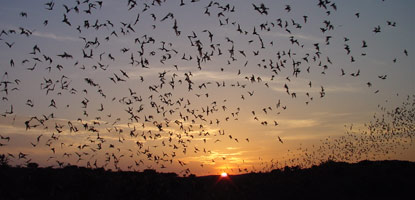
Later that summer, I delivered my first bat flight program, at the amphitheater overlooking the natural entrance to Carlsbad Cavern. I spoke of the Batman symbol and Native American stories of bats as heroes, and the heroic feats that real bats perform, such as keeping insect populations under control. And the bats emerged, the counterclockwise spiral cloud, which has graced our landscape in summer evenings for many millennia. The people watched in awed silence as the bats filled the purple sky. They flapped and whizzed around me, inches from my nose and 500 feet overhead. And so I was Batman.

At what other job do you get to be BOTH Spider-Man and Batman?


My favorite Spider-Man story was “If This Be My Destiny....!”, from the original 1960s run, by Steve Ditko and Stan Lee. This tale remains a classic, an influence and inspiration to generations of cartoonists and readers. After a battle with Doctor Octopus, Spidey has recovered a rare isotope needed to cure Aunt May from a deadly disease. But unfortunately, Spidey is pinned to the ground by a block of fallen machinery the size of a building. Cold water drips on his head and soaks his body. At first, he remembers his failures and gives up, and prepares to die alone under the crushing weight. Then he thinks of his family and all the people who need him, especially Aunt May. He musters the strength and will to lift the machine. You can feel the force and the power, as trembling with agony, he rises to his feet, hoists the titanic hunk of metal and casts it backward.

It reminds me of this winter season at Carlsbad Caverns. We went through 'breaking bat' and 'sewergate' and the rest. We faced broken water lines and broken sewers, and walked on iced-over pathways through winter gusts to reach the port-o-potties. We filled jugs with water in White City, and filled buckets from the trickle off the rooftops. We took hell from the powers that be over minutia and things not our fault. And, by strength of this family, this community, we still lifted the machine. We kept Carlsbad Caverns a world-class National Park. A pristine cave and home for bats, and an unforgettable experience for the people who visit. This victory is collective.


Whenever Tales of the Uncanny from About Comics comes out, look for a parody of the lifting scene, written and drawn by yours truly!

Batflight photo by NPS, public domain. 
ASM #33 cover by Steve Ditko, copyrighted to Marvel, used here for educational purposes only.

Wednesday, August 20, 2014

Bats Over the Water


When first I encountered a bat up close—close enough to touch—I rapidly sketched the critter, and wrote beside it “I am amazed by the live bat, how fuzzy its body, how delicate its fingers, and stretched between them—that's real skin! No photograph can capture it, nor can the sketchbook.”


The event was our first bat survey night of the summer season at Timpanogos Cave National Monument, sometime back in June. The Natural Resources staff run the operation, to discover what bats inhabit the canyon and forest. The method: find a quiet spot on the American Fork river somewhere in the National Forest land, and stretch a net across. Wait for the bats to swoop in for a sip of water and get caught in the net; handle with gloves; identify the species, gender, etc; weigh the animal, photograph it, record its echolocation call; then release the furry flyer. Not having had my vaccinations, I just watch (and draw and photograph, as I can.)


I have been to three more bat nights since; all have provided an opportunity to listen to the river and watch the moonlight draw patterns in the ripples, under the canopy of silhouetted trees and rockfaces. As for the bats themselves, the level of activity has varied. On some nights, only a few get tangled in the artificial spiderweb. On the second bat night of the summer, we had a bonanza.

We most often catch the small bats of the genus Myotis (We can generically call this group “little brown bats.”) These streamed in on that special night in June, but so did one hoary bat—a larger and feistier type—followed by another and another. These fellows don't take kindly to being grabbed, and bite and flail, captives to no one, not even the pale-skinned Kaiju. For hoary bats, two pairs of gloves are recommended.


Up close, bats provoke incredulity: so like us, as mammals, and yet so alien—with small size, skin and veins stretched like a latex glove across wings and tail, and a different sensory world by flight and echolocation. What goes on in their little minds is hard to fathom, and that such animals can exist can be hard to believe. We might seem just as strange to them, were they not caught up in the struggle to escape our clutches at bat night. Let us hope that they can continue to awe us, and escape the wrath of White Nose Syndrome.

Back at the studio, I made tribute to the winged mammals on scratchboard. I chose the Townsend's big-eared bat, which we see sleeping or flying about in Hansen Cave (part of the Timpanogos Cave system) from time to time. I intend to create more stories on bats, in words and pictures. I'll make the time somehow.


Third picture (Hoary Bat) by National Park Service, public domain.

Tuesday, August 27, 2013

Facing the Scorpion


In the darkness, a pallid bat hears the sound of crawling legs.  The bat swoops in to face dangerous prey. The scorpion does not yield easily, and stings repeatedly, even after being snatched in the bat's jaws. Unaffected by the stings, the bat enjoys a hearty meal. It remains mysterious how this small mammal can be immune to the scorpion's potent venom. Pallid bats inhabit much of the western United States, including Carlsbad Caverns National Park.


Friday, August 9, 2013

First Contact in Ancient New Mexico


In recent travels with my parents, I experienced more of the great state of New Mexico—the state which looks and feels like the set of a science fiction movie. I'll have more to say about the otherworldly frontiers of the land of enchantment soon. For now, I'll share a piece of my own science fiction art, inspired by New Mexican artifacts.

At Three Rivers Petroglyph Site, near to Alamogordo, the rocky hills are docrated with more than 21,000 glyphs, chiseled into stone by the Jornada Mogollon people, between 600 and 1100 years ago. The images feature birds, insects, mammals, humans, circular symbols, abstract geometric patterns, and animals with geometric patterns on their bodies. A trail winds through the gallery of stones, and gives us a rare and up close view of the mysterious artwork. So many centuries hence, it is hard to know the meanings of images—archeologists and others can make but educated guesses.


We observed a bug-eyed creature, etched in the stone. We speculated that it was a record of humankind's first contact with aliens, centuries before the Roswell incident. I imagined what such an event might look like, and recorded this dream in my sketchbook.


UPDATE on previous post: After the rainstorm, the mighty thunderhead of bats rose from the cave. Evidently, the rains brought out more insects, and brought more bats from other regions for a stay over in our bat cave, just as the inns in Portland become crowded with travellers when a convention on local organic food takes place. Unfortunately for us, the additional bats didn't stay at our cave for long, and we have returned to a small but captivating nightly exodus of bats.


CURRENT EXHIBITION: On August 10 and 11, I am exhibiting at Portland Zine Symposium (Oregon), alongside fellow artist Lesley McClintock! I shall exhibit and sell my comic books Frog Stories, The Raven and the Crayfish, and others, as well as posters (Thunderbird!) Lesley shall offer prints, illustrations, and paintings, taking inspiration from Crater Lake and the forests of the Pacific Northwest. It shall also be great to see my comrades Chris Seigel and Nolan Calisch of Wealth Underground Farm!

Topmost photo by © Susan Moyle Studlar

Wednesday, June 26, 2013

Encounter with a Wild Tarantula


By evening at Carlsbad Caverns, people gather about the outdoor amphitheater before the cave's natural entrance, to witness the nightly mass exodus of Brazilian free-tailed bats. When conditions are right, a spiraling funnel cloud containing hundreds of thousands of bats emerges from out of the cave, and rises high into the purple and orange sunset sky. I have not yet witnessed the “bat tornado” in its full glory; bat flights this year have, thus far, been on a smaller scale; some have included a thin but steady stream of the flying mammals. (We do not know the reason for the smaller number of bats, but drought could be a factor.)

At the outdoor amphitheater, some people (especially children) are often distracted by another denizen of the desert. A brown hairy beast, gigantic—for a spider. Tarantulas commonly pass through the theater, or stop for a rest from their evening prowl. Male tarantulas are especially common, as they make their walkabout in search of a mate. Their partnership will be brief. After mating, the male must flee from the hungry female.

I have, a few times, joined the tourists and pointed my camera at the great spiders. I followed one for a good walk, in search of a better photo. And then I found myself, and the tarantula, right outside the door of the men's restroom. I thought this a potentially dangerous spot for the arachnid. A man's boot might squash the poor beast, accidentally or on purpose. And so I pondered how to relocate the spider. When I was ten years old, I acquired a Chilean rose tarantula, whom I named Espigah, for a pet. I sometimes “held her” by allowing her to crawl on my hand. Luckily, I decided not to attempt the same technique in this setting. Instead, I tried sliding my boot next to the tarantula, to encourage him to move. Evidently, the spider thought my intentions were hostile, and responded accordingly. He rose up, with several front pairs of legs in the air and fangs on display, the classic tarantula threat posture. I needed a different strategy. I thought that perhaps I could slide a newspaper under the spider and move him without causing disturbance. As I reached the newspaper towards the arachnid, he rose in threat again and struck the paper with his fangs. The bite sent vibrations through the pages to my hand, a safe distance away. I decided to leave the spider be, to fend for himself should the need arise. Perhaps I had discovered a difference between wild and domestic tarantulas. This fellow seemed to be more inclined to defensive reaction than my pet tarantula was. (Although Espigah did once throw a cloud of urticating hairs in response to a girl's scream.)

Understandably, I had started the confrontation, as far as the spider was concerned. These hairy beasts are quite harmless, when left unmolested. (And even if they are provoked to bite, the venom has no serious effects, for most people.) They are a joy to observe, in the desert wanderings, with their smooth coordination of all eight legs, which suggests a slow jazz rhythm.

Like all animals, tarantulas must eat. From time to time, their fangs sink into beetles or crickets or small lizards. In the right circumstances, small mammals are also fair prey. And so I have drawn a tribute to the big spiders, with their skill at predation. On the sand and rocks, in the cool desert night, beneath the light of full moon, the tarantulas thrive. Like the cacti and the bats, the ring tails and the roadrunners, they are an essential part of the desert.