Showing posts with label Carlsbad Caverns. Show all posts

Thursday, February 22, 2018

Crickets of Carlsbad Cavern

I am sharing here the first post I made for the official Carlsbad Caverns National Park Facebook page:


Of three species of cave crickets found in Carlsbad Cavern, Ceuthophilus longipes is the most adapted to cave life. It has pale coloration, long slender legs and body, and long antennae. A second species, Ceuthophilus carlsbadensis, shows fewer adaptations, and spends more time in areas close to the Underground Lunchroom, where crumbs are abundant. The crickets also eat natural foods such as bat guano and plant debris washed in by floods. The Ceuthophilus carlsbadensis also likes to eat Ceuthophilus longipes! Ceuthophilus conicadus, the third species of cricket, is in between the other two in its level of cave adaptation. It is less common in Carlsbad Cavern, but abundant in the nearby Spider Cave.

NPS/Ross Studlar


#CarlsbadCaverns #NationalPark #FindYourPark #EncuentraTuParque #NPS101


I wrote and drew this specific post about cave crickets on work time for the U.S. government (mostly), therefore it is in the public domain.

Friday, December 18, 2015

Dawn of the Bats


I created this logo for Carlsbad Caverns National Park to promote their Dawn of the Bats special event! Millions of people have seen the spectacular out-flight of Brazilian free-tailed bats from the cavern's natural entrance in the evening. Much fewer have seen the awe-inspiring IN-FLIGHT, which takes place near the break of dawn. With a belly full of moths and beetles from the night's hunt, each bat, individually, rises high above the natural entrance, tucks her wings in and dives into the void at high speed. A loud cascade of VWOOSH sounds accompanies the dives--even a tiny animal can make a big noise if she swoops fast enough. Inside the cave, each mother bat will use sound, smell, and touch to locate her own pup and nurse him, converting the tasty insects into nutritious milk for the baby. The adult male bats, having only themselves to sustain, will probably get more sleep for the day. The next night, the adult bats will fly out again, while the babies stay clinging to the ceiling together in the "nursery" and peep back and forth, perhaps dreaming of the outside world which they have not yet come to know.

My logo will appear on the park's Facebook page, as well as fliers and advertisements for the special event. I wish good luck to the bats, rangers, and visitors at Carlsbad Caverns!

I produced the logo as an outside illustrator, not as a park employee, so the image is copyrighted to me and the park has permission to use it.

Tuesday, April 28, 2015

CAVE Exodus, the freeing of a trapped Spider


It has been a trying winter at Carlsbad Caverns. We recently had a collective going away party for the last five seasonal rangers to go off to their new parks and new adventures. They asked us each to give an informal exit speech. Reluctantly, after urging from my peers, I stepped to the “podium.” A slightly-edited version of what I said:

“As you all know, my childhood hero was Spider-Man. I wanted to be Spider-Man: to scale sheer walls, to swing from webs, catapult myself from a web-slingshot, and kick-out villains with both feet. It never quite happened.

But when I arrived for work at Carlsbad Caverns for the first time in May 2013, I learned that my proving ground would be Spider Cave. I was nervous. I had been on one wild cave tour before, when I was twelve. That was long ago. Had I become claustrophobic? There was only one way to find out.

I emerged from Spider Cave covered in red dirt, having belly-crawled through the narrow passageways, with the red crusts of corrosion residue all over the walls, the ghostly calcite formations—the gnome and the Medusa room and the pirate ship. I emerged victorious—I had survived Spider Cave. Therefore, I must be a Spider-Man!


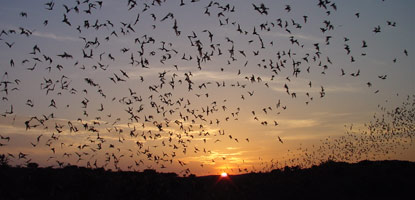
Later that summer, I delivered my first bat flight program, at the amphitheater overlooking the natural entrance to Carlsbad Cavern. I spoke of the Batman symbol and Native American stories of bats as heroes, and the heroic feats that real bats perform, such as keeping insect populations under control. And the bats emerged, the counterclockwise spiral cloud, which has graced our landscape in summer evenings for many millennia. The people watched in awed silence as the bats filled the purple sky. They flapped and whizzed around me, inches from my nose and 500 feet overhead. And so I was Batman.

At what other job do you get to be BOTH Spider-Man and Batman?


My favorite Spider-Man story was “If This Be My Destiny....!”, from the original 1960s run, by Steve Ditko and Stan Lee. This tale remains a classic, an influence and inspiration to generations of cartoonists and readers. After a battle with Doctor Octopus, Spidey has recovered a rare isotope needed to cure Aunt May from a deadly disease. But unfortunately, Spidey is pinned to the ground by a block of fallen machinery the size of a building. Cold water drips on his head and soaks his body. At first, he remembers his failures and gives up, and prepares to die alone under the crushing weight. Then he thinks of his family and all the people who need him, especially Aunt May. He musters the strength and will to lift the machine. You can feel the force and the power, as trembling with agony, he rises to his feet, hoists the titanic hunk of metal and casts it backward.

It reminds me of this winter season at Carlsbad Caverns. We went through 'breaking bat' and 'sewergate' and the rest. We faced broken water lines and broken sewers, and walked on iced-over pathways through winter gusts to reach the port-o-potties. We filled jugs with water in White City, and filled buckets from the trickle off the rooftops. We took hell from the powers that be over minutia and things not our fault. And, by strength of this family, this community, we still lifted the machine. We kept Carlsbad Caverns a world-class National Park. A pristine cave and home for bats, and an unforgettable experience for the people who visit. This victory is collective.


Whenever Tales of the Uncanny from About Comics comes out, look for a parody of the lifting scene, written and drawn by yours truly!

Batflight photo by NPS, public domain. 
ASM #33 cover by Steve Ditko, copyrighted to Marvel, used here for educational purposes only.

Wednesday, December 31, 2014

Rock of Ages


I wrote most of this on Dec 17th, 2014:

I shared this photo with some family and friends, accompanied by the following email:
“We took this photo at the dress rehearsal of the Rock of Ages historic lantern tour. My fellow Rangers and I portray various key people from the history of Carlsbad Caverns. I portray Ray V. Davis, photographer. His pictures were instrumental in drawing attention to Carlsbad Caverns, from both the public and government officials, leading to its protection as a National Monument in 1923. (It became a National Park in 1930.) I may temporarily lose the facial hair for the final performance, to look more period-authentic. Yes, that is a real period-authentic camera that I carry, from the days when exposures were 14-28 minutes, and you needed to illuminate the cave with a brilliant flame--Davis invented a pyrotechnic device for this purpose, wherein he blew through tubes to feed magnesium powder into the flashpan torch. I have a mock-up of that too, but can't use it, since it wouldn't pass OSHA."

Now, Rock of Ages is over. It was a collective victory. I am exhausted.

Along this lantern-lit tour, the historic figures positioned themselves at various points along the trail. Upon arriving at each point, the lighting technicians showed their spotlights upon the character, who presented their sketch, to illustrate their importance in caverns history, and connect it to the tour's broader themes--this one focused especially on preservation. Each historic person then joined the tour--in character. I shared my stop with Ranger Jeff, who portrayed Dr. Willis T. Lee (fourth from left in middle row)--the first geologist to make study of Carlsbad Cavern. And he wrote articles for National Geographic about the great cave experience. These were illustrated with photos by both Davis and Lee, after Davis taught Lee how to tackle the challenge of cave photography. At our stop, we each promoted ourselves and the cave. Jeff portrayed Lee as an egotistic and condescending Scientist; my version of Davis was an enthusiastic southern business man, skilled at customer service, but ready to hold his ground. (And I quoted Davis directly as much as possible in my dialog, drawing upon the various articles and interviews he left behind.) The back-and-forth banter and bickering between us reminded me a bit of the interactions of the twin protagonists of Dual Survival. In any case, this artist-playing-an-artist could hold his own in the flyting. I also involved the audience by posing them for a group photo with the antique camera. I received laughs when I explained that it's a 28-minute exposure. I took out and explained the pyrotechnic device, and lit a match--but was interrupted by Lee before I could start the blaze! Some members of the audience gasped, thinking I really was going to fire it up.


Both performances sold out. Our audience included some of the public, and MANY members of the broader CAVE community, employees and volunteers and their friends and families. A few members of the audience had the thrill of seeing themselves portrayed as Rock of Ages characters! Notably, Pat Joblansky (played by Ranger Ellen, far right end of photo) was a key player in this historic tour. Pat is a volunteer who conducted scientific research on the damage which lint does to caves, and undertook steps to mitigate the problem. She has led an annual volunteer lint removal camp for many years, wherein they use brushes and forceps to rid the speleothems of the offending debris. She put forth a proposal that the park service construct walls around the trails to contain the lint (after her research demonstrated the efficacy of this method), which they implemented. When the real Pat Joblansky saw Ellen's rendition of her and her work, she was moved to tears.

Pat retires this year. Her work was the inspiration for the preservation theme of this year's Rock of Ages tour. By a fortunate coincidence, 2014 marks the 50th anniversary of the Wilderness Act; and so we subtitled our tour "Preserving an Underground Wilderness."

The tour culminated with a black out by column known as the Rock of Ages, accompanied by the singing of the traditional Christian hymn of the same title. Then, from out of complete blackness, the Big Room is re-illuminated a section at a time, with our loyal light technicians scurrying from one switch to the next. This is a historic reenactment of the ceremony which used to conclude all guided cave tours of the Big Room from 1928 to 1944. Eventually, the Secretary of the Interior ordered the caverns staff to stop the Rock of Ages ceremony, claiming that it was unprofessional. Maybe so, but it was also a moving and emotive moment for many visitors (and rangers!) Therefore it is unsurprising that there have been many reenactments over the years; with the formalized historic lantern tour in December established as a new tradition since 2008.  

 For months, the caverns staff has prepared for Rock of Ages. Now that it's over, a weight is off our shoulders (to soon be replaced by other weights.) Along the way, I made sure that we experienced the other Rock of Ages--I coordinated it with our Thanksgiving for "orphans" back in November. We thumped to the raucous Def Leppard song and the greatest hits album of the same title while cooking parts of our Thanksgiving feast. And after Thanksgiving dinner, we gathered around a large flatscreen television with its theater-like sound system, and watched the 2012 Hollywood musical Rock of Ages. Some film critics and members of our CAVE team rather dislike this film, but I am indifferent to their claims. For me, the film pulls at my heart strings, while making me laugh, and relive the wonder and nostalgia of the 1980s "decade of rock." (Even though I did not become a serious rock listener until the 1990s, many of these same hits still rattled our boomboxes and televisions, much to the chagrin of our parents.)


I have always supported the personal freedom to draw and sing, and contended that whales and polar bears should have these freedoms too. Which is why you and I have cause for some holiday cheer--President Obama has used executive action to protect Bristol Bay in Alaska! Take a moment to celebrate--and then a thousand more battles await. We have wilderness and farm and sea to protect, realms above ground and below.

Topmost photo by Mannie Bemis, National Park Service.
Middle photo by Jeff Strang, National Park Service.
Rock of Ages movie poster copyrighted to New Line Cinema, low-resolution reproduction used here for educational purposes only. 

Tuesday, December 23, 2014

Sasquatch versus Condor!


Christmas in the land of deserts and caves! An odd prospect for this man of the eastern forests. The Carlsbad Caverns community has its own unique holiday traditions--importantly Rock of Ages--to be revealed in an upcoming post. We also have a Secret Santa gift exchange, which I planned not to participate in, being that I had so many other holiday engagements. Then fellow ranger Christina commissioned me to draw a Secret Santa gift for fellow ranger Lee, who is an avid fan of the Sasquatch (and less a fan of the California Condor.) This drawing was a hit among the CAVE people, and Christina has planned to cook something good for me as payment.

In the real world, Sasquatch and Condor peacefully ignore each other. IF the former is out there, which remains a matter of debate. I am told that he is often seen near Ruidoso, New Mexico, at the Mescalero Apache reservation and its environs. It is a place of Ponderosa Pine forests, and just might be right for a large bipedal ape....

Tuesday, December 31, 2013

The Year of the Cave


Inevitably, the year's end is a time of reflection. When I worked with my parents and brother on our old-fashioned family Christmas letter, I came to realize what an epochal year this has been, for all of us. Whether documenting and reporting rare bryophytes in the New River Gorge of West Virginia, teaching political science at a prestigious university in Scotland, or representing clients at bail hearings in Alaska—the Studlars have been busy. (Sue, Don, and Ross pictured above, Carl pictured below.)


My portion of the letter reads as follows:
“Ross has declared 2013 'the year of the cave,' although that moniker does not fully summarize the diverse events. His year began in West Virginia, and the highlights of the first few months were environmental activist events. He attended the Forward On Climate Rally in Washington, D.C., then gained unique new education at Mountain Justice Spring Break, a camp which drew student and professional activists from around the country to rural West Virginia, to study and protest mountaintop removal and fracking, in cooperation with local concerned citizens. It featured classroom trainings, tours of desecrated landscapes, and a march on the state capital. In the midst of the camp, Ross received a job offer on his cell phone—from Carlsbad Caverns National Park. Ross made the westward trek in his Subaru Outback, first to the Grand Canyon for a backpacking trip with a friend, then to Carlsbad, New Mexico. He served as a seasonal Park Ranger from May through October. He guided tours of the developed caverns, and led or acted as “caboose” for off-trail adventure caving tours. He navigated the winding maze of Spider Cave and the vertical climbs and tight squeezes of The Hall of the White Giant, and was relieved to discover that he is not particularly claustrophobic. He narrated evening bat flight programs, sharing science and mythology about bats, before the swirling cloud of winged mammals emerged from the cave's natural entrance. Ross made sure to visit nearby Roswell to rekindle childhood fascinations with UFOs. A few days before his expected layoff from Carlsbad Caverns, Ross managed to secure a winter Volunteer Ranger position at Wind Cave National Park, which is located in the black hills of South Dakota. On his road trips, Ross met the archeological marvels of the southwest, including multiple petroglyph sites, and the Great Houses of Chaco Culture National Historical Park; he also visited natural wonders like Delicate Arch and Cataract Canyon. Although Wind Cave's complex maze of underground passageways has its intrigue, Ross has been most enamored with the rolling prairies and pondersa pine forests found at the surface, and their wildlife—including bison, elk, pronghorns, coyotes, prairie dogs, and black-footed ferrets. Ross also made two trips to the Pacific Northwest, to attend the wedding of a friend from The Homestead, and to exhibit comics work at the Portland Zine Symposium.”

 
My activist endeavors, and the stinging interruption in work from the government shutdown, should serve as a reminder that there is much to be done to make the world better. This interview with Noam Chomsky gives us a good reminder of the uphill battle ahead, and that each of us CAN make a difference. In the face of environmental, economic, and humanitarian crises, we should remember the heroic life of Nelson Mandela, and strive to achieve a tiny percentage of similar courage.


But on a lighter front, I wish to reflect on my explorations of dark worlds, in the Year of the Cave. At Wind Cave, I will remember the winding tunnels and boxwork, which resembles ethereal spiderwebs. At Carlsbad Caverns, I will remember the spacious Guadalupe Room, with its pincushion ceiling of soda straws (thin stalactites.) To arrive there, we had to face the four challenges of Hall of the White Giant, then go beyond, down subterranean muddy slopes and boulder fields. I won't easily forget Slaughter Canyon Cave, where, upon emergence from the blackout, I led a crew of boy scouts to create a light show, by blinking our headlamps onto the Christmas Tree, a formation that looked and sparkled like its namesake. I keep a map of Spider Cave on my wall, the wondrous maze, with its calcite formations that seem to be made of marshmallows, and the dark red and gray pattern of crusts that grow on its walls, the excrement of strange bacteria. Caves are truly alien worlds, with life forms so strange that they—alongside deep ocean extremophiles—have forced science to revisit and expand its definition of life. And there are creatures quite related to us—the bats—who perceive the world so differently, via echolocation, that we cannot fully imagine what the world is like through their eyes. In 1974, philosophy professor Thomas Nagel asked “What is it like to be a bat?,” and his essay had an influence on the study of consciousness. I borrowed some of his ideas, and tried to blow minds on my tours of the King's Palace at Carlsbad Caverns.


As surface dwellers, our bodies don't know how to react to subterranea—we quickly lose orientation and sense of time; and, with extended stays, our circadian rythms go out of alignment. Long term cave explorers may keep awake and active for 24 hours or more, then take a long sleep.

Over time, people have found many symbolic meanings in caves, from the dragon's lair to the womb of Mother Earth. Carlsbad Caverns early explorer Jim White named the first several features he encountered after the devil. Later explorers named features after characters from Greek mythology, or the Lord of the Rings series. The Mescalero Apache tell a story about two disabled men who were lost in a cave, then visited by the mountain spirits who led them to light, and granted them new powers and new gifts. The Lakota tell a story of how the ancestors of their people , and the bison, were created underground, and born into the world via Wind Cave, the “breath of life hole.” As I journeyed through caves, I came to know that strange combination of security and fear, awe and apprehension, which cave explorers have known since ancient times.


And caves are truly a new frontier. Almost every square inch of earth's surface has been mapped, but many thousands of miles of cave still lie in darkness and await discovery. New and unimagined worlds await.

 Top two photos by ©Susan Moyle Studlar

Wednesday, November 20, 2013

Alone Before the Sun Dagger


“I left the caverns for as good a reason as I went there.” Well, not exactly. Being a Ranger for the National Park Service is a deeply rewarding line of work, but it is not quite the fantasy which most park visitors seem to think. Most people think that once admitted to the park service, one can stay for life, and live for free in America's wonderlands, with a fat federal salary and full benefits, and “get moved” from one National Park to the next by request. In fact, most park service jobs are seasonal, which means that the worker is laid off after two to six months. The pay is less than half that of a public school teacher in California, and there are no medical benefits, and no assistance with relocation. Park housing is often provided, but the ranger is charged rent; and the ranger must supply their own food. One seasonal job does not automatically lead to another; one must apply and compete with hundreds of other fully qualified individuals. And if seasonal jobs are impossibly competitive, permanent jobs are yet beyond. Permanent jobs for the National Park Service typically offer higher pay and more benefits, but remain specific to a single National Park Service site. To move to a different site, one must apply for a different position and re-enter the mass competition. Most field work in National Parks is conducted by seasonal staff. Permanent employees are more commonly found sitting at desks, much like their urban counterparts, albeit with a longer commute. (Over half of permanent National Park Service employees opt to live in town, where there are private homes, public schools, are other amenities.)

Hence, in a repeating cycle in my years of seasonal work, I anticipate the end of the term with a bit of fear and dread, but also a sense of opportunity. To be cast off alone again, to face unemployment and find new work. My last day at Carlsbad Caverns was November 2nd, and I knew not where I would go next, until October 31st. On which day I was “hired” as a Volunteer Park Ranger at Wind Cave National Park. With so few seasonal jobs in the winter, it is not uncommon for summer seasonal rangers to accept winter volunteer positions, even though the “rank” is lower. Some volunteer posts, including this one, offer a small stipend and free housing.

The offer for the volunteer post was a welcome relief, and a thrill at the chance of new adventures, in a new part of the country. South Dakota was barely on my map until now (although I do fondly remember visits to The Badlands and Mount Rushmore from my youth). Wind Cave was the first cave to become a National Park (in 1903, under Theodore Roosevelt and congress). It is one of America's longest caves, and is known for its unique “boxwork” formations. The park also boasts prairie and pondersa pine forests, and a herd of bison. I look forward to the setting, despite warnings about the winter weather.

NPS photo, public domain

Once again, I had to gather and organize and re-organize my chaotic mass of belongings, and pack them tightly, and play the jigsaw puzzle of the subaru. I pushed the vehicle to the limits of its spatial carrying capacity. I departed from the caverns later than planned, and was further delayed by the need to replace one of my vehicles headlights, for which I received crucial assistance from fellow ranger Jon, who also allowed me to sleep on his couch, because it was late and not the best time to launch a prolonged drive. He also urged me to visit Chaco Culture National Historical Park, for its amazing archeological sites. I took his advice.

When I reached Albuquerque, I underwent a stressful rush up and down the streets, guided by GPS, trying to arrange all car repairs and gather all supplies needed for my upcoming 'survival' quest at Chaco Culture NHP. I also stopped at Astro Zombies and the Comic Warehouse. Both of these fine comics retailers now carry work by yours truly! I advise all fanboys to go visit.

At last, after some days in Albuquerque, I entered my blue subaru outback, and headed north and west. I turned off the GPS. The NPS website gave dire warnings about using GPS to guide a trip to Chaco Culture NHP—it could get one lost or stuck in no man's land. To avoid this, I followed the map and signs. Into the desolate desert of rocky orange sandstone bluffs I went, on bumpy dirt roads. I established camp in Gallo campground, near to where the ancients had farmed.


As nightfall came on, the temperature dropped like a bowling ball. Heat radiated from the ground and walls, unimpeded by moisture or trees. Initially clad in a long-sleeved t-shirt and jeans, I added another layer every fifteen minutes or so, until I wore full thermal underwear, two layers of fleece, rain pants, a winter jacket, hat, scarf and gloves. Although I had all of this, I had no campfire, for I carried no wood. But even the tiny flame of my pocket rocket stove brought some gift of warmth. And it boiled water for hot tea and the hydration of some thai beans. Generally, I had to keep moving to resist the night's terrific cold. I paced across the campground and read The Life of Pi by flashlight. The half moon cast an indigo glow across the sky; the stars too were bright.


That night, I covered myself in two sleeping bags and a fleece blanket, with my therma-rest a vital barrier between me and the ground. I became warm eventually, so long as I stayed buried in layers. Getting up in the middle of the night to use the facilities was a bitch.

As the sun rose in the morning, the landscape warmed quickly. The desert's 45-degree farenheit swings in temperature are hard to believe, until one experiences them directly. I was back to my original attire when I explored the ruins, and hiked Pueblo Alto trail.

With intrigue I examined the wreckage of Chetro Ketl, Pueblo Bonito and Pueblo Alto. Between 850 and 1250 A.D., the ancestral pueblo took on these extradordinary feats of construction, in an inhospital desert. These Great Houses are built of sandstone and mortar, with wooden logs for structural support. The people hauled the thousands of logs by hand, from forests up to 70 miles away. They probably had to haul food from outside as well, as the desert gave them little sustenance. Some of the housings are acres in size, and contain hundreds of rooms, including the circular kivas. Perhaps twelve generations worked to build the same Great House, a span of time difficult for we modern humans to comprehend. In 50 years time, I wonder if we will all be cyborgs, or if New York City will be wholly annihilated by climate change and rising seas.

In 1977, artist Anna Sofaer shed new light on what was behind the Chaco engineering feat. She observed a petroglyph of concentric circles on Chaco's Fajada Butte on summer solstice... and a “sun dagger” of light formed, to perfectly bisect the circles and mark “the middle of time.” This prompted the Solstice Project, wherein archeologists took closer examination of the archeoastronomy. They found that Chetro Ketl and Pueblo Bonita were aligned on an east-west axis, which captures the passage of the equinox sun. They found many other amazing astronomical alignments in the buildings. Hence, Chaco Culture has been called “the American Stonehenge.” It was likely a place of worship.


As I gazed into the kivas, I recalled a story, which was read to me many times as a child. Arrow to the Sun a pueblo legend as reinterpreted by Gerald McDermott (with guache paintings which mimic native styles.) I was delighted to see this very picture book for sale at the park's visitor center. Glad to know that it can still captivate the young, and perhaps corrupt their minds with education. In the story, the sun god sends the spark of life down to earth, and a pueblo woman becomes pregnant. When the boy comes of age, he goes on a quest to find his father, which takes him to the sky and a series of trials, in the form of four kivas: the kiva of lions, kiva of snakes, kiva of bees, and kiva of lightning. In that final kiva he is tranformed into a super-powered, electrified demi-god, worthy to join his father and help the people.

As a child, this story was to me a power ballad, told in a small number of words and pictures. I was thrilled and moved by the Kiva of Lightning, every time I heard the story. It seemed to tap into something deep and potent. Upon recent re-reading, I recognize the tale as a quintessential example of the “monomyth” which Joseph Campbell described in The Hero with a Thousand Faces. And it ought to be a familiar story to anyone who has read the Bible. The details are always different, sprung from a particular culture and its particular environment. But certain common plots threads recur, across all continents, and across time and space. One of these is the virgin birth. In the southwestern United States alone, the Native American mythic heroes also include Child of the Water (Apache), conceived when his mother White Painted Woman lay out in a rain storm and allowed water to run all over her belly (or a more discreet place, in some versions of the story); and Clay Pot Boy (Pueblo), whose mother was impregnated by earthen clay. All of these heroes eventually sought and found their divine fathers, in one way or another.

And all of them went out alone, to meet their trials and face their enemies. In life, I have set out alone many times, but still have never died and been reborn, nor have I developed super-powers. In my lonely travels in the southwest, I found some joy and discovery, but wished a friend was along, with whom to share them. My next destination was Moab. There, things would change.

Monday, October 28, 2013

Free from the Shutdown and Atop a Mountain


 At the Pecos River in the town of Carlsbad, on October 17th, "Cave Rangers" celebrate the news, just received by cell phone, that work will resume tomorrow.

The American flags fly again, at the visitor center at Carlsbad Caverns, and at the other 400 sites managed by the National Park Service. Business resumed on October 18th, with the reopening of the federal government. The first guests to come through the visitor center doors received a hug from the chief ranger.

And for all the damage it has caused, the shutdown has had at least one positive side-effect. We appreciate National Parks all the more after having been locked out of them, just as a man who was temporarily wheelchair-bound finds new joy and exuberance in walking and running. Many are the ways in which people restore their bodies and spirits in the National Parks, the egalitarian landscapes which Ken Burns calls “America's Best Idea.”

I have a special affinity for hiking to the top of a mountain. Many are the summits I have scaled, in National Parks, State Parks, and National Forests. Most recently, Guadalupe Peak, at Guadalupe Mountains National Park (pictured below.) The highest point in Texas, the trail makes a steep ascent, through mesquite gulleys to piney forests, and finally to boulder fields with shrubs and lichens, 3,000 feet above the starting point. The rolling planes of Texas spread for countless miles below; earth and sky meld at the horizon, inestimably far away. The wild landscape is interupted only by the highway, and an increasing number of oil-wells.

For the Mescalero Apaches, Guadalupe Peak is one of the four sacred mountains, and home to the mountain gods, benevolent spirits who bestowed upon the people various gifts, including the agave, the staff of life. (The agave or century plant is an all-important source of sustenance in a harsh desert. The Mescaleros use various parts of the plant to make food, soap, medicine, clothing, sewing needles, the pointed tips of weapons, and much more. When roasted, the plant's pulpy interior is said to taste a bit like a sweet potato.)

Many Native American tribes claim sacred sites on mountains, all over North America. And the same phenomenon occurs on other continents. Religions across the world give special significance to high places. In the Biblical story of Jesus, the savior dies on a hill. On a summit, the earth and sky meet. It is the liminal space where the terrestrial realm touches the ethereal.

We earthbound humans may not be able to see the “big blue marble” of earth from space, like the astronauts of the Apollo missions. But the view from atop a mountain may be the closest we can come.

Thursday, October 10, 2013

Bound and Shackled as the Balloons Rise


No American flag flies over the visitor center. And the lights are out, blinds drawn. No one walks on the pathway from the visitor center to the cave's natural entrance. An eerie quiet pervades our mesa of fossilized reef, and the rolling plains of desert beyond. The sky above is blue and silent, with clouds like frozen trails of cotton. Grasshoppers clad in resplendent colors leap and hop about, with soft clicks and whirs. The ringtail cats wander through the outdoor amphitheater by the cave entrance, as though reclaiming the space, in a miniature version of The World Without Us. Welcome to Carlsbad Caverns National Park, one week into the shutdown of the federal government.

The scene that I witness is one that few people can. The entrance to this park is blocked by a gate, with a sign that reads “Park closed due to absensce of appropriations.” I possess a secret code, due to my status as a seasonal Park Guide. Now, my uniforms are in the closet. My iconic flat-hat is on the coffee table next to me; kept against a flat surface so as to retain its shape. Even I am not allowed to witness much of this quiet park. Having been furloughed, along with all but five or so rangers at the Caverns and 87% of my National Park Service colleagues nationwide, and 800,000 federal employees running the full gamut of public services—my approved activities have tight limits. I may still inhabit the park housing, and travel into and out of the park by automobile. I may not go into the cave, or the office, or the visitor center, or the gym, or even hike the trails. These are all federal facilities, and deemed off-limits for the duration of the shutdown. I cannot help but wonder if the bats are conducting their own King's Palace tours, in the absence of humans.

For some, morale is low. My comrade Susanne has been despondent about this situation, angry at the government powers, and concerned about her loans from graduate school. I have offered her movies and games, but they provide only small comfort. Some of my colleauges have conducted thorough cleanings of their residences, or returned to occasional pursuits of music or art. Some have cleared the park until further notice, and now navigate their vehicles through Texas or Arizona. I too find that I am quite unwilling to stay in the park for very long. Trips to the outside world have become a daily occurrence, and I normally escape to the town of Carlsbad, where the library provides opportunities to use fast internet and look for a new job, and a nearby gym affords a chance to practice martial arts. Before the shutdown, My last day at the cave had been set for November second: what is to occur now is unknown.

Luckily, this weekend, I made an escape further afield. Riding with Cassie—a charming young woman with blonde hair, who drives a beastly red pickup truck—I experienced the long road 285 through the desert no-man's lands of New Mexico, due north. We listened to classic Guns n' Roses, and the audiobook Blind Descent as the engine rumbled. Christina also was on board, driving separately, so as to undertake an extended stay in Albuquerque. At the home of Leslie, a friend of Christina, we took up residence on beds and couches and cots, and slept for only a short while. We arose at the break of dawn, for the balloons.

It was a cold morning, and my fleece vest and rain jacket weren't really enough. We stopped en route for breakfast burritos, laden with green chiles, in the New Mexico tradition. There was a line of cars at the exit to the balloon festival, while the sky had turned to indigo: dawn was incipient. We waited out the line, and found our space in the expansive parking lot, and walked towards the assortment of booths and trailers, which reminded me of the carnivals of my youth. We stopped at one for hot chocolate, which provided a valued source of internal warmth. To the fields we went, to observe the Albuquerque International Balloon Fiesta in full form.


The fields were vast, and hot air balloons, in varied stages of inflation, were everywhere. Out of the dusk came a roaring flame, and the orb above it expanded. In spurts, the balloon fired and grew. Finally, it rose into the air, lifting its basket, and two human passengers.


Hundreds of balloons went skyward; one wave followed the next. The sky turned violet and orange with the rising sun, and the balloons kept coming. It was daylight, but still cold. The most decorative balloons went last. There was a butterfly, a hummingbird, a gargoyle, Spider-Pig, Snow White, Elvis, the bees, and Smokey Bear. Evidently, the Forest Service icon had not been furloughed, even though large numbers of real wildland fire crews had. The balloons drifted up and away and vanished in the distance. Like the bats of Carlsbad Cavern, they fly upward from a central location and dispersed across the landscape. Unlike the bats, who must fend for themselves, the balloons had chase vehicles to look out for their safety. The balloon pilots, above the earth in the open air, must have experienced considerably more thrill and freedom than we earthbound spectators.


And it was ironic. Hot air balloons and airships are a longtime symbol of human progress, imagination, and overcoming limits, from Around the World in Eighty Days to The Adventures of Baron Munchausen to the epochal image of the first real-life hot air balloon, built by the Montgolfier brothers, in France in 1782. It was the first untethered flying machine, the first time that humans could fly like birds.


Yes, even as these great orbs rose into the sky, we were bound and shackled. Our progress stymied, thanks to the federal shutdown. Scientists who seek cures to Alzheimer's and Parkinson's and track disease outbreaks and other health risks forced to stay home. Permits for renewable energy projects halted. All 401 National Park Service sites closed. The EPA prevented from monitoring the quality of the water we drink. The FDA unable to conduct food-safety inspections; the Labor Department unable to enforce occupational safety. And millions of low-income women and children at risk of losing access to proper nutrition, due to the "furlough" of WIC. All because the tea party has rejected the structures of representative democracy upon which our nation is founded in order to stop the Affordable Care Act. Even though the tea party Republicans cannot win this battle, they have taken control of the Speaker of the House, Coward-in-Chief John Boehner, who has thus far prevented a vote on a clean budget resolution, which would end the shutdown. I retain hope that we are better than this. That the Republican party will find its sanity, that the gates of Carlsbad Caverns National Park will reopen. And that both parties learn to prioritize helping people over fighting wars for oil. That we find a way to save our people from hunger, poverty, and the monstrous hurricanes, droughts, and floods which will result from global climate disruption.

To my distressed comrades in the lonely confines of park housing, I have shared the closing line of Alfred Bester's science fiction novel The Demolished Man: "There has been joy. There will be joy again."


Monday, September 30, 2013

Beast of the North Woods


One month to go at Carlsbad Caverns. Assuming that I don't get upended by the pending government shutdown. Either way, I'm thinking about where to go next. Perhaps to the west coast, where most of my comrades dwell. The north woods of Washington and Oregon.

At the high altitudes, at my old home of Crater Lake National Park, the rain and snow fall hard. The mountain hemlock trees bend under water's weight. Somewhere among the column trunks, a beast glides for branch to branch, quick and silent. The fisher (Martes pennanti), of the weasel family (mustelids.) Equipped with claws and canines, a voracious appetite, and an amazing lack of fear. Ready to take on prey that is armed, dangerous, and much larger than itself (i.e. a porcupine).

When I encountered footprints in the snow, in a snowy spring at Crater Lake, I developed a fascination with the creature who left them behind. The fisher now appears in my sketchbook, and co-stars in my new comic book (currently being penciled and inked.) The fisher has had considerably less interest in me, being preoccupied with the pursuit of rats and rabbits. However, I am sure that as I trekked through the forests of the north, the fisher has watched me--from an unseen vantage point in the trees.

Saturday, September 14, 2013

Of Zines, Forest Wonders, and Aliens


Much has happened in the past month. My journeys have taken me to the bountiful forests of the pacific northwest, and back to the mysterious deserts and caves of the southwest, a few times. Alongside fellow artist Lesley McClintock, I had a successful exhibit at the Portland Zine Symposium. In preparation, we had a memorable art-jam session, as well as an “open mike” gathering and reading, at the Independent Publishing Resources Center (IPRC). The IPRC had tools ranging from old-fashioned letterpress and printing press to high tech computers and scanners, and varied cartoonists and zinesters working away to finish their publications for the big show. There was an energy present, which reminded me of my alma mater The Center for Cartoon Studies, and made me envious of the independent artists of Portland, who have regular access to such resources. At the symposium, I sold or traded a stack of my own comic books, and returned with a pile of new and different works by the other exhibitors, which I am gradually reading.


Back at Carlsbad Caverns, I reintroduced myself to the world of caves, and worked frantically in preparation for guiding my first tours of Lower Cave and Slaughter Canyon Cave. No sooner had I completed these interpretive missions, past such luminary speleothems as the Texas Toothpick, the Monarch, and Skeletor (shown below, driving his slaves), than I had to depart for my next expedition to the west coast.


This one brought me first to Seattle, then to Mazama, Washington. I was witness to wonder, both in the mighty forests of Mazama, and the wedding of Brad Halm and Erika Kercher. Brad is an ol' Homestead friend of mine, and co-founder of the Seattle Urban Farm Company. Erika is an Outward Bound instructor, based in Mazama, hence the wedding location of their favorite place to hike, climb, canoe, and grow a garden. For me, the wedding was another Homestead reunion, with multiple Homestead and post-Homestead comrades sharing a cabin in the woods, with camping space in its yard, which I capitalized on. The ceremony took place in a field, against a backdrop of towering evergreens and volcanic rock-faces. It would be hard to imagine a better send-off to the next phase of life, with the spirits of earth as witness. At night, the lights of countless stars glimmered through the black void of space; perhaps they bore witness as well.


On my drives between Carlsbad and the airport in Albuquerque, I contemplated visitors from space. For betwixt these locations on Route 285 is Roswell, a small New Mexican town, whose name, for the world, has become synonymous with UFOs. I finally made landing at the International UFO Museum and Research Center. Established in 1994, the Museum is devoted to the UFO phenomenon, and especially the "Roswell Incident." In 1947, on the morning after a violent thunderstorm, rancher William “Mack” Brazel found strange wreckage and debris scattered across his sheep ranch in the desert of southeastern New Mexico, and later made the 75-mile journey to Roswell to report it to civilian and military authorities. After inspection, the air force announced to the press that a flying saucer had crash-landed, but changed their story to a weather balloon a few hours later. At the UFO Museum, the walls are covered with affidavits and testimonials from witnesses, who claimed that the flying machine was from another planet, and contained materials not of this earth; that the military recovered alien bodies along with the wreckage; invented the weather balloon story as a cover up; and silenced anyone who knew otherwise with bribes and threats. The Roswell Incident makes for an intriguing story, whatever the origins of the aircraft in question.


Especially in my youth, I regarded the possibility of extraterrestrial visitors with a special sense of awe—and fear. While vampires and werewolves could send shivers across my frame, I had confidence that these creatures were pure fantasy. Aliens on the other hand, might be real. When I saw the 1993 film Fire in the Sky, I became apprehensive about walking in the woods alone, especially in my home territory of West Virginia. I was concerned that I might be next, and didn't want the little grey men to put a needle in my eye. In recent years, I have become less afraid of otherworldly travelers, and more concerned about global warming and nuclear war. After revisiting some of my childhood wonders and fears at Roswell, I expressed them in my sketchbook.


I wish happy and safe journey to my readers, and hope that you stay clear from all threats. terrestrial or extraterrestrial!

Tuesday, August 27, 2013

Facing the Scorpion


In the darkness, a pallid bat hears the sound of crawling legs.  The bat swoops in to face dangerous prey. The scorpion does not yield easily, and stings repeatedly, even after being snatched in the bat's jaws. Unaffected by the stings, the bat enjoys a hearty meal. It remains mysterious how this small mammal can be immune to the scorpion's potent venom. Pallid bats inhabit much of the western United States, including Carlsbad Caverns National Park.


Friday, August 9, 2013

First Contact in Ancient New Mexico


In recent travels with my parents, I experienced more of the great state of New Mexico—the state which looks and feels like the set of a science fiction movie. I'll have more to say about the otherworldly frontiers of the land of enchantment soon. For now, I'll share a piece of my own science fiction art, inspired by New Mexican artifacts.

At Three Rivers Petroglyph Site, near to Alamogordo, the rocky hills are docrated with more than 21,000 glyphs, chiseled into stone by the Jornada Mogollon people, between 600 and 1100 years ago. The images feature birds, insects, mammals, humans, circular symbols, abstract geometric patterns, and animals with geometric patterns on their bodies. A trail winds through the gallery of stones, and gives us a rare and up close view of the mysterious artwork. So many centuries hence, it is hard to know the meanings of images—archeologists and others can make but educated guesses.


We observed a bug-eyed creature, etched in the stone. We speculated that it was a record of humankind's first contact with aliens, centuries before the Roswell incident. I imagined what such an event might look like, and recorded this dream in my sketchbook.


UPDATE on previous post: After the rainstorm, the mighty thunderhead of bats rose from the cave. Evidently, the rains brought out more insects, and brought more bats from other regions for a stay over in our bat cave, just as the inns in Portland become crowded with travellers when a convention on local organic food takes place. Unfortunately for us, the additional bats didn't stay at our cave for long, and we have returned to a small but captivating nightly exodus of bats.


CURRENT EXHIBITION: On August 10 and 11, I am exhibiting at Portland Zine Symposium (Oregon), alongside fellow artist Lesley McClintock! I shall exhibit and sell my comic books Frog Stories, The Raven and the Crayfish, and others, as well as posters (Thunderbird!) Lesley shall offer prints, illustrations, and paintings, taking inspiration from Crater Lake and the forests of the Pacific Northwest. It shall also be great to see my comrades Chris Seigel and Nolan Calisch of Wealth Underground Farm!

Topmost photo by © Susan Moyle Studlar

Wednesday, July 17, 2013

A Revival for Insects


As I write these words, rain falls in a steady drizzle, across the expansive and flat landscape of the Chihuahuan desert. I'm glad to be inside this old stone house, with a cup of hot tea, listening to the persistent tapping and gushing. The desert needs rain. We have not had enough of it in recent years. Cacti and ocotillo and agave have extraordinary abilities to sustain themselves on low water, but even they will eventually meet their limits. And the drought is the most likely explanation why our numbers of bats have been lower than previously years. Carlsbad Caverns is famous for the Brazilian free-tailed bats that rise from the cave in a giant thunderhead, composed of hundreds of thousands of individuals. Bat flights this year have featured only a thin, steady stream of the flying mammals. The bats feast upon flying insects, mostly moths and beetles. In a drought-stricken landscape, there are fewer insects, which prompts bats to go elsewhere.

Even with the drought, some rugged insects persist. I am familiar with this desert's diversity of ants, as both the large and red and the tiny and black varieties scamper through my dwelling, and leave no tiny crumb of foodstuff or minute leg of cricket uneaten. And there are the cicadas whose song fills the air on the mid-morning hike to Slaughter Canyon cave. The desert is a fearsome, eat-or-be-eaten world, and so many invertebrates are armed, with stingers, fangs, or chemical defenses. On my night walks, I have encountered tarantulas (see previous entry), scorpions, centipedes, and millipedes. By night and by day, wasps and tarantula hawks buzz past.

It will take more than today's rainfall for the desert to recover from drought, but it is a beginning. We must bring a stop to anthropogenic climate change, for it is the cause of much of our recent spate of planetary extreme weather. In the meantime, as a tribute to the insects, I am sharing a few drawings (above and below.) These hornets were inspired by a nest which a friend and I found on a hike in the forests of Oregon. But they are equally fitting to the desert, and its panoply of insects who bite and sting for defense.