Sunday, January 13, 2013

Marmot TV


Following up on the success of Frog Stories, I am developing a new comic book, to be a set of stories starring mountain wildlife.  One of the stories will be a collaboration with Steve Bissette (of Swamp Thing fame); he is at work on the script.  And I have started a solo story with the page above.  I based this page upon a good session of "Marmot TV".  Marmot TV is an experience shared by rangers at Crater Lake National Park.  Behind Sleepy Hollow (the dwelling place of seasonal employees), there is a talus slope, which is quiet by day.  But at dusk, against a purple sky, the pikas and marmots and Douglas squirrels emerge from under rocks and out of trees, and they frolic.  Sometimes, we go out and watch.  Hence, Marmot TV does not involve telecommunication technologies--just our eyes and ears, a viewing adventure we could share with Paleolithic man.  On a warm night in late summer, Lesley and I explored the rocky slopes, and had the good fortune to encounter a porcupine--who promptly huffed and turned and crawled inside a cave, evidently concerned that the biped mammals could be dangerous.  I intend to postulate some adventures for the spiny rodent, wherein he encounters fearsome denizens of the forest.

My cartooning process varies--this time I seem to be developing the pictures first, and will add the words later.  Sometimes, the order is reversed.  While I labor at these new images and text, my fans can seek wisdom and entertainment in Frog Stories.  This well-received comic book on wildlife is available from my etsy store, only a few clicks away, at a cost of only several dollars.  Additionally, I recommend a visit to a nearby forest, to experience real frogs and mammals!

Happy 2013, one and all!


Sunday, December 23, 2012

A colorful take on art and nature


There is an alliance between The Center for Cartoon Studies and The Montshire Museum of Science, which is almost as old as the former. I should know, for I was part of the first-ever class at CCS; and so, I was part of many first-evers, including the first-ever CCS field trip to the Montshire. We came equipped with sketchbooks and pencils and brushpens and charcoal; we departed with sketchbooks full of amazing rare things, the preserved moose and the preserved insects being among the most popular subjects to draw. Upon return to base, our task, or “drawing challenge” was to depict a story about a miniature figure among the specimens. I wove a semi-autobiographical narrative around the dead bugs. The result, “Insecticide” is one of my best works from my prolific two years at CCS:


Recently, I revisited my alma mater, and also returned to the halls of the Montshire. Of course, I carried a sketchbook. And a new brush. I'll share a few sketches:


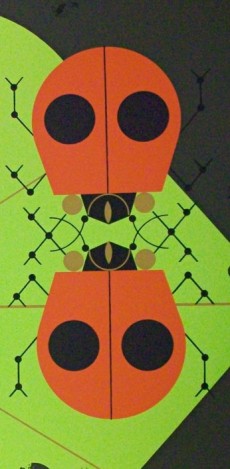
Since my graduation, CCS has moved onward and upward in so many respects—including collaboration with the Montshire. The people of these two institutions have taken it to the next level, with a new exhibit (on display at the Montshire through February 3, 2013): Cartoonists' take on Charley Harper. It provides a unique compliment to the traveling exhibit Beguiled by the Wild: the Art of Charley Harper. Harper was a famed nature artist, best known for his seriagraph (silk-screen) prints of wildlife, in a style he called "minimal realism." He made art for many nature organizations, including the Cincinnati Zoo, Hawk Mountain Sanctuary, and the National Park Service. On a trip with the Denison outing club (pre-CCS), I saw a poster by Harper on sale, probably at the visitor center of Bandelier National Monument. I knew that I had to take it home, and adorn the ceiling of my cabin at The Homestead. I didn't yet know Harper by name, but I recognized his remarkable compositions of wild animals, distilled to their essence.


And so,  in the Montshire, with a set of Harper prints at one end of the room, the other is adorned by work by CCS students, taking inspiration from Harper and from nature. (Evidently, I don't have a trademark on “Comics from the Wood.”) The colors are vibrant; and while Harper was a master of telling a story with a single image, the intrepid cartoonists apply minimal realism to a stories composed of multiple images in sequence. The results are charming, and well worth taking home, in the form of the comic book collection of the CCS work, which can be found at the Museum shop.


And I can recall all this positive detail about the exhibits, despite having lost my wallet on the trip back. Subsequently, I have been pressed to replace all my essential cards and Ids. Simultaneously, I have worked to prepare for Christmas with family, in my old home in West Virginia. It is a way of starting afresh, but with the weight of what has been and what's to come. I have much to do, to re-evaluate my life and path, and the pursue new challenges. I hope that I can take a hint from The Center for Cartoon Studies, and rise to new frontiers.

Happy Holidays and Merry Christmas!

The two color images are by Charley Harper, the former for the National Park Service, public domain; 
the latter is being used online to promote the traveling "Beguiled" exhibit.

Friday, December 14, 2012

Praise for Frog Stories!


Frog Stories, which I released in May 2012, has received a highly positive review from the comics critic Robert Clough.  Rob has a sharp analytical eye, and a column in the prestigious Comics Journal.  Evidently, I have passed his rubric.  He hopes to see more comics from me, which is good, because I will create more.

Comics legend Stephen Bissette (known for Swamp Thing, Tyrant, and The Unbelievable N-Man, among other works) has also given big cheers to the frogs.  On Twitter and Facebook, Steve wrote:

"Ross Studlar's FROG STORIES is one of my fave comics of the year; ideal Xmas gift for amphibian-fans, too!"

"I love Ross Studlar's comix, and this one is his best yet. Highly recommended, and a lovely package and read all the way around."

Frog Stories features four short narratives of life and death drama, starring frogs, mice, moths, beetles, and other small animals.  The eat-or-be-eaten world of the swamp comes vividly to life, in  black, white, and cross-hatched shades of grey.  Readers of any age can thrill to the feats of the frogs.  Yes, I agree that it makes a fine Christmas gifts, for fans of frogs or comics or nature or dramatic stories.  My etsy store is open, while supplies last.

Thursday, December 13, 2012

My first winter in the Sierra


Lesley and I visited the Sierra mountains near Lake Tahoe, on a December weekend when the great majority of recreationists stayed home. We drove her old reliable station wagon uphill through cold rain, which became wet snow once we reached the elevation of 5,000 feet. And finally, in the dark, we arrived the entrance of Clair Tappan Lodge, and walked the final 100 yards to the heavy wooden front door. The vanilla smell of the Sierras was instantly recognizable, as we trudged ankle-deep in wet snow, schlepping our gear. We gladly stepped inside, where it was dry and warm. In the Lewis and Clark room, we sat by the fire, and met new friends. The rain and snow made conditions for skiing or snowboarding less than ideal. Therefore, only six or so souls, ourselves included, occupied the lodge per night.

The next day, it was hard to pull ourselves away from the fire. There were books to read and tea to drink and sketchbooks to draw in and online courses to complete for the renewal of our EMT certifications. The wind billowed against the windows of the lodge and the rain fell hard. Lesley and I are people who love the woods, regardless of weather. However, she was recovering from a cold, and wished to be cautious. In the afternoon, our opportunity arose, with a moment of clear blue sky, and light rain only. We saddled ourselves up with backpacks and snowshoes and ski poles, and into the woods we went.  We followed a trail called the "main drag."

All about us, the red firs, Abies magnifica, stretched for the sky, their trunks nearly black in color. Upon them, stag-horn lichens glowed yellow-green, like fluorescent lights. And there were lodgepole pines, and hemlocks, and spruces. We sloshed our way through sloshy snow, which was a foot deep in places. Breaking trail through the icy sludge was not easy. I walked in Lesley's footsteps for a spell, then took my turn. (And compared the former to Good King Wencelas.)

Save the moans of the wind, it was quiet. Except for the rhythmic sway of the treetops—back and forth like a pendulum—it was still. I teadily put one foot and one pole in front of the other, in front of the other. I had to keep my thermal engine pumping its pistons. We were two spots of warmth, in a polar landscape.

The forest seemed empty of animals, but they were nearby. Under cover of bark or earth, escaped from the wind and rain. Some animals, on the other hand, were quite unperturbed by the elements. We crossed footprints, a line of them, from a small canid. Perhaps a fox. Squirrels, too, had left their marks in the snow.

And then a black form swooped past us. The raven finished its concave arc, and alighted atop a dead tree. It croaked and called, and proclaimed itself lord of the realm. Then it flapped and rose from the tree and into the wind. It beat its wings strong, but hovered like a helicopter, against the wind's push. Then the raven broke the stalemate, and soared onward, and out of sight.

We came finally to the Lytton Lake, our destination. Or rather, the rippling snowy field, with boulders and forest beyond. The map assured us of a lake under the snow. We turned around, and commenced our return trip.

We stepped into a copse of trees, and felt the calm. Their trunks kept the wind at bay; we had a safe fortress. From the side of my backpack, I removed a gift. A thermos of hot tea. It warmed our hearts, both figuratively and literally.

In this landscape of rolling hills, rocky and snow-covered, the trees stood strong. The rain began to fall again and the wind grew stronger, and the trees swayed but stood. For many centuries, they had braved every storm, and then the coldest depths of winter and the scorching summer heat. The weathered old giants took the monsoons and droughts, undaunted. As for me, I was glad that we had taken some of their brothers and sisters, and fashioned their strong bodies into a house. With a fire inside, wherein I could warm myself. I thanked the trees, and quickened my pace for the hike home.

Tuesday, November 27, 2012

Thanks be to friends, goats, and the wealth of the soil


Ross and the goats of Wealth Underground Farm

I have much to be thankful for this post-Thanksgiving season. I am thankful for my mom, dad, and brother, and the rest of my extended family spread throughout the country. I am thankful for Lesley and my other great friends. I am thankful to be a Park Ranger at Crater Lake National Park for some of the year. I am thankful for the results of the November 2012 election: given that only two political parties have realistic chances at office, the better of the two has made substantial gains. My heart goes out to the victims of Hurricane Sandy in New York and Haiti and elsewhere. I hope that we can rebuild and restore. And I hope that we work to curb global warming, and prevent worse recurrences.

The Homestead 35th reunion, 2012
 
I am thankful for my other family—the community of current and former residents of The Homestead. We share a unique bond, like no other place I've known. Once, I was stranded in Austin, Texas, as a “refugee” from Galveston Island after Hurricane Ike. With no place to stay, I sent an email to a Homestead alum named Grant, whom I had never met, but knew lived in Austin from correspondence on our alumni email list-serve. And yes, he took me in for a week. Such is the kinship among Homesteaders.

Several of my Homestead comrades have launched new sustainable business projects, and furnished careers for themselves and earth-friendly goods and services for their communities. Among these pioneers are Colin and Brad of The Seattle Urban Farm Company, and Chris and Nolan of Wealth Underground Farm. (Side note: Colin and Brad published a book this year.  Food Grown Right, In Your Backyard provides wise advice for novice and seasoned gardeners alike.  And it makes a great Christmas gift!)

The new tome of garden wisdom

From time to time, I return to these outposts of Homesteading, for a few hours or a few months. This Thanksgiving, Lesley and I paid a visit to Portland, on that rare and precious thing known as a sunny day. From downtown, we rode bicycles for ten miles, past green houses surrounded by vine maples, past street mosaics and telephone poles full of staples, and across the St John's Bridge. The snow-covered Mount Hood was like a shining cloud in the distance; the river, 200 feet below us, swirled green and grey; we pedaled on a little patch of earth, surrounded by expanses of sky. The icy wind turned our knuckles white. Cars and trucks rumbled by slowly. In Portland, they slow down for cyclists.

After the bridge, between us and our destination, loomed a great hill. We pedaled and breathed hard. We hopped off the bikes and walked them, and breathed harder. I felt my legs become a little stiff, and I walked faster. Eventually, by this combination of walking and pedaling, we reached the top of the hill. We guessed a distance of five miles uphill, although the cold green highway signs indicated we had traveled only one.

After a right turn and a short downhill coast, we reached Wealth Underground Farm. Within the house, Nolan, Chris and his family, and their comrades crowded by warmth of a wood-burning stove, which provides both heat and cooking. While they steamed vegetables and boiled free-range flesh, we talked about life, mutual friends, present and past work and farming (wherein Chris and Lesley discovered that both had worked at Hidden Villa), and The Homestead of our origin.

Nolan, Chris, and Ross at Wealth Underground, 2011

We went out into the farm. I had last seen it in the spring of 2011, and tilled the earth and planted seeds alongside the agrarian duo. Now, in the fall, the garden swelled and gushed with plant-life. Cabbages the size of my head, turnips the size of my fist, and kale leaves wider than the span of my hand. Pumpkins and squash. A greenhouse with still-ripe tomatoes. It was impressive, to put it mildly. And they regularly furnish goods for a 30-member CSA!

The Mind of the Goat

And we met the goats. Their fur was soft, their brains inquisitive. They accepted petting from Lesley and I, and expressed special interest in the Portland map. I only permitted them a little nibble.

Lesley and the goats of New World Farmstead (Eugene, OR)

To roam among goats, to eat of the earth, to build my own shelter, and to gather by the warmth of the fire. I seek all these in life, but wonder if it is too much to ask of the modern world. Fossil fuels can rapidly take one from point A to point B, and can give any room a tropical climate. But the joys of walking the journey or splitting the wood are missed. We celebrate in winter because of the need for companionship against the challenges of weather, wherein there is hard darkness but also joyous light. Life in a climate-controlled box makes for an even, dull grey. However, when the age of cheap oil comes to an end, we may all learn the way of the Homestead, by necessity. If such occurs, we will have losses but also great gains.

On the way back down, the hill was short. It felt like half a mile at most. Thanksgiving with Lesley and her family went well. After dinner, we performed “Dumpster Theater,” our new show of storytelling and shadow puppets. We told ancient stories, and used new materials, acquired in the rubbish. We shared the wisdom of coyote and huckleberries and fire, across the generations.


Top photo by © 2012 Lesley McClintock.  Reunion photo by © 2012 some Homie alum.

Thursday, October 25, 2012

Hornet Woman and Scarier Things


With Halloween at the near, I ought to share something spooky.

On a recent hike along the Rogue River beginning near Union Creek, my comrade Lesley—who has the eyes of an owl—chanced upon an abandoned hornet's nest, on the ground, having fallen from a tree, and now withering away. Instantly, I noted that it looked like the face of a monster, or zombie perhaps. And Lesley expressed a desire to see my depiction of said creature. After a few sketchbook attempts at beasts with the layered carapace of the hornet's nest, I came upon “Hornet Woman."


I am considering making her the subject of a comic book. She has potential.

All autumn at Crater Lake, I guided children on school field trips through a forest of hemlock trees and—yellow jackets. In the warm autumn, the stinging insects were prevalent. On cold days, they slowed to a torpor. For many insects, weather has a direct impact on behavior, including activity and breeding. In our modern era of global warming, we have increased populations of mosquitoes and the diseases they carry. And the whitebark pines featured in my previous post are getting devoured by mountain pine beetles, who are in a population boom, thanks to climate change.

While bees and wasps are rather non-agressive, and not to be feared, they may be an indicator of something truly ominous.

I hope that we come together against global warming, before it's too late. 

Saturday, October 13, 2012

Through the forest and into the snow


 Clark's nutcracker

Recently, I and my comrade Emily paid a visit to Scoria Cone. On the southern end of Crater Lake National Park, nestled in the old growth forest, Scoria Cone, like the rest of the Cascade mountains, was formed by volcanic heat and violence. Now, it is the land of perpetual snow. No trails or signs lead to Scoria Cone. To get there, one must venture into the conifer forest, with only map and compass as guide. (We didn't bring a GPS.)

We walked for an hour or so on the Pumice Flats trail, and the heat of exercise countered the cool of the fall morning.  We walked until there was a clearing in the pines and firs, enough of an overlook to see the mountain peaks behind. Using the area maps, we determined that the tall one was Scoria Cone. We took a compass bearing and followed it. First we went downhill, surrounded by lodgepole pines, which quickly obscured the broader view of the landscape. We followed our compasses, past a place where the lodgepole pines had bent over under snow, to look more like “arch pines”, or like monks bowing in a prayer circle. We walked on.

Away from highway 62, the forest was quiet, save the occasional croak from a Raven, or the yank-yank-yank of a nuthatch (which sounds like a truck backing up, as I learned from a wise birder.) We kicked up dust as we walked, for the ground was dry. Barely any rain had graced the landscape in months, but the hardy pines and firs stayed evergreen, like their namesake. From time to time, a shy chipmunk ran across our path and disappeared again. I'll admit to a slight nervousness, being away from the safety of the trail. Would I find the way back? Would I be lost in the woods, and have to put some wilderness survival techniques to work? I recalled Survivorman's cool attitude, and tried to imitate.

Our walk took us back upwards, towards the peak which we believed to be Scoria Cone. As the landscape came back into view—including in the distance, familiar landmarks like Llao rock and Mount Scott. This put my mind at ease. Crater Lake National Park has become to me a sort of home to me, and these landmarks give a sense of security, like the arch for residents St Louis, or the space needle for Seattle-ites. We walked past a healthy pile of bear scat, whose author had feasted upon berries and plants. We walked to the top of Scoria Cone. Just below, a bushy Ponderosa Pine stood proud and defiant, growing from out of the dark red rocks. Emily examined the map and determined locale of the crater, and the “snowcone”. We walked around the Ponderosa and down below it. And then we saw the pit, like an inverted cone. In the middle of the pit, snow. 

 Slowly, carefully, we edged down the steep walls. Near the end, I had to slide a bit on the seat of my pants, similar to the maneuver of the first white man to touch the water of Crater Lake. For the final stretch, a log acted as walkway between crater walls and snow, with one problem. The log was occupied by a yellow jacket nest. We edged past the log, and jumped onto the snow. A thick layer of snow. Below our feet the snow went on for tens of feet or more. Emily wondered how much snow must pile in the crater in the winter, for so much snow to remain now. It was chunky, icy snow, the kind that would draw blood if you fell into it at the end of a sled run. A Clark's nutcracker visited us on the snow. The bird pecked at the snow, and flew off. By my best observation and estimation, the bird ate chunks of snow as a source of water. A wise technique in a dry forest. Constantly, in fact, birds flew into and out of the cone. Nutcrackers and nuthatches and gray jays and stellar jays came along. Wasps and yellow jackets buzzed around us, so I made no sudden moves. We took some photos, and climbed out of the crater, free from stings, and with only the slightest of scrapes from the sojourn into the unknown. We followed our compasses back to the trail, where Emily set out for her new destination: Stuart Falls. I stayed along until the next grand view of the landscape, then was ready to turn around, having had a long and vigorous hike, and having met my goal of reaching Scoria Cone.

In her hike to Stuart Falls, Emily encountered a small bear. The beast ran in terror, climbed a tree, and howled and mewled like a dying puppy. I was envious and regretted having missed the bear. But I was prompted to fashion a bear with my oil-pastels. To join the mammal, I included another icon of western national parks—the whitebark pine. This high altitude tree is symbiotic with the Clark's nutcracker, who both eats and distributes their seeds. A nutcracker's thanksgiving would include volumes of whitebark pine nuts, some flavorful insects, and, evidently, a bowl of icy snow.


Clark's nutcracker photo by U.S. Fish and Wildlife Service, public domain; Ross descent photo by © Emily Prud'homme