 I too take inspiration from wolves. I have not yet encountered one in the wild, and hope that if I do, it is at sufficient distance so as not to disturb the canid. They have taken quite enough disturbance from us already!

Sunday, January 23, 2011
Wolf on the Prowl
I too take inspiration from wolves. I have not yet encountered one in the wild, and hope that if I do, it is at sufficient distance so as not to disturb the canid. They have taken quite enough disturbance from us already!

Saturday, January 22, 2011
Wolf of Legend
I have seen a lot of good wildlife documentaries in recent years. But 'The Wolf That Changed America' (Nature episode, 2007) stands out for its emotional impact.
And you can see it for free online.
Based on Ernest Thompson Seton's Wild Animals I Have Known (1898) and his journals, the film reenacts the story of Seton's hunt for the legendary wolf Lobo, evaluates the scientific plausibility of the story, and explains its significance for Seton and this country.
Lobo, a huge alpha male, leads a pack of livestock-hunting wolves in the Currumpaw region of northern New Mexico. The cunning animal eludes all guns, traps, and poison, and feasts heartily on cattle. The bounty on Lobo escalates until it reaches a record $1000, and still he makes fools of all pursuers. Finally, the ranchers call in one of America's foremost authorities on wolf-hunting--Ernest Thompson Seton. And so the contest for the ages ensues, the best trapper versus the wiliest wolf. The wolf proves no easy opponent.
In his prolonged hunt for Lobo, Seton comes to new insights about the animal's intelligence, bravery, loyalty, and capacity for love and loss. By the end of the saga, Seton's attitude towards wolves has changed, and he has discovered a new desire to preserve wild America. Seton goes on to become a founder of the American conservation movement.
Many of the early leaders of the conservation movement were writers and artists. Seton was both... and a cartoonist. Cartoon images populate his books, along with occasional comic sequences. I wish that I could travel back in time to meet this master of animal stories.

Wolf image by Seton, public domain
Thursday, January 20, 2011
I have joined the Jobs Party
There is an obvious solution to many of our economic woes, a way to stimulate the economy, improve the lives of millions of Americans, and even curb global warming along the way... Create government jobs!
A federal jobs program, a 21st-century equivalent to Franklin Roosevelt's WPA and CCC, is exactly what the nation needs right now. We need high speed rails and effective forms of public transportation--and thousands could be put to work building them. There are countless potential "green collar" jobs in our cities and towns, doing things like installing photovoltaic systems, passive solar heating, and good old insulated windows. Our National Parks have a huge maintenance backlog of bridges, buildings and other infrastructure in need of repair. Many people who lost their jobs in the recession are from technical fields like construction and automotive and would bring valuable skills to such projects. And new recruits would have a grand opportunity to learn from the experienced. There are so many projects for the public good that we could undertake with the right federal investment.
And many of you are asking "how are you going to pay for it?" Consider the following calculation, which I borrowed from Bob Fertik on the new Jobs Party website:
"In December, Republicans demanded - and won - an extension of Bush's tax cuts for the rich costing $858 billion over two years. I advise everyone to tell your senators and congressmen to create jobs now!

CCC workers constructing a road, 1933, Franklin D. Roosevelt library and museum, public domain
A federal jobs program, a 21st-century equivalent to Franklin Roosevelt's WPA and CCC, is exactly what the nation needs right now. We need high speed rails and effective forms of public transportation--and thousands could be put to work building them. There are countless potential "green collar" jobs in our cities and towns, doing things like installing photovoltaic systems, passive solar heating, and good old insulated windows. Our National Parks have a huge maintenance backlog of bridges, buildings and other infrastructure in need of repair. Many people who lost their jobs in the recession are from technical fields like construction and automotive and would bring valuable skills to such projects. And new recruits would have a grand opportunity to learn from the experienced. There are so many projects for the public good that we could undertake with the right federal investment.
And many of you are asking "how are you going to pay for it?" Consider the following calculation, which I borrowed from Bob Fertik on the new Jobs Party website:
"In December, Republicans demanded - and won - an extension of Bush's tax cuts for the rich costing $858 billion over two years. I advise everyone to tell your senators and congressmen to create jobs now!
CCC workers constructing a road, 1933, Franklin D. Roosevelt library and museum, public domain
Monday, January 3, 2011
Wherefore art thou Wood
Happy New Year 2011! Twenty-Eleven (or Two-Thousand Eleven, if you prefer). The words sound high tech, science fiction-like; the future has become the present.
For my first blog entry of 2011, I shall discuss a technology that sounds "old school," but may actually be quite appropriate for the future: a wood furnace. I shall also discuss one of my favorite activities: splitting wood. And I have yet another educational comic to share, which involves (you guessed it)--wood.

When I returned home for Christmas, I was glad to meet a gathering of stumps in my parents' backyard, the remains of a cherry tree. I fetched the maul to prepare wood for stove. My brother Carl (left) joined in the action.
In the immortal words of Henry David Thoreau, "He who splits his own wood warms himself twice."

Splitting wood is one of the most rewarding forms of exercise. It gets the blood pumping, and works both the upper body and core muscles. One hears the satisfying THWACK of a well-placed blow, and sees the two halves of stump fly in opposite directions. As the pile of firewood around him grows, so does the splitter's sense of satisfaction. The morning chorus of birds provides background music to this ancient and practical sort of work-out.
I trained in the art of wood-splitting at The Homestead. Since graduating, I have experienced some splitting deprivation, as most of my subsequent residences have been heated exclusively by gas or electricity. Still, I jump at the opportunity to bring maul to stump, and split wood voluntarily for Land's Sake last spring when I was in Massachusetts.
The ecological footprint of wood fuel is debated. It is worth noting the wood is a local resource, which can be harvested and used with little or no expenditure of middle-eastern oil. And it is renewable, provided that one harvests and plants at the right pace. And, with the use of newer wood-gasifying technology, wood heat can be very energy efficient and low in greenhouse gas emissions. Indeed, a wood-gasifying furnace is a vast improvement over an ordinary wood stove. No, I don't have a wood-gasifyer. I was first introduced to the technology at Cobb Hill CoHousing. I visited this intentional community in Hartland, Vermont in 2006, to complete a journalism comic (which appeared in the Connecticut Valley Spectator as well as Cobb Hill's own newsletter.)
And here, I share my comic again:
 My middle name is Wood because it is a family name from my mother's side, not because of any preordained affinity for fibrous plant tissue. I am not related to the cartoonist Wally Wood, or to any of the other famous people named Wood, as far as I know.
For my first blog entry of 2011, I shall discuss a technology that sounds "old school," but may actually be quite appropriate for the future: a wood furnace. I shall also discuss one of my favorite activities: splitting wood. And I have yet another educational comic to share, which involves (you guessed it)--wood.

In the immortal words of Henry David Thoreau, "He who splits his own wood warms himself twice."

I trained in the art of wood-splitting at The Homestead. Since graduating, I have experienced some splitting deprivation, as most of my subsequent residences have been heated exclusively by gas or electricity. Still, I jump at the opportunity to bring maul to stump, and split wood voluntarily for Land's Sake last spring when I was in Massachusetts.
The ecological footprint of wood fuel is debated. It is worth noting the wood is a local resource, which can be harvested and used with little or no expenditure of middle-eastern oil. And it is renewable, provided that one harvests and plants at the right pace. And, with the use of newer wood-gasifying technology, wood heat can be very energy efficient and low in greenhouse gas emissions. Indeed, a wood-gasifying furnace is a vast improvement over an ordinary wood stove. No, I don't have a wood-gasifyer. I was first introduced to the technology at Cobb Hill CoHousing. I visited this intentional community in Hartland, Vermont in 2006, to complete a journalism comic (which appeared in the Connecticut Valley Spectator as well as Cobb Hill's own newsletter.)
And here, I share my comic again:
 My middle name is Wood because it is a family name from my mother's side, not because of any preordained affinity for fibrous plant tissue. I am not related to the cartoonist Wally Wood, or to any of the other famous people named Wood, as far as I know.
photos for this post ©2010 Susan Moyle Studlar
Sunday, December 26, 2010
Real(!) Christmas Trees; Adventures in Recycling

I hope that everyone had a Merry Christmas (or a merry whatever-other-holiday-you-celebrate), and will have a Happy New Year.
I celebrated Christmas with my family in West Virginia. My brother Carl and I arrived on December 24th, just in time for the whole family to partake in a tradition of ours, acquiring a real Christmas tree from a local cut-it-yourself tree farm. We chose a fraser fir (an authentic Appalachian species).
Regarding the perennial debate over which is better (or worse) for the environment, a real Christmas tree or an artificial one... Research demonstrates that a real tree is clearly the more earth-friendly choice (1)(2).
And speaking of the environment, here is another educational comic from the pen of yours truly. This one I created in the fall of 2003, during my senior year at Dension University. Throughout my time at Denison, I was involved in DURP (Denison University Recycling Program). Due to great organizational efforts by some other DURP members and university staff, the institution greatly expanded its recycling program in 2003--introducing, among other things, recycle containers for every dorm room. But there was a problem: many students did not follow proper recycling protocol. We faced recycle bins contaminated with non-recyclable garbage, and various other issues. To address these difficulties, I created this instructional comic/ poster.
 Boris, the star of the story, is DURP's long-time mascot. I do not know who originally created the character.
My comic still graces some walls at Denison, thanks to the efforts of current DURPers. It may be the second most widely-viewed media work of mine, after my earthship video.
Happy Holidays!
Monday, December 20, 2010
An Attendance Issue
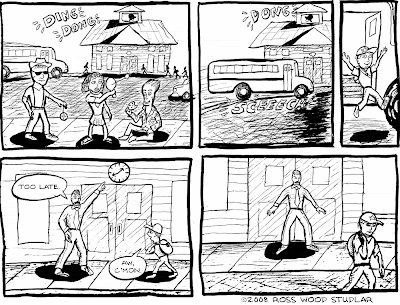
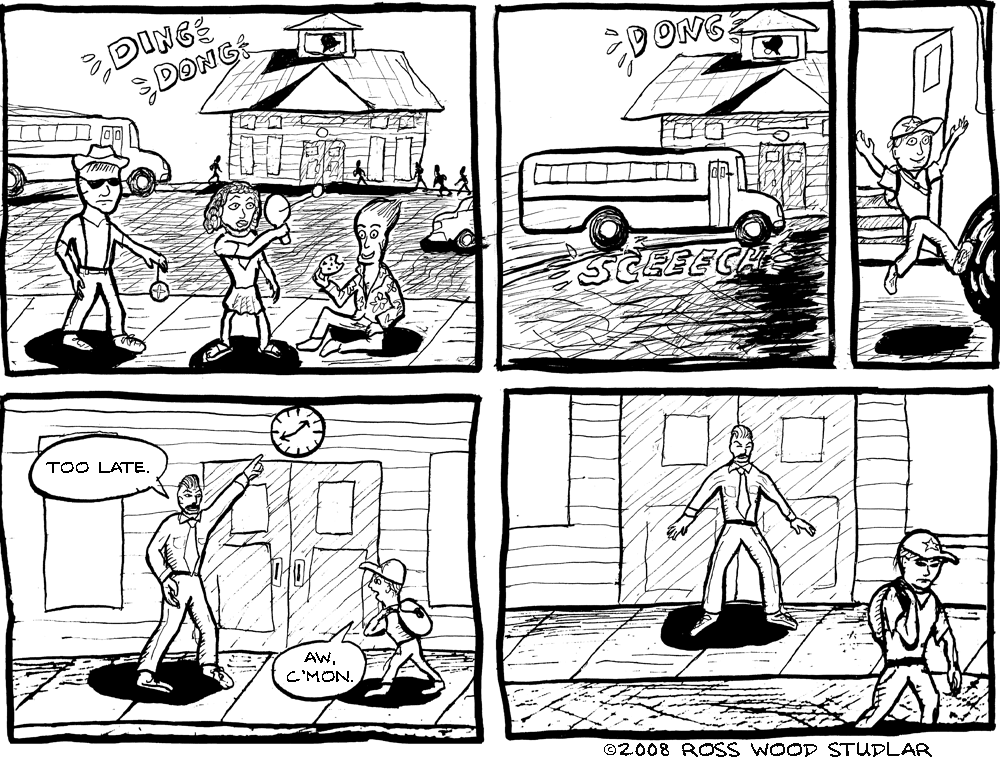
Here is the second of the two educational/ instructional comics that I produced for ICLAD. This case deals with the problem of a high dropout rate in Marshallese Schools. Analysis revealed that the schools' strict policies on attendance and timeliness were counterproductive, if keeping students enrolled through graduation is the goal.


Wednesday, December 15, 2010
Keeping the Charles River clean
I produced this educational comic for the International Consortium for Law and Development (ICLAD). It illustrates the "Seidman Method" for addressing social and environmental problems. In this example, the problem at hand is a Charles River contaminated with motor oil....


Subscribe to:
Posts (Atom)