

Wednesday, April 27, 2016
Gibbon

Monday, March 21, 2016

Sunday, March 6, 2016
The wolf who fought for the working class
Although we may not be homeless in the streets yet (in many cases saved by our parents), many people in my "Millennium" generation have been stung by the scorpion of this fierce and rigged economy. (In one dramatic example, A Yelp! [$1.37 billion company] employee was forced to live off of brown rice and with no heat, thanks to low pay and high rent in San Fransisco. When she shared the truth on her blog, they fired her.) Maybe that's why we are willing to consider progressive reforms from a true visionary. Today, we have a socialist candidate with a chance of winning the Democratic nomination! Bernie Sanders has gone from protest candidate to real candidate with amazing rapidity. Although Bernie calls himself a Democratic Socialist, Noam Chomsky describes him as a decent and honest New Deal Democrat. Many of the programs Sanders proposes, such as universal health care and tuition-free college, already exist in much of the developed world. Only the highly conservative political atmosphere of the United States (where Republicans are far right and Democrats are right-of-center) are his plans perceived as extreme left.
Like many kids, I thrilled to Jack's Klondike stories. I began to discover his broader scope of work when I was sixteen, and saw The Star Rover on the shelf at the public library of Morgantown, West Virginia. I read the tome, and was awestruck. From there, I started trying to read all of Jack's books. (Maybe someday, I will complete that project.)
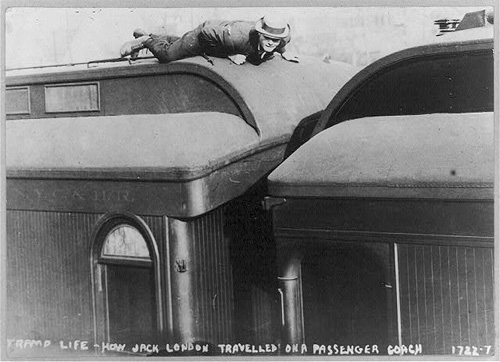
After his prison stint, Jack returned home to Oakland, crammed the contents of four years of high school into one-and-a-half years of intensive study, did well on standardized tests and was accepted into the University of California at Berkeley, did not graduate, and went on more adventures such as gold-prospecting the Yukon. He submitted many manuscripts to literary magazine, taking artistic and philosophic inspiration from Rudyard Kipling, Edgar Allan Poe, Karl Marx, Charles Darwin, Friedrich Nietzsche, and above all his own life experience. His first pro sale was the science fiction short story "One Thousand Deaths" to The Black Cat. His big breakthrough was his second novel, the overnight bestseller The Call of the Wild, published in 1903. This work catapulted Jack from obscure scribe to international celebrity. From then until his untimely death in 1916, he received pay and fame for his writing comparable to today's Hollywood actors.

Inevitably, readers of The Iron Heel will see parallels with their own contemporary times, whether its the 1980s or 2010s. The connections are as obvious today as ever, as a Democratic Socialist (Sanders) faces off against an opponent who is basically a Fascist (Trump) for the office of president. Movements like Occupy Wall Street and the Fight for Fifteen are reminiscent of the worker's revolution which Jack London hoped and fought for.

By my senior year of high school, Jack London had become much more than the topic of my final project in English class. He was a literary hero of mine. I too hoped to be an adventurer and storyteller (through both words and pictures--comics--in my case), and to fight for marginalized beings (in my case, I was especially concerned with animals and plants, Mother Earth's world.) And I am not the only Studlar upon whom Jack's work had a profound effect. My big brother Carl was attending Wittenberg University when I was still at Morgantown High School, and when he came home for Christmas Break, he caught hold of my library copy of The Star Rover. He too was left in awe, and he too was soon reading more of Jack's work. This fueled a yearning he had been developing to go out and experience true adventure. To escape the sanitized and protected world that privileged people inhabit, and not just to climb rocks with the high tech gear. Eventually, he found the adventure he sought by joining the Peace Corps, and served for two and a half years in rural El Salvador. He survived amoebas and parasites, and left his village El Matazano with many improvements, including a computer lab at the public school, to prepare students for work and life in a high-tech world.
Today, our world evolves rapidly. I too can be affrighted by new online worlds and forms of virtual reality, and how they will change the direction of ourselves and our society. However, one thing is clear. Older forms of virtual realty--in this case, prose--continue to affect and direct what we do in the real world!

***********
Recommended:
"Jack London and Science Fiction" by Clarice Stasz
Review of The Iron Heel by Ben Granger, Spike Magazine
Because Jack London has been deceased for over 70 years, his entire body of work is in the public domain and can be freely copied and shared. Some of his works can be found here. Or if you're like me and you like paper, visit a public library.
The photos and book covers are also in the public domain, with the trains image in the Library of Congress collection and boxing image from the Imperial War Museum.
Tuesday, February 16, 2016
A Year for Parks
The year 2016 is the one hundredth anniversary of the National Park Service! For the past few years, the NPS has teamed up with the nonprofit National Park Foundation to promote this centennial. The promotional poster below (composed by their graphic artists) is neat and befits the event well:

The year to celebrate public lands began with men in cowboy hats challenging the very concept of federally-managed public land--in the form of the armed occupation of the Malheur National Wildlife Refuge in Oregon by an armed militia led by Ammon Bundy. Apparently, the Bundys have a utopian vision of a world where the Grand Canyon of Arizona is a giant uranium mine, and one can no longer hike and fish in the National Forests of Oregon, without fearing gunfire from the logging companies to whom ownership of the forest has been transferred. For the record, I put my boots on the ground and markers on the paper in opposition to Y'all Qeada, in a protest at Holladay Park in Portland, Oregon. (The Audobon Society, Center for Biological Diversity, and others worked to organize the event.)

There may be more challenges to public lands, and more armed crazies to come. At least one of my fellow seasonal rangers has told me she is nervous about returning to work at Yellowstone. In response, I noted that national parks carry many calculated risks, including earthquakes, lightning strikes, and falling trees. The Yee-Hawdists are another one, but we must temper our imaginations with reason. The leading causes of death in national parks are drowning and automobile accidents. (And no public employees were harmed physically in the Oregon standoff.) And, of course, terrorists seek to strike terror, so we must not allow them to scare us away.
Now is a great year to flood public lands of all types with your support. I especially recommend going and playing in some of the not-quite-as-famous gems (such as Crater Lake, Timpanogos Cave, and Chaco Culture.) Yellowstone, Yosemite, and Grand Canyon will be PACKED this summer, so if you go, make good use of the early morning and late evening.
Recommended: Comments by Tim DeChristopher (who went to jail to protect public land) on the Malheur standoff.


Now is a great year to flood public lands of all types with your support. I especially recommend going and playing in some of the not-quite-as-famous gems (such as Crater Lake, Timpanogos Cave, and Chaco Culture.) Yellowstone, Yosemite, and Grand Canyon will be PACKED this summer, so if you go, make good use of the early morning and late evening.
Recommended: Comments by Tim DeChristopher (who went to jail to protect public land) on the Malheur standoff.
Friday, January 8, 2016
Spinosaurus!

On a visit home for Christmas, I riffled through a pile of National Geographic's, accrued from the past few years. The issue with Spinosaurus on the cover caught my attention. I recalled how I had thrilled to pictures and stories of dinosaurs in my youth--including some Nat Geo's from the 1980s and '90s! In an instant, my child's sense of curiosity and wonder came back. Spinosaurus has dethroned and replaced Tyrannosaurus Rex for the title of largest carnivorous dinosaur, as measured by body length from tip of nose to tip of tail (fifty feet for Spiney, forty for Rex.) In habits, Spinosaurus resembled a modern crocodile, spending most of its time in water and some on land. Fish were probably its primary food, along with other aquatic life, such as turtles. Nature is a harsh and unforgiving place for the hunted--or for the hunter who doesn't meet his dietary quota and starves. I tried to faithfully represent the ancient reptile in this drawing, although he's not around anymore to give me a critique. Ah well, if he were around, he'd probably be more interested in my warm flesh than my drawing!
Happy New Year, World!
Friday, December 18, 2015
Dawn of the Bats

My logo will appear on the park's Facebook page, as well as fliers and advertisements for the special event. I wish good luck to the bats, rangers, and visitors at Carlsbad Caverns!
I produced the logo as an outside illustrator, not as a park employee, so the image is copyrighted to me and the park has permission to use it.
Tuesday, December 15, 2015
A Good Home for Giant Apes, Perhaps


The lush rain forests of the Pacific Northwest are so full of life. A fitting habitat for squirrels, weasels, bears (rarely in Forest Park because we are in the city), Sasquatch (if they exist, probably never in Forest Park because we are in the city.) However, much of the state of Oregon consists of vast tracts of national forests, occasionally punctuated by a small town. Out there, Gigantopithecus might lurk in relative peace, dodging hunters and logging trucks as needed.
Wild animals are elusive. I have only seen a mountain lion one time in all my years of hiking in the woods, and they have probably seen me more times than I can count. In Norway, brown bears, having been extensively hunted, learned to avoid people. (Biologists even use the term "gun selection" to describe this behavior, which has also been observed in rhinoceros.) People presumed the bears extinct from many areas, until biologists gave it a thorough investigation, and found they yet lived. After this discovery, civilian eyewitnesses to the bears came forward to describe past events, apparently no longer deterred by prevailing wisdom. All over the United States and Canada, there are native peoples who believe that Sasquatch is not only a spiritual being, but a physical one as well. The Sasquatch hypothesis has gained more credibility in recent years, thanks efforts by anthropologist D. Jeff Meldrum, survival expert Les Stroud, and others. As happened with Norway's bears, civilian eyewitnesses to Sasquatch have come forward to describe their hard-to-explain experiences. Les Stroud has propounded the idea that if Sasquatch exist, they must be even smarter than big cats or bears. To have avoided confirmed detection for so long, they must have NEAR-HUMAN levels of intelligence. If Sasquatch is real, it could be cause for a loud new cry for conservation. It could provide not only moral grounds for forest preservation, but legal ones as well. The Endangered Species Act has long been one of the most powerful forces for protecting natural habitats--and it can only be applied to species whose existence has been confirmed.

What if Bigfoot is proved real? To gain some idea for how human society might react, it is wise to look at the past record. For hundreds of years, legend had it that there were "ape-men" in the forests of East Africa, with various Native tribespeople and European explorers telling stories of their close encounters. In 1902, German officer Robert von Beringe ventured deep into the jungles of Rwanda, and shot two of these simians. With type specimens in hand, biologists named the new species Gorilla beringei. They are more commonly known as mountain gorillas. Europeans generally mistook the peaceful herbivores for aggressive monsters. And, uncomfortably, these behemoths looked all-too-humanoid; they appeared to be "between man and beast." This discovery came at a time when Charles Darwin's revolutionary theory of evolution was still relatively new, and humanity still reeled from the blow to its collective ego--that scientific evidence led to the conclusion that we are animals descended from apes, instead of divine beings who stand apart from the rest of nature. Could the giant ape REALLY be our close relative? This question ignited a firestorm of debate in the newspapers and universities, which became known as the Gorilla war. Scientists and others weighed in, in a dispute focusing largely on the details of comparative anatomy, and representing the conflict between Darwinism and human exceptionalism. An American boy named Merian C. Cooper followed the Gorilla war. After he grew up and became an Airforce pilot and filmmaker, he became captivated by W. Douglas Burden's written account of his expedition to the island of Komodo, where he confirmed the existence of the "dragon lizards." Another mythic beast had turned out to be real! Drawing upon inspiration from these remarkable animals, Cooper conceived an idea for the ultimate adventure movie: African gorillas battle Komodo dragons, with a band of human explorers caught in the fray. He revised the idea to feature a single giant gorilla who would face off against both dinosaurs and men with guns, and fall for the charms of a beautiful woman. In 1933, Cooper co-wrote and co-directed the classic monster film King Kong, with stop motion maestro Willis O'Brien bringing the beasts to life.

The name Sasquatch is a variation of sásq'ets, borrowed from the Halkomelem language. The name is often translated as "wild man of the woods," but a better translation is "wild master of the woods," (according to Les Stroud, as he learned from his "native teacher.") Indeed, if the great hominid exists and has survived and evaded us for this long, he is a greater master of the woods than even the best human trackers and survivalists. His connection to earth far outclasses mine, but still I am still happy to be of service, in replanting small patches of the forests where he might thrive!

The Gorilla War is brought back to light by Monte Reel's recent book Between Man and Beast.
Artist unknown on the old gorilla image.
Kong vs. T.Rex image was used for promotional purposes by the now-defunct RKO pictures, and is used here for educational purposes only.

Subscribe to:
Posts (Atom)