Tuesday, February 8, 2011

Living Dinosaurs

One of my childhood ambitions was to become a paleontologist, to study dinosaurs. A competing ambition was to draw comics for Marvel. I haven't met either goal. In recent years, I have shown greater interest in living animals than extinct ones. Maybe my paleontological dreams have vanished like the great sauropods, or maybe they have simply morphed--evolved--into something new.

Among my sketchbooks and comic book productions, we find a variety of reptiles, as well as their relatives, the amphibians and birds. Among these, we find modern giant reptiles, such as sea turtles and Komodo dragons. Some biologists have described these creatures as 'living dinosaurs.'


Last fall, I encountered a giant amphibian! (Almost a living dinosaur?) It was a giant coastal salamander. Although considerably smaller than me, it was a leviathan by salamander standards, nine inches in length (and they can get bigger.) I chanced upon this critter on a rainy day hike, in a forest just outside Portland, Oregon. Northwest dwellers, these great beasts may be lurking in YOUR backyard, unbeknownst to you. Dear salamander, it is an honor to share the forest.

Sunday, February 6, 2011

Computers of Future Passed, part II: Man vs Machine

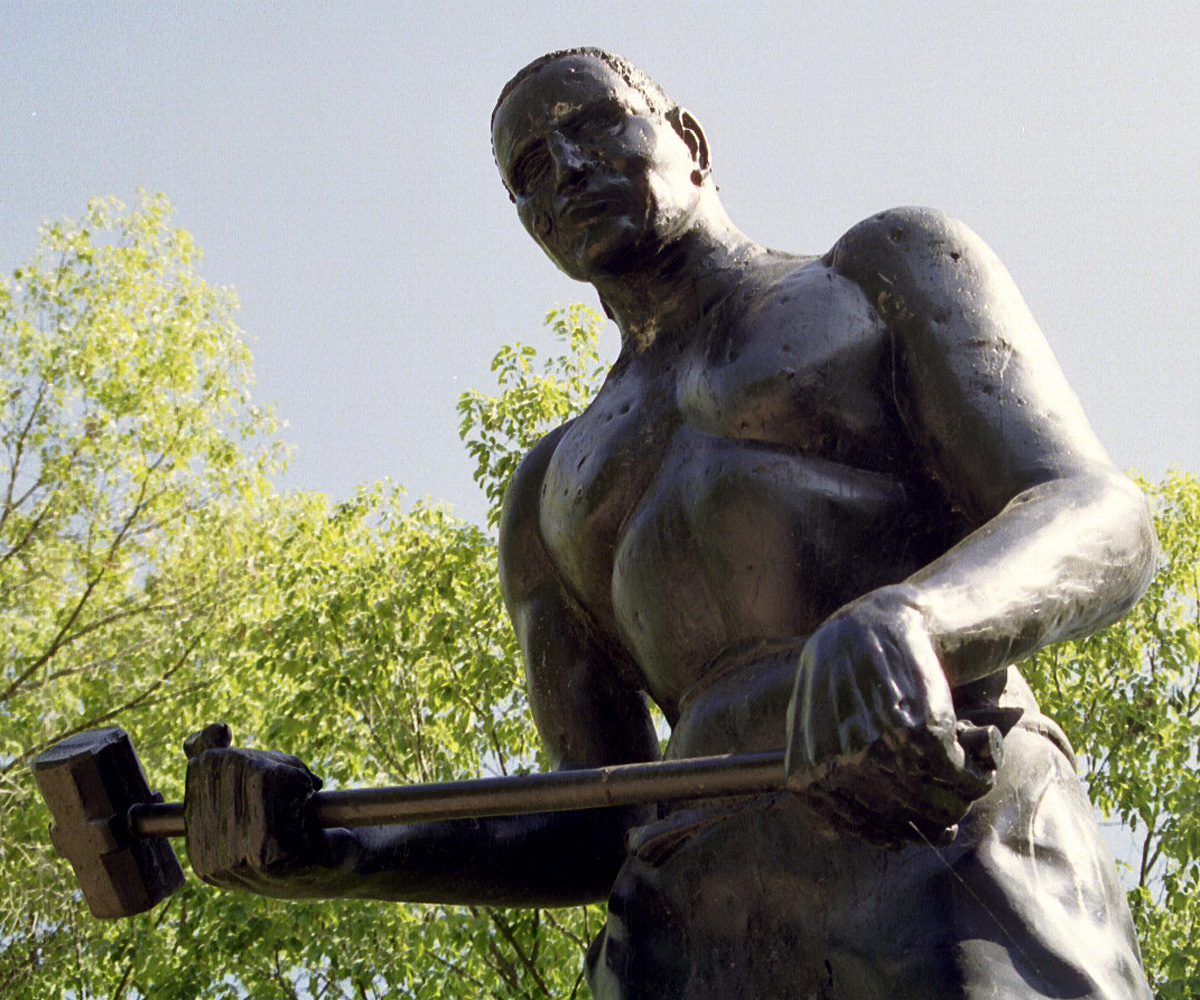
Most of us don't think of the folktale of John Henry as a science fiction story. But, in a sense, it is one. It is a story about how new technology affects people and society. At the time the story was invented, strong men were feeling the new competition from stronger machines. Today, we take it for granted that a forklift can lift more than the strongest person in the world, and that a bulldozer can move more earth in a day than a person can in a month.

Today, humans have another (greater) source of pride with which machines are competing: our brains. And so, not surprisingly, many science fiction stories on computers and robots deal in the question of what will happen when the machines become smarter than us. In the real world, the much-publicized Garry Kasparov versus Deep Blue chess match of 1997 was the intellectual equivalent to John Henry versus the steam-powered hammer.

Although computers can play mean chess, compose music, write poetry, and devise clever TV commercials, they can't yet do everything that humans can. I'll leave it to the philosophers, linguists, psychologists, and computer scientists to debate over whether they will match or exceed all our cognitive abilities someday. I simply know that such prospects are good material for science fiction. My SF comic book Myths from the Future contains stories about intelligent robots, and a great awakening, when robots become self-aware. And I have comic book in preparation (still untitled), wherein a humans brain is copied into a new cyborg body--although it isn't exactly the body he was hoping for!


Photo at top: statue of John Henry outside town of Talcott, West Virginia. Photographer Ken Thomas has released this image into the public domain.

Tuesday, February 1, 2011

New links and promotions; Computers of Future Passed

Comic book retailers take note: I have hired Tony Shenton as freelance sales representative for my Raven and Crayfish.

Comic fans take note: On the right sidebar, I have added links to retailers who are cool enough to sell my comics, as well as links to some other notable cartoonists and artists.

Comic people also note: Susan Soares of Sky Pirates of Valendor was nice enough to let me post a banner on their site. I'd better go read some Pirates!

Even though I am in what educators call the "millennium generation," I have been a bit slow to catch on to the world of online self-promotion. I am trying to catch up.

Remarkable machines, these computers. Remarkable tool, this internet.

Hardly anyone foresaw the world wide web as we know it, and increasingly we forget what life was like without it.

Indeed, most predictions regarding computers of the future are famous for being so far off the mark.

The line from a 1949 issue of Popular Mechanics is frequently quoted:
"Computers in the future may weigh no more than 1.5 tons."

At the time the article was written, computers were giant, centralized machines. The author extrapolated from current trends. Science fiction did similarly. Most SF stories on computers from the 1950's and 60's feature super-versions of the early digital computers--whirling tape, vacuum tubes, flashing light bulbs and all.

ENIAC, built in 1946, was the world's first general-purpose electronic computer (according to wikipedia).

On New year's eve 2011, I was visiting family and presented a reading of Isaac Asimov's classic "The Last Question" (1956). It tells the saga of Multivac, the grand supercomputer on the moon (at the stories beginning), and its quest to solve for man the question of whether there is a way to reverse entropy and prevent the end of the universe. (The "AC" in Multivac or ENIAC stands for automatic computer.) In only 13 pages, Asimov takes the reader on a journey beginning in the year 2061, and ending trillions of years later. By a few generations from the opening scene, the planet-spanning Multivac has been replaced by Microvacs, miniaturized computers--each occupies only half a starship! Microvac later evolves to a universal computer, a cosmic AC. In the final scenes he is simply AC, existing in hyperspace, and instantly reachable from anywhere in the universe. Through calculation, the AC solves all man's problems until man discards the flesh, and his immortal collective mind roams across space. But still that problem of entropy vexes Man and AC alike …..

Although many of the details in Asimov's story now seem quaint, still he predicted that computer would become humankind's best friend ... a forecast for the "information age." That may be one of the reasons why "The Last Question" was Asimov's favorite of all the short stories that he authored.

Asimov mainly foresaw computers (and robots) as being used for peaceful purposes. Robert Heinlein explored more military applications, as with his giant supercomputer "Mike" in The Moon is a Harsh Mistress (1966). The self-aware computer is a likable character. And he is invaluable for aiming rock bombs in the war between the lunar colony and Earth.

Then there are the good computers that turn bad and take over. The most famous of these is HAL 9000--with his gently disturbing voice--from 2001: A Space Odyssey (1968). Colossus: The Forbin Project (1970) is another example. Notably, this film contains a short scene of a chess game between Colossus and the man who programed him. At the time, the idea of a computer that could challenge the smartest human in chess was wild speculative fiction. Now, it's history.

All of the aforementioned works deal in giant "super-brain" computers. None predict the decentralized international network of today.

As far as early and accurate predictions for the internet age are concerned, there is one story that tops them all.

"A Logic Named Joe" by Murray Leinster, 1946. ('Logic' is Leinster's term for what we now call a personal computer.) He forecast in the existence of desktop computers with screen and keyboard. The story goes farther from there. He offers a clear and accurate prediction of the world wide web, google, craigslist, Skype, concerns about the absence of censorship on the internet, and much more...fifty years before the fact, and at a time when the world thought of ENIAC as the pinnacle of computing. I first learned of this story from a column by Robert Silverberg in the December 2008 issue of Asimov's Science Fiction Magazine. I found the tale and was amazed. (You can find it at your library, or use your 'logic' to find it online.)

The lesson that I take from 'A Logic Named Joe': somewhere out there in science fiction, there is a story that seems too fantastic to believe, but that will come true. I just wonder what story it is!


ENIAC image (top) by an unindentified US Army photographer, public domain.

Sunday, January 23, 2011

Wolf on the Prowl

I too take inspiration from wolves. I have not yet encountered one in the wild, and hope that if I do, it is at sufficient distance so as not to disturb the canid. They have taken quite enough disturbance from us already!

Saturday, January 22, 2011

Wolf of Legend

I have seen a lot of good wildlife documentaries in recent years. But 'The Wolf That Changed America' (Nature episode, 2007) stands out for its emotional impact.

And you can see it for free online.

Based on Ernest Thompson Seton's Wild Animals I Have Known (1898) and his journals, the film reenacts the story of Seton's hunt for the legendary wolf Lobo, evaluates the scientific plausibility of the story, and explains its significance for Seton and this country.

Lobo, a huge alpha male, leads a pack of livestock-hunting wolves in the Currumpaw region of northern New Mexico. The cunning animal eludes all guns, traps, and poison, and feasts heartily on cattle. The bounty on Lobo escalates until it reaches a record $1000, and still he makes fools of all pursuers. Finally, the ranchers call in one of America's foremost authorities on wolf-hunting--Ernest Thompson Seton. And so the contest for the ages ensues, the best trapper versus the wiliest wolf. The wolf proves no easy opponent.

In his prolonged hunt for Lobo, Seton comes to new insights about the animal's intelligence, bravery, loyalty, and capacity for love and loss. By the end of the saga, Seton's attitude towards wolves has changed, and he has discovered a new desire to preserve wild America. Seton goes on to become a founder of the American conservation movement.

Many of the early leaders of the conservation movement were writers and artists. Seton was both... and a cartoonist. Cartoon images populate his books, along with occasional comic sequences. I wish that I could travel back in time to meet this master of animal stories.

Wolf image by Seton, public domain

Thursday, January 20, 2011

I have joined the Jobs Party

There is an obvious solution to many of our economic woes, a way to stimulate the economy, improve the lives of millions of Americans, and even curb global warming along the way... Create government jobs!

A federal jobs program, a 21st-century equivalent to Franklin Roosevelt's WPA and CCC, is exactly what the nation needs right now. We need high speed rails and effective forms of public transportation--and thousands could be put to work building them. There are countless potential "green collar" jobs in our cities and towns, doing things like installing photovoltaic systems, passive solar heating, and good old insulated windows. Our National Parks have a huge maintenance backlog of bridges, buildings and other infrastructure in need of repair. Many people who lost their jobs in the recession are from technical fields like construction and automotive and would bring valuable skills to such projects. And new recruits would have a grand opportunity to learn from the experienced. There are so many projects for the public good that we could undertake with the right federal investment.

And many of you are asking "how are you going to pay for it?" Consider the following calculation, which I borrowed from Bob Fertik on the new Jobs Party website:

"In December, Republicans demanded - and won - an extension of Bush's tax cuts for the rich costing $858 billion over two years.

Amazingly, that same $858 billion could create jobs for all 14.5 million unemployed Americans paying nearly $30,000 per year!"

I advise everyone to tell your senators and congressmen to create jobs now!


CCC workers constructing a road, 1933, Franklin D. Roosevelt library and museum, public domain

Monday, January 3, 2011

Wherefore art thou Wood

Happy New Year 2011! Twenty-Eleven (or Two-Thousand Eleven, if you prefer). The words sound high tech, science fiction-like; the future has become the present.

For my first blog entry of 2011, I shall discuss a technology that sounds "old school," but may actually be quite appropriate for the future: a wood furnace. I shall also discuss one of my favorite activities: splitting wood. And I have yet another educational comic to share, which involves (you guessed it)--wood.


When I returned home for Christmas, I was glad to meet a gathering of stumps in my parents' backyard, the remains of a cherry tree. I fetched the maul to prepare wood for stove. My brother Carl (left) joined in the action.

In the immortal words of Henry David Thoreau, "He who splits his own wood warms himself twice."


Splitting wood is one of the most rewarding forms of exercise. It gets the blood pumping, and works both the upper body and core muscles. One hears the satisfying THWACK of a well-placed blow, and sees the two halves of stump fly in opposite directions. As the pile of firewood around him grows, so does the splitter's sense of satisfaction. The morning chorus of birds provides background music to this ancient and practical sort of work-out.

I trained in the art of wood-splitting at The Homestead. Since graduating, I have experienced some splitting deprivation, as most of my subsequent residences have been heated exclusively by gas or electricity. Still, I jump at the opportunity to bring maul to stump, and split wood voluntarily for Land's Sake last spring when I was in Massachusetts.

The ecological footprint of wood fuel is debated. It is worth noting the wood is a local resource, which can be harvested and used with little or no expenditure of middle-eastern oil. And it is renewable, provided that one harvests and plants at the right pace. And, with the use of newer wood-gasifying technology, wood heat can be very energy efficient and low in greenhouse gas emissions. Indeed, a wood-gasifying furnace is a vast improvement over an ordinary wood stove. No, I don't have a wood-gasifyer. I was first introduced to the technology at Cobb Hill CoHousing. I visited this intentional community in Hartland, Vermont in 2006, to complete a journalism comic (which appeared in the Connecticut Valley Spectator as well as Cobb Hill's own newsletter.)

And here, I share my comic again:

My middle name is Wood because it is a family name from my mother's side, not because of any preordained affinity for fibrous plant tissue. I am not related to the cartoonist Wally Wood, or to any of the other famous people named Wood, as far as I know.

photos for this post ©2010 Susan Moyle Studlar