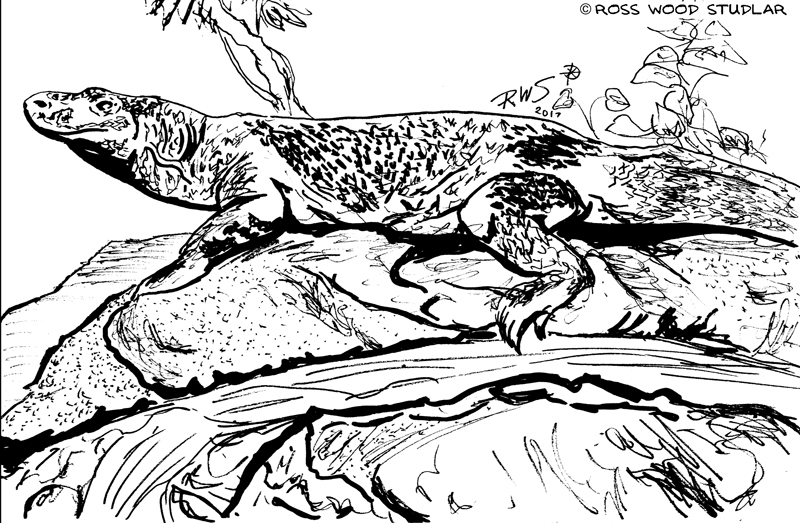
En route to Carlsbad, I visited the Albuquerque Biopark Zoo and sketched living Komodo dragons! This is a warm-up for Awesome 'Possum Volume 4 (the natural science comics anthology, edited by Angela Boyle.) I have teamed back up with the legendary Stephen Bissette; our new comics story will be about Komodo dragons, the beasts that inspired King Kong. We'll be at work on this one this winter, with Bissette as scribe, me as artist. Stay tuned!
Friday, October 20, 2017
Wednesday, September 20, 2017
A Night on Observation Peak
“9/13/17 We had a glorious overnight trip to the cabin, departing this morning. Crew consisted of my friend Emily, her daughter Calia (age 10), and myself. We trekked up from Cascade Creek Trailhead. Two-thirds of the way up, Calia became fed up with hiking and threw a fit (as children are wont to do.) The rest of the trip was challenging, despite the perfect weather (sunny with a cool breeze) and the vistas of increasing grandeur as we ascended. We finally reached the cabin, and I was relieved to find that my 79 key really does work on the door—open sesame! Calia’s mood turned 180, from misery to elation, with the opportunity to stay the night in the ULTIMATE tree house. My friends are from North Carolina and have not previously sojourned west of Chattanooga, Tennessee. Therefore, the elevation here of 9,396 feet is by far the highest they have yet experienced! The challenge of removing the shutters was rewarded by the world’s best view of sunrise and sunset. I read Shoshone and Nez Pierce stories about the origins of the land below aloud to my friends in the night and the early morning. It was warm inside under the blankets at night, as the wind buffeted and rattled our little sanctuary. In the morning, the piercing bugles of elk rose from somewhere in the forest below. Emily is awed by the place and grateful for the opportunity to have stayed in the backcountry. Calia declares, “I want to live here!” Other wildlife observed include northern harrier and grouse, and two bald eagles, a mated pair. Emily is concerned that nearly all forbs were crispy and desiccated between Cascade Lake and here—punishing effects of an unusually hot, dry summer, due to global climate change?
We are all boundlessly appreciative at having gotten to stay in this marvelous shelter in a sacred land.
—Ross Wood Studlar, Interpretive Ranger, Norris
SKREEYAOOW! [sound effect for bugling elk]”
Bottom photo by Calia Sampson at Fairy Falls. All others by yours truly at Observation Peak.
Tuesday, August 29, 2017
The Great American Nightfall
One family used a colander for an eclipse pinhole-viewer, and it worked well. The shadow of the moon advanced over the sun. The sun reduced to smaller and smaller crescent, until it was only a thin sliver. The sky shifted to a darker blue, and the yellow grass of the field turned to orange. Long shadows were cast on the landscape, from the human figures, the trees, and the flagpole. I raised my camera to take a photo, and it kicked automatically into sunset-mode. (A simple AI had interpreted what was happening.)
A chill wind blew. I heard the voice of a seven-or-so-year-old boy asked his mom, “Why is it getting so cold?” Near the peak of the sky’s dome, another point of light emerged—the planet Venus! We were not in the path of totality, so were not privileged to the full effect of nightfall in the daytime. This was the closest we came. The sliver of sunlight moved to the top of the sun, and slowly the crescent of sun enlarged again, as the moon’s shadow moved away. The moment the sun began its return, the persistent dull roar and whoosh of traffic returned. To me, the eclipse was not over until the sun resumed its full form; but many tourists obviously saw it differently, taking to the road the instant our star began to return.
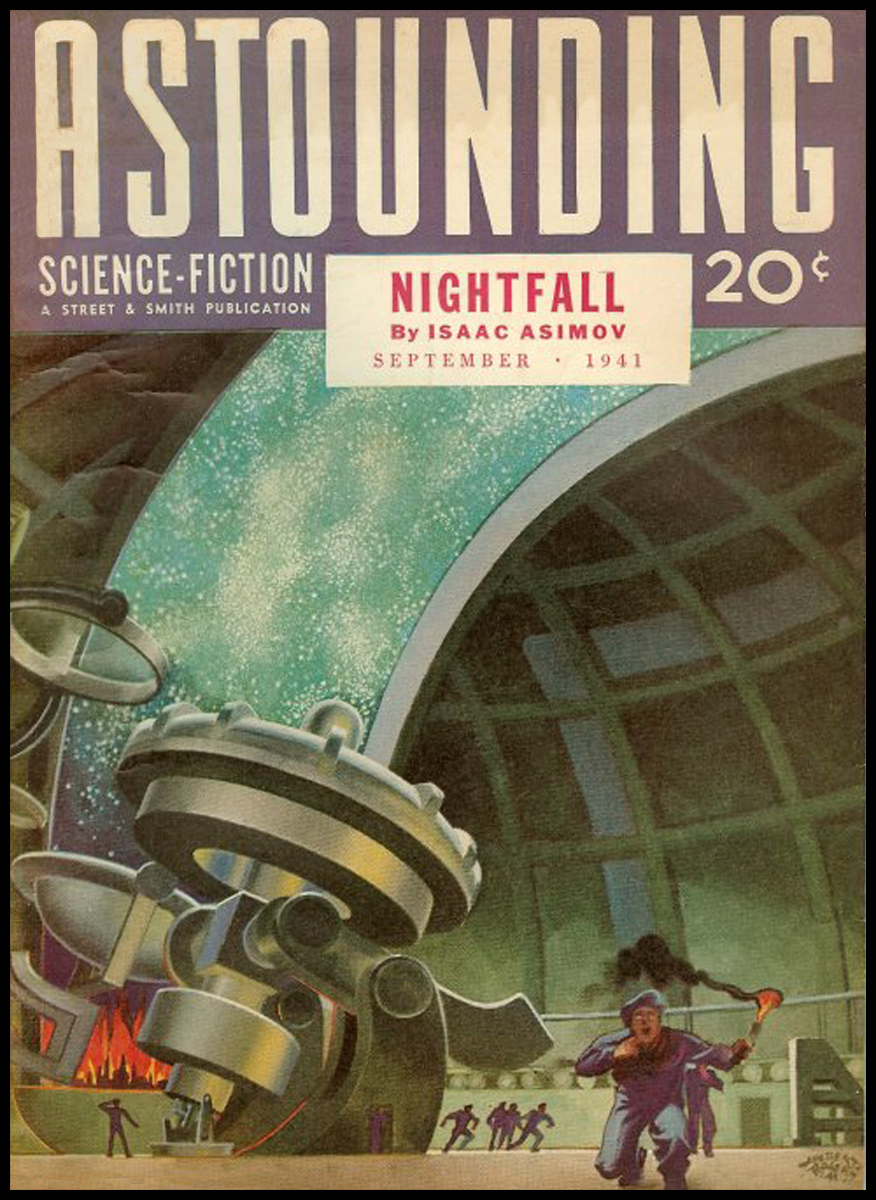
Richard Lea, writing for The Guardian in 2012, notes that the conflict between science and science-denial brought to vivid light in “Nightfall” is even more relevant today than it was 70 years ago, as global warming threatens to destroy much of civilization, and many powerful people deny the science. I note that climate-deniers are driven less by religious belief than by the knowledge that addressing the climate crisis will compromise their profit margin. And most politicians and mainstream commentators who do acknowledge climate change propose solutions that are woefully inadequate. On some level, we are all in denial of the coming storm.
Astounding cover by Hubert Rogers, originally published by Street & Smith publications, and I'm not sure of its current copyright status. Low-resolution reproduction used here for educational purposes only. Photos of Ross by Amy Rether.
Tuesday, August 8, 2017
Ode to the Buffalo Bull
Bison are the most reliable beasts in
Yellowstone. Nearly 5,000 in number, they are commonly seen from the
valleys and overlooks, by the rivers and by the roads. They scratch
their great heads upon trees to deal with insect pests, rub off the
bark, and leave scars across the forest, which everyone misattributes
to bears or elk. On a misty morning in August, the bellows of the
bulls echo across the plains like a rumbling volcano. As the mist
rolls away in the rising sun, the battlefield is revealed. Hundreds
of bison in the valley below. A bull trots beside a cow, sniffs her
rear end, waits for her to come into heat, roars across the plains,
telling other bulls that this one is MINE. His hold lasts only as
long as he can keep other bulls away, by intimidation or by force.
The cows swear fealty to no partner. Their criteria is simple: the
best fighters are the most attractive. He who dominates others of his
kind will sire many children whom he will not know. For the life of
the bull bison is solitary, walking with the herd when convenient,
walking alone when convenient, eating grass all day, tolerating
others of his kind when sharing the meadow. In the prime of health,
he has little to fear. At 2,000 pounds, with a battering ram for a
forehead, swords in his horns, and knives in his hooves—grizzly
bears and wolves keep their distance and search for easier prey. The
bull eats and walks and stays out of trouble, until the next mating
season. Then the fury of testosterone consumes him again. All of his
weapons are at the ready, but his opponents are equally armed.
Corpses litter the field at mating season’s end, the result of
those fights in which both adversaries refused to back down. And this
attracts beasts that are normally harder to see. Grizzly bears appear
on the field, thankful for the scavenged feast, in time to prepare
for winter hibernation.
Labels:
animals,
bison,
buffalo,
National Parks,
Yellowstone National Park
Tuesday, July 11, 2017
Returned to Yellowstone, Surrounded by Wonders Large and Small
I wrote this entry on May 19, 2017. Revisited and finally posted it now.
I’m back at Yellowstone. My first work day will be Sunday. My parents have come to visit the park and me before the work season starts. Today, the wildlife was out in abundance. In the valley by the Yellowstone River, the bison calves chased each other and frolicked, then trotted behind their mothers as they ambled through the pasture, munching along the way.
My mom (the wise botanist Susan Moyle Studlar) and I leaped from the car at stop after stop, and clicked away with our digital cameras. For most of the trip, my dad (Donley Studlar, political scientist of the world) drove, and took the opportunity to tilt back the driver’s seat and rest at most of the stops. Along the Lamar River, an osprey chick poked its fuzzy head out from the nest like a little periscope and peeped hungrily as it saw its mother soaring home, with fish in talons. By the bridge over the Yellowstone River near Tower Falls, a black bear sow and two cubs chomped on grass, ambled down the hill and hopped across the water. Their black forms disappeared and reappeared among the sage.
On green slopes in the Lamar Valley, with snowy mountains in the background, eight bighorn rams sat and rested, while a red fox trotted up and down and around in the foliage, listening and sniffing and periodically looking back over its shoulder. Farther down the road, we walked into the valley and saw pronghorns graze in the distance to the north. To our west, a coyote ran in a wide arc around a resting bull bison, perhaps cautious not to disturb the aggressive herbivore while hunting for ground squirrels. In a mucky place on the other side of the road, six mountain bluebirds alternately hovered and landed on the ground or on the sage. Remarkably, various wildlife photographers honed their telephoto lenses on the little beauties.
For the bears and the buffalo, the osprey and the bighorn sheep, the tourists pulled off the road in every which direction, and pointed spotting scopes and mobile phones. A young woman from China took repeated selfies with the rams in the background, as if the bighorns were insufficient as primary focus. Across the park, the animals carried on their wild behavior undisturbed, as the humans kept a healthy distance. Late in the day, I finally met two grizzly bears out together somewhere on the road between Mammoth Hot Springs and Norris Geyser Basin, and some Asian tourists approached the beasts at far too close a range, within ten feet. An international chorus of voices from other visitors called for them to back up.
By a pond in Lamar, with binoculars and field guide, my mom and I worked together with two Frenchmen in black puffy coats to identify the ducks. There was a ruddy duck afloat, and a goldeneye diving and resurfacing. There were the familiar mallards, and the less-familiar harlequins. Guided by the wise botanist, we took special note of life forms that all the other travelers around us ignored—such as the monkey flowers and Eriogonum flowers and moss growing in the stark environment of Biscuit Basin, and the lichens growing upon a glacial erratic boulder in Lamar Valley. Although wolves and bears are worthy of all the attention that is lavished upon them, so many wonderful forms of life are not given their due. I hope that my fellow travelers can learn to stop and look at and smell the earth and witness the moss and small birds, in between waiting for an eruption of Old Faithful or driving up and down Lamar Valley in hopes of glimpsing a wolf’s ear behind a stump.
Touring (and blogging) as Civilian Ross, I had to maintain the ethics imparted on park visitors by my alter ego, Ranger Ross. Hence, I’ll note that my point-and-shoot cameras have surprisingly good zoom lenses. And the very close-range wildlife photos were taken from out of the car’s windows!
Photos #11-15 and #17 (of Black Pearl Spring with moss, lichen-covered boulder [broad view and close-up], Eriogonum, and Ross at Storm Point) by © Susan Moyle Studlar. All other photos by © Ross Wood Studlar.
My mom (the wise botanist Susan Moyle Studlar) and I leaped from the car at stop after stop, and clicked away with our digital cameras. For most of the trip, my dad (Donley Studlar, political scientist of the world) drove, and took the opportunity to tilt back the driver’s seat and rest at most of the stops. Along the Lamar River, an osprey chick poked its fuzzy head out from the nest like a little periscope and peeped hungrily as it saw its mother soaring home, with fish in talons. By the bridge over the Yellowstone River near Tower Falls, a black bear sow and two cubs chomped on grass, ambled down the hill and hopped across the water. Their black forms disappeared and reappeared among the sage.
On green slopes in the Lamar Valley, with snowy mountains in the background, eight bighorn rams sat and rested, while a red fox trotted up and down and around in the foliage, listening and sniffing and periodically looking back over its shoulder. Farther down the road, we walked into the valley and saw pronghorns graze in the distance to the north. To our west, a coyote ran in a wide arc around a resting bull bison, perhaps cautious not to disturb the aggressive herbivore while hunting for ground squirrels. In a mucky place on the other side of the road, six mountain bluebirds alternately hovered and landed on the ground or on the sage. Remarkably, various wildlife photographers honed their telephoto lenses on the little beauties.
Back at the visitor centers and government housing areas, I met some familiar Homo sapiens. Many of my old comrades from past seasons of ranger work were back. I received hugs from Rosa and Dana, shook the hands of Michael and Corey and Mike. It’s seems like the months of November through April have faded into oblivion, and work and life in the Yellowstone community has returned, after a week’s hiatus. It is good to be back. And the return is made all the sweeter by the chaos of the winter months. On November 9, 2016, I thought that I might not live to see this day, that the newly-elected president might have started a global nuclear war by now. That is still a very real possibility and I remain concerned. But for now, I revere and revel in the wonders of the Yellowstone.
Photos #11-15 and #17 (of Black Pearl Spring with moss, lichen-covered boulder [broad view and close-up], Eriogonum, and Ross at Storm Point) by © Susan Moyle Studlar. All other photos by © Ross Wood Studlar.
Due to limited internet access and other demands on my schedule, it may be two months before my next blog post.
Tuesday, May 30, 2017
Life in Plastic
Plastic is an indestructible material that we use once and then dispose of. But there is no “away;” the toxic miracle material must go somewhere; and all too often its destination is the ocean. Plastic can kill quickly, such as to the turtle that chokes on a balloon; or slowly, by giving people cancer or sterility.
And yet, it’s damn hard to stop using so much plastic. I avoid bottled water and straws, and bring reusable cloth bags to the grocery store. Still, almost every product comes in a plastic container. (That glossy cardboard? It’s coated in plastic!) I’m still searching for ways to de-plastify. Some suggestions can be found here. Marine plastic is a crisis on the same level as global climate change, and requires a similar all-hands-on-deck response.
Highly recommended: A Plastic Ocean, documentary film directed by Craig Leeson, 2017.
Also check out Greenpeace's Story of a Spoon.
Saturday, May 6, 2017
Bud, Lord of the Manor
Every year, Bud takes a long sleep in a burrow by winter, and rises for spring. His human caretakers have trouble comprehending the different pace by which the amphibian lives. For one reason or another, we have suspected him dead year after year, then are surprised when he reappears, alive and healthy. This year, when warm weather didn’t awaken him, and a bumpy ride from West Virginia to North Carolina didn’t awaken him, we wondered if Bud would not awaken. Then we spotted him in hibernation, having made a burrow near to the glass wall of the terrarium. This gave us a window into Bud’s world, one we had never had before in so many years. The amphibian slept inside a sort of bubble carved out of the soil, and slowly breathed the fresh air. The earth gave insulation, to make a comfortable environment for an exothermic animal. He shifted positions periodically, and sometimes awakened for a little while. Now we know how he avoids bedsores.
I acquired Bud when I was a teenager, and the amphibian has led an astonishingly long life for his species of more than 20 years, and there’s no telling how long he will live. After I moved away from home, my Mom, the wise botanist Susan Moyle Studlar, has cared for the creature. Hence, Bud is Lord of the Manor, commanding some able servants. It seems that Bud has taken well to the move from West Virginia to North Carolina, and is getting some healthy sunlight as he looks out the south-facing window beyond his terrarium. The new Studlar family home in North Carolina is a little closer to Bud’s ancestral home of South America. His wild cousins live in the rainforest and prey upon insects, lizards, small mammals, other frogs, and anything that will fit down their gullet! Perhaps the scene that Bud surveys in the photo recalls ancestral memories of the rainforest. Then again, the aged amphibian’s eyesight has declined a bit…. I hope he at least sees some nice splotches of green against the sunlight.
Bud hibernating photo by © Susan Moyle Studlar. Bud belongs to the species Ceratophrys ornata.
Subscribe to:
Posts (Atom)