Tuesday, March 22, 2011

Dangers from nuke and sewer; wiser approaches

For this drawing, I took some influence from Japanese giant monster movies.

The nuclear situation in Japan remains frightening, as does the threat of a similar event in the US. The bone-chilling guitar riff from Black Sabbath's “Electric Funeral” plays repeatedly in my head.

Since my previous post, I have learned some new things about our unsafe reactors. According to Dr. Ira Helfand, The U.S. nuclear plant most vulnerable to earthquake damage is not in California, but Indian Point, 27 miles north of New York City—with a population of over 20 million within a 50 mile radius. Where or how that population could evacuate in a meltdown crisis is an open question. For more on nuclear power and why it is not good energy policy, consult this thoroughly-researched blog by the U.S. PIRGs.

Meanwhile, wind farms in Japan were unscathed by the earthquake. Remarkable.

Tectonic and climactic forces have ravaged our cities multiple times in recent years. And repeatedly demonstrated our unpreparedness for such events.

I have experienced the destructive power of weather firsthand. In 2008, I lived on Galveston Island, Texas, and worked for an environmental education organization there. In September, Hurricane Ike struck. Prior to the storm's arrival, I evacuated to a Houston. I and several other employees and relatives of the director rode it out in an upper floor apartment. I spent the day before the storm frantically gathering and preparing all the supplies I could—gasoline, batteries, emergency phone charger, radio, water, more water, canned food, rubber boots, etc. The night of the storm, I was alternately asleep and awake, as I listened to wind and rain pummel the building—first from one side, then the other. The sturdy brick structure absorbed the weather's assault. The next day, we were without electricity. The building quickly overheated, being designed for air conditioning. Neighbors gathered for a grill-fest of the meat in their fridges—we had to eat it before the bacteria set to work seriously on that task, making the stuff foul-smelling and unpalatable. We gathered around battery-powered radios and listened to weather updates (and audiobooks). I stood in a long line to collect my allocated food and water from FEMA. Driving in Houston became even more hazardous than usual, in the absence of functional traffic lights.

I returned to Galveston after the storm, to move myself out, and to help the organization recover. I found a devastated island. I learned about the dangers brought on by a storm surge.

An excerpt from an email that I sent to friends about the situation on September 26, 2008 (slightly edited):

“I have made my exit from Galveston Texas. I hid safely in Houston during the storm, and my second-floor apartment back on the island was remarkably undamaged. I lost amazingly little property in the storm, only some books that were at the office. The office was not so lucky as my place. The office is located on the ground-floor, but near the highest street on the island. Even so, the storm surge flooded the building up to four feet. Computers, microscopes, binoculars, slide-projectors, many books, and cabinet drawers full of essential grant papers were waterlogged, went swimming, or were overgrown with mold. And this was no ordinary water filling the office. When the water level riseth, the sewer overfloweth. My last day with the organization was spent clearing and cleaning the toxic office. The smell made my head swell and nose run, and I hoped that my rubber gloves and boots were sufficient shield from the brown scum that covered all surfaces that were flooded. The organization lost about 75 per cent of equipment, and the Galveston Bay will be unsafe to kayak for months. All but the four veteran employees were laid off temporarily, and I have decided to migrate onward.”

When the water level riseth, the sewer overfloweth. Even without a Hurricane, there are many dangers to so-called sanitary sewers. Human excrement combines with drain cleaners and industrial chemicals, and is distilled at sewage treatment plants to create toxic sludge. Depending on your municipality, the sludge may be landfilled, incinerated, or applied to agricultural lands. All of these approaches can be hazardous to your health, and none are environmentally sustainable.

There is a better way. I learned about it thanks to The Homestead, and made it my topic for the Homestead Seminar for my senior year. Human excrement or “humanure” can be a valuable resource—if it is composted under the right conditions so as to kill pathogens. Sustainable living-practitioner Joseph Jenkins has authored an invaluable resource on this subject—The Humanure Handbook. (The Composting Toilet System Book by David Del Porto and Carol Steinfield is also a worthy tome.) With composting toilets, we could all be safer and our planet healthier.

Beyond waste management, The Homestead also taught me about temperature management. The strawbale Cabin Bob is cool in the summer with no air conditioning, and comparatively warm in the winter, even when there isn't a fire. Overall, the structure maintains homeostasis considerably better than the apartment complex in Houston. The Homestead has much to teach us about wiser forms of technology.


Cabin Bob and its proud south-facing windows, which capture the sun's warmth in the winter. The structure and its surroundings have evolved considerably since this 2001 photo.

I had intended to include with this post the educational comic/ poster on humanure that I created for my seminar project. I have been unable to find this item, so will post it at a later date. For now, I'll share a sea turtle. These critters are affected by all that occurs around coasts, and will appreciate a transition to sustainable methods.

Monday, March 14, 2011

Love in Washington; Tragedy in Japan; Innovation in Ohio; Hopes for a Sustainable Future

A huge congratulations to my friends Dave Hughes and Erin Stamper, who will be married this Saturday.

I spent the weekend at Mount Baker, Washington, for Dave's bachelor party. What better way to spend one's last weekend as a bachelor than skiing in a winter wonderland?

Left to right: Mark Pascoli, Andy Juechter, Ross Studlar, Dave Hughes, Colin McCrate; photo by Brad Halm

Since returning to town, I have been barely able to leave my computer, as I read, watch, and listen to news with rapt attention.

My heart goes out to the people of Japan. My sorrows and sympathies go to the casualties and their families. I hope that the survivors of the Sendai earthquake and tsunami can recover your lives and livelihoods as soon as possible.

I sincerely hope that the damaged nuclear reactors at Fukushima Daiichi do not have a full-scale meltdown. I also hope that humanity learns from the experience.


satellite image of explosion at unit 3 of Fukushima I nuclear plant on March 14, from Digital Globe

Japan is not the only geologically unstable area with nuclear reactors. A similar or worse event could easily happen in California. As the anti-nuclear activist Harvey Wasserman points out, the nuclear reactors in Japan and the United States are designed to withstand earthquakes with magnitudes of 7.5 on the Richter scale. The Sendai quake had a magnitude of 9.0over 10 times what the reactors were built to handle. No reactor is earthquake-proof (or terrorist-proof), despite the assurances of industry pundits. I stand with Wasserman that “this technology simply does not belong on this planet.”(1) If only we could get our elected officials to agree! President Obama's 2012 budget currently includes $36 billion in loan guarantees to the nuclear industry, to provide for the construction of new reactors. But with sufficient public pressure, that can be changed.

Civilization is better off with solar energy. It is clean and renewable, and a damaged solar panel will not give anyone radiation sickness. There is no time like the present to launch a full-force effort to transition to sustainable energy sources, solar included. (It would create jobs!)

Harvesting sunlight at The Homestead.
Structures left to right: green outhouse, tool-shed and photovoltaic panels, corner of Cabin 3

As a graduate of The Homestead at Denison University, I have seen the power of renewable energy up close and personal. I even used wrench and screwdriver to install solar panels, and hammer and saw to build parts of a strawbale cabin. The Homestead has always been ahead of the curve when it comes to sustainable technology. Homesteaders installed the first on-site solar-electrical system in 1983 (when I was a wee child in Kentucky); it is one of the oldest continuously-operating photovoltaic systems in Ohio. Homesteaders started work on the strawbale Cabin Bob in 1997; it is one of the first such structures on any U.S. college or university. And Homestead students were building cabins with passive solar heating way back in 1977. As Michael Noble (executive director of Fresh Energy) said, “First you change your lightbulb, then you change the law.”(2) The latter change is markedly more difficult than the former. But The Homestead and places like it give us glimpses of what is possible if we work together. Perhaps that can inspire us to move to change the larger world.

At work on the mudroom of Cabin Bob, 2004, Ross at far right.

1. Harvey Wasserman interviewed on Democracy Now! 13 March 2011, 32:28.
2. Michael Noble interviewed on Fuel (2008 film by Josh Tickell) 1:42:50
Low-resolution version of copyrighted image from Digital Globe is used for educational and informational purposes.

Sunday, March 6, 2011

Those clever and compassionate critters

In the beginning of Wild Animals I Have Known, Ernest Thompson Seton writes:

“THESE STORIES are true. Although I have left the strict line of
historical truth in many places, the animals in this book were all
real characters. They lived the lives I have depicted, and showed
the stamp of heroism and personality more strongly by far than it
has been in the power of my pen to tell.”

I feel the same way about the animal stories that I have written and drawn. With pencil, brush, or even film camera, we can only capture faint shadows of the real animals.

Animals show personality, compassion, love, intelligence, insight, foresight, creativity, and a host of other traits that we arrogant humans try to claim are reserved for ourselves.

I recently discovered this video thanks to my Homestead comrade Luke. A story of friendship and compassion between a canine and a pachyderm.

And THIS video shows one of the most impressive displays of insight by an animal. The raven is the star. Biologist Bernd Heinrich presented Ravens with a never-before-seen puzzle, and 80 per cent of them found the solution with no demonstrable trial-and-error learning.

Ravens and their brain-power have become a subject of fascination for many people, including yours truly. I discuss the subject in my Crater Lake campfire presentation “Tricksters in Myth and Science.” And of course, the mythic Raven is co-star of the my epic comic book (right). I have just completed a new mini-comic, which does not involve a raven, but does involve his distant cousins--mergansers, bald eagles, and others. I'll have more to say in an upcoming post, when I announce its release. In the meantime, I'll be drawing more of our wise and caring relatives, the other animals.


Merganser spreads her wings

Sunday, February 20, 2011

Thinking Machines

Curious that, right after I post some thoughts about intelligent thinking-machines, IBM's computer Watson soundly defeats the two best human players at Jeopardy. An astounding move forward for computers in understanding human language--which is a feat that continues to challenge even the most sophisticated silicon-based brains.

It seems almost a shame that Isaac Asimov did not live to see this event. However far-fetched it may be, the premise of "The Last Question" now seems slightly more plausible.

It is interesting to note how in discussing Watson's significance for the future, people refer to science fiction works. David Ferrucci, IBM researcher who led the development of Watson, urges us to compare the electronic Jeopardy champ not to the villainous Hal, but to the wise and helpful computer on Star Trek. In a similar vein, the novel Brave New World and movie Gattaga are frequently cited in discussions of the impact of human genetics on the future. Scientists may love or hate these cautionary tales, but cannot avoid them, and the vivid images they create in the minds of the public.


sneak preview (above). Image from my upcoming (not-yet-titled) SF comic book.


Tuesday, February 8, 2011

Living Dinosaurs

One of my childhood ambitions was to become a paleontologist, to study dinosaurs. A competing ambition was to draw comics for Marvel. I haven't met either goal. In recent years, I have shown greater interest in living animals than extinct ones. Maybe my paleontological dreams have vanished like the great sauropods, or maybe they have simply morphed--evolved--into something new.

Among my sketchbooks and comic book productions, we find a variety of reptiles, as well as their relatives, the amphibians and birds. Among these, we find modern giant reptiles, such as sea turtles and Komodo dragons. Some biologists have described these creatures as 'living dinosaurs.'


Last fall, I encountered a giant amphibian! (Almost a living dinosaur?) It was a giant coastal salamander. Although considerably smaller than me, it was a leviathan by salamander standards, nine inches in length (and they can get bigger.) I chanced upon this critter on a rainy day hike, in a forest just outside Portland, Oregon. Northwest dwellers, these great beasts may be lurking in YOUR backyard, unbeknownst to you. Dear salamander, it is an honor to share the forest.

Sunday, February 6, 2011

Computers of Future Passed, part II: Man vs Machine

Most of us don't think of the folktale of John Henry as a science fiction story. But, in a sense, it is one. It is a story about how new technology affects people and society. At the time the story was invented, strong men were feeling the new competition from stronger machines. Today, we take it for granted that a forklift can lift more than the strongest person in the world, and that a bulldozer can move more earth in a day than a person can in a month.

Today, humans have another (greater) source of pride with which machines are competing: our brains. And so, not surprisingly, many science fiction stories on computers and robots deal in the question of what will happen when the machines become smarter than us. In the real world, the much-publicized Garry Kasparov versus Deep Blue chess match of 1997 was the intellectual equivalent to John Henry versus the steam-powered hammer.

Although computers can play mean chess, compose music, write poetry, and devise clever TV commercials, they can't yet do everything that humans can. I'll leave it to the philosophers, linguists, psychologists, and computer scientists to debate over whether they will match or exceed all our cognitive abilities someday. I simply know that such prospects are good material for science fiction. My SF comic book Myths from the Future contains stories about intelligent robots, and a great awakening, when robots become self-aware. And I have comic book in preparation (still untitled), wherein a humans brain is copied into a new cyborg body--although it isn't exactly the body he was hoping for!


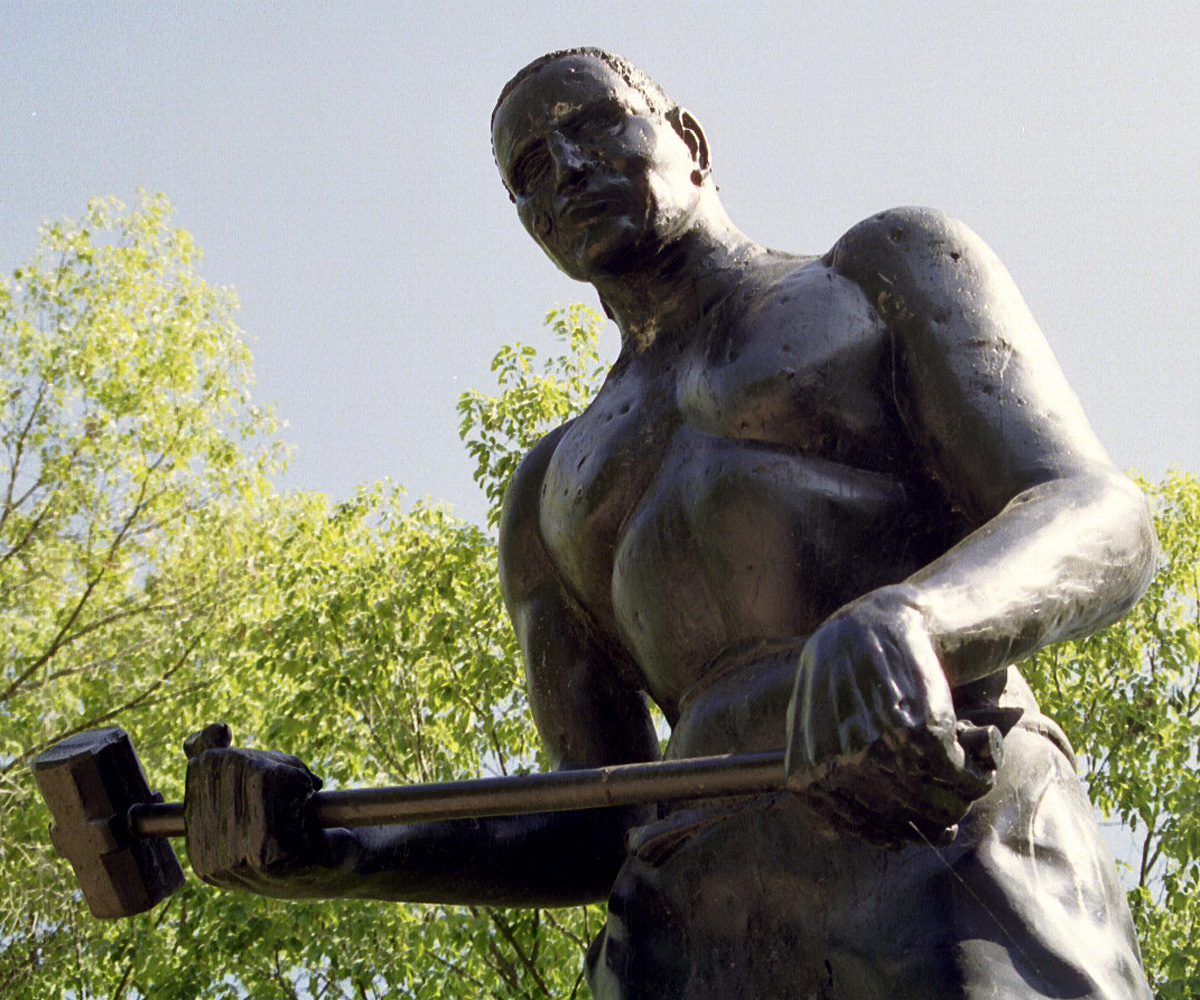
Photo at top: statue of John Henry outside town of Talcott, West Virginia. Photographer Ken Thomas has released this image into the public domain.

Tuesday, February 1, 2011

New links and promotions; Computers of Future Passed

Comic book retailers take note: I have hired Tony Shenton as freelance sales representative for my Raven and Crayfish.

Comic fans take note: On the right sidebar, I have added links to retailers who are cool enough to sell my comics, as well as links to some other notable cartoonists and artists.

Comic people also note: Susan Soares of Sky Pirates of Valendor was nice enough to let me post a banner on their site. I'd better go read some Pirates!

Even though I am in what educators call the "millennium generation," I have been a bit slow to catch on to the world of online self-promotion. I am trying to catch up.

Remarkable machines, these computers. Remarkable tool, this internet.

Hardly anyone foresaw the world wide web as we know it, and increasingly we forget what life was like without it.

Indeed, most predictions regarding computers of the future are famous for being so far off the mark.

The line from a 1949 issue of Popular Mechanics is frequently quoted:
"Computers in the future may weigh no more than 1.5 tons."

At the time the article was written, computers were giant, centralized machines. The author extrapolated from current trends. Science fiction did similarly. Most SF stories on computers from the 1950's and 60's feature super-versions of the early digital computers--whirling tape, vacuum tubes, flashing light bulbs and all.

ENIAC, built in 1946, was the world's first general-purpose electronic computer (according to wikipedia).

On New year's eve 2011, I was visiting family and presented a reading of Isaac Asimov's classic "The Last Question" (1956). It tells the saga of Multivac, the grand supercomputer on the moon (at the stories beginning), and its quest to solve for man the question of whether there is a way to reverse entropy and prevent the end of the universe. (The "AC" in Multivac or ENIAC stands for automatic computer.) In only 13 pages, Asimov takes the reader on a journey beginning in the year 2061, and ending trillions of years later. By a few generations from the opening scene, the planet-spanning Multivac has been replaced by Microvacs, miniaturized computers--each occupies only half a starship! Microvac later evolves to a universal computer, a cosmic AC. In the final scenes he is simply AC, existing in hyperspace, and instantly reachable from anywhere in the universe. Through calculation, the AC solves all man's problems until man discards the flesh, and his immortal collective mind roams across space. But still that problem of entropy vexes Man and AC alike …..

Although many of the details in Asimov's story now seem quaint, still he predicted that computer would become humankind's best friend ... a forecast for the "information age." That may be one of the reasons why "The Last Question" was Asimov's favorite of all the short stories that he authored.

Asimov mainly foresaw computers (and robots) as being used for peaceful purposes. Robert Heinlein explored more military applications, as with his giant supercomputer "Mike" in The Moon is a Harsh Mistress (1966). The self-aware computer is a likable character. And he is invaluable for aiming rock bombs in the war between the lunar colony and Earth.

Then there are the good computers that turn bad and take over. The most famous of these is HAL 9000--with his gently disturbing voice--from 2001: A Space Odyssey (1968). Colossus: The Forbin Project (1970) is another example. Notably, this film contains a short scene of a chess game between Colossus and the man who programed him. At the time, the idea of a computer that could challenge the smartest human in chess was wild speculative fiction. Now, it's history.

All of the aforementioned works deal in giant "super-brain" computers. None predict the decentralized international network of today.

As far as early and accurate predictions for the internet age are concerned, there is one story that tops them all.

"A Logic Named Joe" by Murray Leinster, 1946. ('Logic' is Leinster's term for what we now call a personal computer.) He forecast in the existence of desktop computers with screen and keyboard. The story goes farther from there. He offers a clear and accurate prediction of the world wide web, google, craigslist, Skype, concerns about the absence of censorship on the internet, and much more...fifty years before the fact, and at a time when the world thought of ENIAC as the pinnacle of computing. I first learned of this story from a column by Robert Silverberg in the December 2008 issue of Asimov's Science Fiction Magazine. I found the tale and was amazed. (You can find it at your library, or use your 'logic' to find it online.)

The lesson that I take from 'A Logic Named Joe': somewhere out there in science fiction, there is a story that seems too fantastic to believe, but that will come true. I just wonder what story it is!


ENIAC image (top) by an unindentified US Army photographer, public domain.